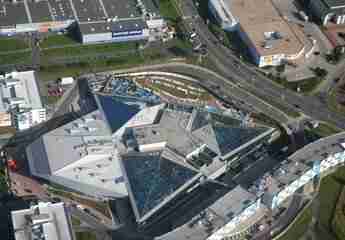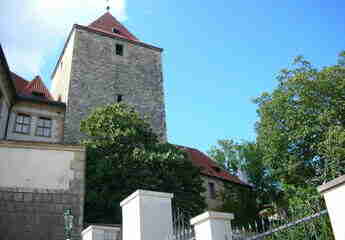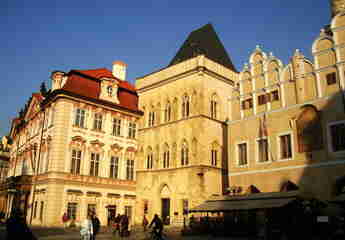
Prague Castle is the official seat of the Czech president and the centerpiece of one of the largest ancient castle complexes in the world, covering about 70,000 square meters.
Updated for 2026: Prague Castle is still one of Prague's busiest sights, so come early if you can, expect security checks and lines at the main interiors, and wear shoes that can handle plenty of cobblestones.

FLICKR, PANTCHOA
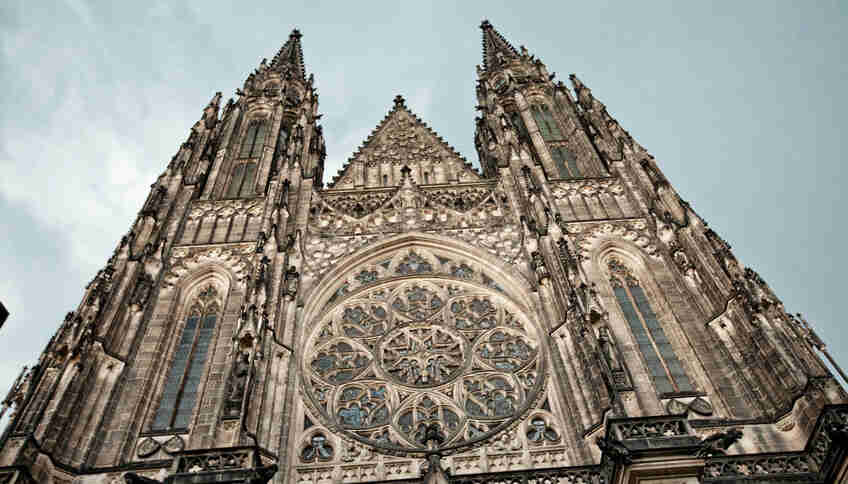
The architectural star of Prague Castle is St. Vitus Cathedral. Work began in the 14th century, while the fortress on this hill is much older.
Give the castle a full day if you can, or better yet more. This is not just a quick sightseeing stop but a whole maze of courtyards, churches, palaces and stories. Read more in a separate article.
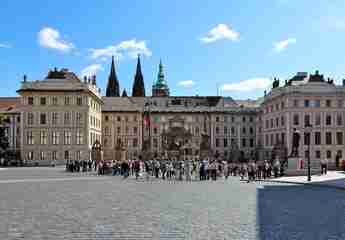
Our self-guided walk through Prague Castle begins at Hradcany Square. We will pass old palaces and grand townhouses once owned by Czech noble families, some now home to museums and galleries, admire the architecture and sculpture, and ease into one of Prague's most rewarding districts.
Hradcany Square almost deserves the name Palace Square, because so many beautiful palaces from different eras line it. What began as land set aside for castle servants gradually grew into a small town of its own and is now part of historic Prague.
People come to Hradcany Square for the views, but also for the changing of the guard at the entrance to the presidential residence. It takes place every hour, and at noon the ceremony comes with music.

Flickr, Tarakanov Dmitry
The square's best-known monument is the Marian Column, sometimes also called a plague column. Like many such monuments across Central Europe, it was raised in thanks for deliverance from plague. In the early 18th century, public prayers to the Virgin Mary were held on the very spot where the column now stands.
You will also see a monument to Tomas Masaryk, the first president of Czechoslovakia. It is one of the square's newer additions, and nearby a path leads to a lookout with a sweeping view over Prague.
From the Masaryk monument, walk straight ahead to the Giants' Gate and Matthias Gate, which lead through the presidential complex into Prague Castle's Second Courtyard.
Matthias Gate is a richly decorated stone arch built into the wing facing the First Courtyard. It was erected under Emperor Matthias and became Prague Castle's third ceremonial entrance. It is also considered Prague's first major Baroque structure.
Originally, Matthias Gate stood between bridges and moats and was more of a standalone decorative gateway than part of the palace. The surrounding building came later, and the gate was incorporated into the wing.

Flickr, MONUDET
The attic of the wing is crowned with sculptures symbolizing war and peace, added in the late 18th century. Look closely and you will see Emperor Matthias's titles and coat of arms, with the arms of his lands below.
To reach Matthias Gate, you first pass through the main gate of the palace, guarded by tall ceremonial sentries with sabers and rifles. The best-known changing of the guard takes place at noon, when soldiers march through the gate to fanfares and then continue across Hradcany Square.
As you come out of the gate tunnel, the white building with the rounded facade right ahead is the Chapel of the Holy Cross. Along with its frescoes and sculptures, it also houses the tourist information center.
Construction of the Chapel of the Holy Cross began in 1758 to a design associated with Nicolo Pacassi. It lasted almost five years, with Anselmo Lurago overseeing the work.
It no longer looks exactly as it did then: in 1852-1856 the chapel was rebuilt in a Neoclassical style more in keeping with the period. Today it is a rectangular building with rounded sides and a pointed roof.

Flickr, beranekp
The facade is marked by niches with statues of St. Peter and St. Paul, while inside you can still see 19th-century wall paintings with scenes from the Old and New Testaments. The marble altar is flanked by angels and the large icon "Crucifixion" by Frantisek Xaver Balka, with other icons nearby depicting St. Vitus, St. Wenceslas, St. Teresa and St. Francis.
From 1961 to 1990, the chapel held the Treasury of St. Vitus - more than 400 rare objects, including armor, vestments, church vessels and relics. That is why it was long known simply as the Treasury. Today it houses a tourist information point and Prague Castle administration offices.
From the chapel, continue through the Second Courtyard and past the Baroque fountain with lions into the Third Courtyard. Here, St. Vitus Cathedral suddenly fills the scene.
You can spot the cathedral's towers from all over Prague, but seeing it up close is something else entirely. However many times you come here, the first impression rarely fades.

JRSRETIREMENT.BLOGSPOT.RU
St. Vitus Cathedral is one of Europe's great churches - and one of its longest-running building projects. Construction began in the 14th century and continued, in stages, for nearly six hundred years.
That long history shows everywhere: Gothic foundations, later Renaissance and Baroque additions, and work by masters from Bohemia, France and Germany. The stained-glass windows, including famous designs by Alphonse Mucha, wash the interior in rich color even on gray days.
The exterior is dense with carving and tracery, while inside you get soaring vaults, sculpture, chapels and royal tombs. If you have the chance to hear music here, take it - the setting does half the work.
After the cathedral's Gothic drama, head on to another church that is smaller in scale but enormous in historical importance.
It lies just behind St. Vitus: a basilica with roots stretching back more than a thousand years.
St. George's Basilica
St. George's Basilica is the oldest surviving church within Prague Castle, founded in 920 by Prince Vratislav I. For centuries it was one of Prague's most important churches: princes were baptized here, and members of the ruling dynasty were buried here too. About fifty years later, the first convent in Bohemia rose beside it. Fire badly damaged the complex in 1142, after which the church was largely rebuilt and eventually gained the two white towers locals nicknamed Adam and Eve.

Flickr, Tjflex2
Over the following centuries, the monastery complex kept expanding. The basilica was altered again and again, and chapels dedicated to St. Ludmila and St. John of Nepomuk were added. In the 18th century the monastery was dissolved and the buildings were turned over to secular use. In modern times, the basilica has also served as an exhibition and concert space.
Restoration work preserved interiors from the 12th to the 17th centuries, including reliefs, tombs and wall paintings. Outside, the vivid facade is accented with statues of Vratislav I, Mlada - the convent's first abbess - and the basilica's patron saints.
To the right of the basilica and cathedral stand the buildings of the Old Royal Palace. This cluster of structures from different periods witnessed many key moments in Czech history, and much of that story still survives in its halls and chambers.
Old Royal Palace
The Old Royal Palace stands in the center of Prague Castle. Built on the site of a 9th-century wooden residence, it served as the seat of Czech rulers from the 12th to the 16th century. Its appearance is eclectic because the complex was repeatedly rebuilt, although Gothic and Renaissance elements dominate.

Flickr, one-thirteen
The palace took on much of its present form at the end of the 15th century under King Vladislav II. During that campaign, architect Benedikt Rejt created the vast Vladislav Hall, still used for major state ceremonies. A Renaissance wing was added at the same time and named for Crown Prince Louis. After the Habsburgs came to power, they preferred newer residences, and the Old Royal Palace became home to governors, the state chancellery, the diet and official offices.
Today you can visit historic halls and royal rooms, along with spaces once used by the diet and chancellery. A large part of Czech political history played out here, and the exhibits help place those centuries in context.
On the lower floors, the permanent exhibition "The Story of Prague Castle" traces the history of the entire complex. Other displays look at the everyday lives of nobles, officials and townspeople.
Pass between St. George's Basilica and the Old Royal Palace and you will reach Jirska Street, which leads to the final stop on this Prague Castle walk - Golden Lane.
Golden Lane is exactly what many visitors imagine old Prague to be: tiny, brightly painted houses, a touch of folklore and more than a hint of fantasy.

FOTO.MAPY.CZ
Take house No. 13. Legend says its window can open onto another reality. More likely, the story is a later echo of the novel "The Golem," but Prague has always had a soft spot for mystery, and Golden Lane wears that atmosphere well.
Franz Kafka also spent time working here, in house No. 22. As for the name "Golden Lane," the usual explanation points to the goldsmiths who once lived and worked here.
Later in the day, access rules have sometimes been looser, though opening arrangements can change and many of the tiny houses close earlier. Most now hold small souvenir shops selling everything from postcards and ceramics to prints and old-fashioned curios. Even if you buy nothing, it is worth coming for the colors, the scale and the photographs.