Updated for 2026: Paris is as busy and beautiful as ever, so book major sights ahead, expect security checks, and start early if you want this route to feel enjoyable rather than rushed.
The best part of this route is how naturally it fits together: these landmarks all sit within walking distance. If you download the Ever.Travel mobile app, you'll see the route laid out on a map, so there's no need for turn-by-turn directions here. Just follow the line and enjoy the walk.
lolapi.ru, Lola Pidluska
The Louvre is the world's most-visited museum and one of Paris's essential stops. Its collections span civilizations, centuries, and just about every major artistic tradition you can think of.
Ancient Greece, Rome, Egypt, and the wider Near East; Islamic art; European painting and sculpture; decorative arts; 19th- and 20th-century masters - it's all here, spread across an enormous complex.
Only a fraction of the collection is on display at any one time, but even that is enough to feel overwhelming in the best possible way. You can move from antiquity to the Renaissance, through Baroque grandeur and into modern movements, all in a single visit.
The building matters almost as much as what's inside. The Louvre grew over centuries from a royal residence into a museum, and its halls still carry that sense of scale, drama, and history.
This walk works well on its own, but it's even easier with our Paris audio guide. It's much more convenient than stopping every few minutes to read.

lolapi.ru, Lola Pidluska
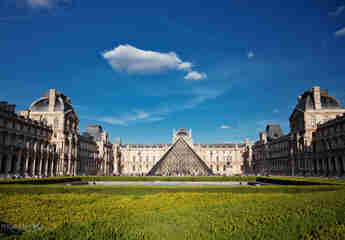
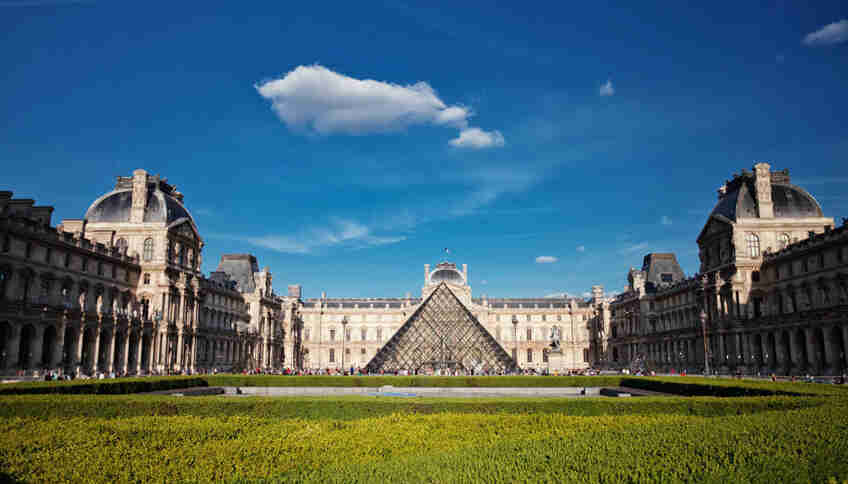
The Louvre Pyramid, a glass-and-metal entrance in the middle of the palace courtyard, caused an uproar when it was unveiled. Today it's one of the museum's defining images.
In 1985, President Francois Mitterrand launched the Grand Louvre project to modernize and expand the museum. Architect I. M. Pei won the commission with a design that paired the historic palace with a boldly contemporary entrance.
At the time, plenty of Parisians hated the idea. Many thought the pyramid clashed with the Louvre's classical architecture. But the project moved ahead, and the pyramid became the museum's main entrance, with ticketing and visitor services below.
That controversy didn't last. These days the pyramid feels inseparable from the Louvre, especially at night, when the glass catches the light and the whole courtyard glows.
One rumor proved harder to kill: the idea that the pyramid was built from 666 glass panes and therefore carried some sinister meaning. In reality, the structure uses 673 panes.
And if you'd rather build your own version of this day, head to the interactive city map, mark the places you want to see, and sync the plan with the Ever.Travel mobile app. Curious how it works? Here's the explanation.

Flickr, Sebastian Bergmann
Everyone knows Paris has the Arc de Triomphe, but fewer visitors notice the elegant Arc du Carrousel just beside the Louvre. It's the second-best-known triumphal arch in the city.
It and the Arc de Triomphe were both commissioned to celebrate Napoleon's victories, and work on both began in 1806. The Arc du Carrousel, however, was finished far more quickly.
The triple-arched monument is a fine example of Empire style, decorated with reliefs and Corinthian columns. Its sculptural program celebrates Austerlitz, Ulm, Tilsit, and Napoleon's entries into Vienna and Munich.
The quadriga on top is a copy. The original bronze horses once stood at St. Mark's Basilica in Venice until Napoleon had them taken to Paris in 1797.
After Napoleon's fall, the originals were returned to Venice, and copies were installed here instead. On either side stand personifications of Victory, while Peace drives the chariot.
The Arc du Carrousel stands just beyond the Louvre and forms part of the famous Historic Axis of Paris.
Stay nearby and you'll have a remarkable number of Paris landmarks within easy walking distance. You can follow our hotel advice or choose a place that suits you.

lolapi.ru, Lola Pidluska
The Tuileries Garden is one of the great examples of French formal design. It was laid out in 1564 for Catherine de' Medici beside the Tuileries Palace, which no longer survives.
The queen's first garden followed Italian tastes, but in the 17th century it was redesigned by Andre Le Notre, the master gardener of Louis XIV. His work helped define the formal French garden as the world now knows it.
Everything here is about order and balance: straight avenues, clipped trees, geometric flower beds, and wide open perspectives. Sculptures line the paths, mixing contemporary works with replicas of older pieces once displayed in the Tuileries and now kept in the Louvre.
Part of the charm is how lived-in the garden feels. Around the ponds you'll see people sailing little wooden boats, reading in the green chairs, or simply taking a quiet break in the middle of Paris.
See also our other Paris guides:

Flickr, French Moments
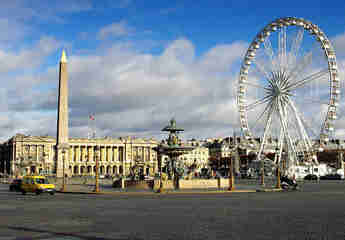
Place de la Concorde is famous not just for its beauty, but for the history that unfolded here. Laid out in the 18th century between the Champs-Elysees and the Tuileries, it was originally dedicated to Louis XV.
At the corners of the octagonal square stand statues representing major French cities. During the Revolution, however, the royal monument at its center gave way to the guillotine.
Louis XVI was executed here, followed by Marie Antoinette and many others during the Terror. Only after that violence subsided did the square receive its current name, meant to evoke reconciliation.
Today, the square's focal point is the Luxor Obelisk, a pink-granite monument from ancient Egypt covered in hieroglyphs. It was gifted to France in the 19th century and remains the oldest monument in Paris.
Top 10 Paris attractions: Notre-Dame, the Arc de Triomphe, Montmartre, and more.

wikimedia, sanchezn
The Grand Palais is one of the great ceremonial buildings on the Champs-Elysees, created for the 1900 World's Fair.
Its Beaux-Arts design combines stone, glass, sculpture, and ironwork on a grand scale. Even if you never go inside, it's worth pausing to take in the facade.
The details are lavish - columns, reliefs, statuary, and the confident inscription across the pediment make it clear this was built as a monument to French art.
Inside, the complex has long hosted major exhibitions, fairs, shows, and cultural events, so there's often something going on beyond the architecture itself.
It has also housed museum and science spaces that make it more than just a showpiece, with hands-on exhibits that appeal to both adults and children.
The Grand Palais still serves as one of Paris's most important venues for large-scale exhibitions, fashion events, concerts, and festivals.
Everything you need to know before a trip to Paris - practical tips for independent travelers

Flickr, Américo Aperta
Pont Alexandre III carries you over the Seine between the Champs-Elysees and Les Invalides, with one of the best postcard views in Paris along the way.
The bridge commemorates the alliance between France and Russia. Its foundation stone was laid during Nicholas II's visit to Paris in 1896, and it was named for his father, Alexander III.
The style is pure Beaux-Arts: ornate lamps, gilded details, sculpted reliefs, and sweeping lines that somehow feel grand without being heavy.
At one end stands the nymph of the Seine with the coat of arms of Paris; at the other, the nymph of the Neva with the coat of arms of St. Petersburg.
Four tall columns mark the approaches, topped with figures representing Science, Art, Commerce, and Industry. Their bases are decorated with reliefs evoking major eras of French history.

lolapi.ru, Lola Pidluska
Les Invalides may sound severe, but the reality is anything but. This vast classical complex, with its gilded dome and formal courtyards, was founded as a home for wounded and retired soldiers.
Louis XIV ordered it built in 1671, partly to honor military service and partly to provide shelter and care for veterans who had been left destitute after war.
The scale is immense, but the dome is what everyone remembers: a richly gilded landmark rising above one of the most recognizable skylines in Paris.
Today, Les Invalides still has a military function, but it is also a major museum complex and burial place associated with French military history. Napoleon's tomb is the best-known site inside.
The complex includes several military museums, among them the Army Museum and collections devoted to historical models, orders, and modern history.
And if you'd like more background, we also have a more detailed guide to Les Invalides.
This is the perfect point to download our Paris audio guide and queue up the section on the Champ de Mars and the Eiffel Tower.

Flickr, jen890
Every great monument needs space around it, and the Eiffel Tower owes part of its impact to the broad lawns of the Champ de Mars.
The park is older than the tower and has seen centuries of Parisian public life.
It began as the parade ground for the nearby Military School, founded in the 18th century. The name comes from Mars, the Roman god of war. Later, the field hosted military reviews, public gatherings, and revolutionary demonstrations.
In the years that followed, the Champ de Mars became a place for national celebrations and public spectacles, including horse races and early balloon flights.
From the late 19th century onward it also became an exhibition ground, and for the 1889 World's Fair it received the structure that would define it forever: the Eiffel Tower.
Today it's one of the city's best places to pause, stretch out on the grass, and look up.

Flickr, Antonio Torres Ochoa
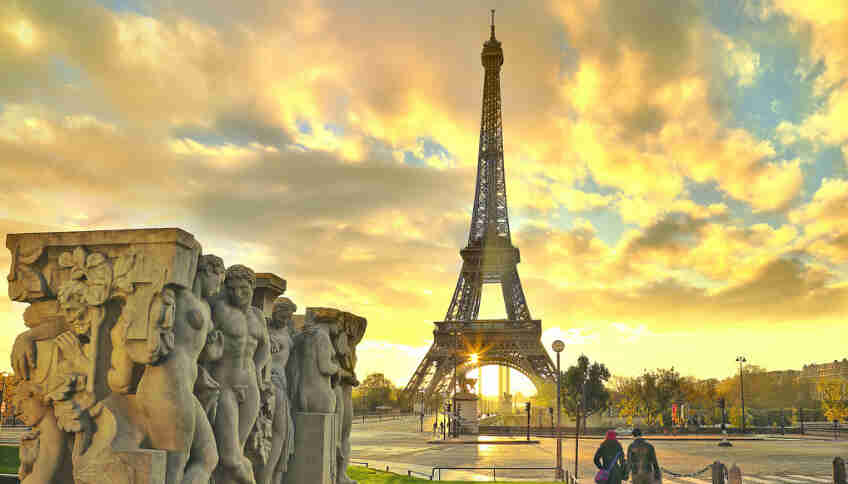
The Eiffel Tower is Paris in a single image: iron lace against the sky by day, a glittering landmark after dark.
It's beautiful in any season. Summer evenings, winter mornings, sudden autumn rain - the tower always seems to rise above the weather and the mood of the city.
It was built for the 1889 World's Fair as a temporary structure and was originally meant to stand for only twenty years.
What saved it was utility. Antennas on the summit made it valuable for communications, and the tower stayed where critics once swore it never belonged.
That early outrage has long faded. Today the Eiffel Tower is one of the most beloved sights in the world, and seeing it up close still feels special.

Flickr, bobmorton
The Palais de Chaillot is another major Paris complex created for a world exposition, standing opposite the Eiffel Tower across the Seine.
When it opened in 1937, plenty of people found its monumental style too severe. Set against the older Paris of the Louvre, the Opera, and Notre-Dame, it felt strikingly modern.
The complex is made up of two curved wings facing a park of fountains and gardens. The terrace between them delivers one of the classic Eiffel Tower views.
It's worth coming here even if architecture isn't the main draw, because the complex houses museums as well.
One focuses on architecture and monuments, another on maritime history, and the Museum of Man traces human development through a wide-ranging collection.
In the Trocadero gardens you'll also find the Paris Aquarium, home to thousands of aquatic creatures.
That wraps up this self-guided Paris walk. If you'd like more ready-made routes, browse the guides section - or better yet, download the Paris audio guide to your phone.