Louvre
lolapi.ru, Lola Pidluskaya
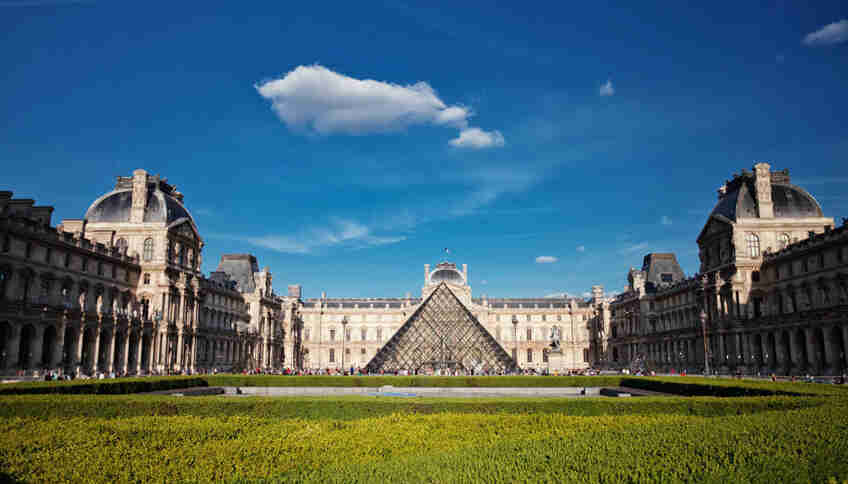
The Louvre (fr. Musée du Louvre) is one of the largest and the most popular[1] museums in the world (9 720 260 visitors in 2012, the third in the world by area occupied: 160 106 square meters, 58 470 of which are exhibition spaces). The museum is located in the center of Paris, on the right bank of the Seine, on Rue de Rivoli, in the 1st arrondissement of the capital. The museum building is an old royal palace (Palais du Louvre). The equestrian statue of Louis XIV marks the starting point of the so-called Historical Axis of Paris, but the palace is not aligned with it. The Louvre is one of the oldest museums with a rich history of collecting France’s artistic and historical relics, from the time of the Capetian dynasty to the present day. Everything was collected at the Louvre; this museum can be called universal. Its collections cover enormous geographical and time spans: from Western Europe to Iran via Greece, Egypt, and the Near East; from antiquity to 1848.
Note: you can walk part of this route — from the Louvre to the Tuileries Garden — by turning on the audio guide, which you will find in the Ever.Travel mobile app.
Louvre Pyramid

lolapi.ru, Lola Pidluskaya
Two hundred years after the French Revolution, President François Mitterrand proposed the “Grand Louvre” project. Mitterrand wanted to turn the royal palace into the largest museum in the world. His idea also included extending the Historical Axis of Paris — a nine-kilometer perspective running along the Champs-Élysées. Now the so-called Triumphal Way begins near the Louvre — in the Cour Napoléon by the pyramid and the equestrian statue of Louis XIV, passes through the Arc de Triomphe du Carrousel, the Arc de Triomphe on Place de l'Étoile (Charles de Gaulle), and ends at the Grande Arche in La Défense. After construction was completed, the pyramid became the main entrance to the Louvre. Around the large pyramid are three smaller pyramids, which serve only as skylights.
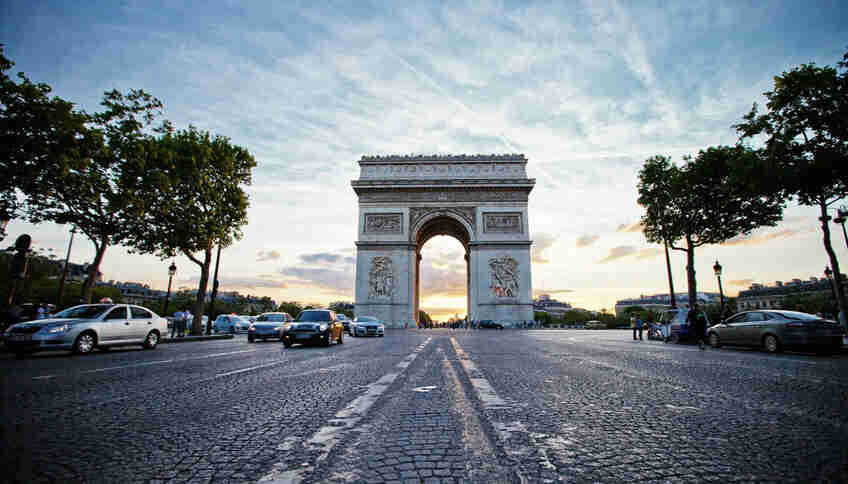
Arc de Triomphe du Carrousel

Flickr, Sebastian Bergmann
The Arc de Triomphe du Carrousel in Paris is an Empire-style monument erected on Place du Carrousel in front of the Tuileries Palace by order of Napoleon to commemorate his victories in 1806—1808. From the arch, a 9-kilometer Historical Axis was laid out to the northwest, consisting of Place de la Concorde, the Champs-Élysées with the much larger Arc de Triomphe, and the Grande Arche de la Défense. The design of the arch was prepared by Charles Percier and Pierre Fontaine, inspired by the forms of the ancient Arch of Constantine in Rome.[1] The 19-meter-high structure was crowned with the quadriga of Saint Mark, taken from Venice. After Napoleon’s fall and the return of the quadriga to Venice, it had to be replaced with a sculptural composition allegorically representing the triumph of the Bourbons (sculptors François-Frédéric Lemot, François Joseph Bosio). The subjects of the sculptural decoration for the arch were selected personally by Vivant Denon.
Tuileries Garden

lolapi.ru, Lola Pidluskaya
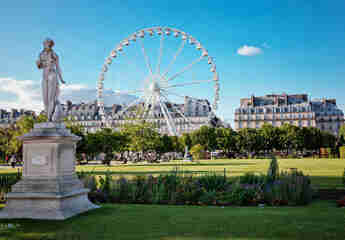
The Tuileries Garden (fr. le jardin des Tuileries) is a public park in the center of Paris, in the 1st arrondissement, occupying the area between Place de la Concorde, Rue de Rivoli, the Louvre, and the Seine; it covers 25.5 hectares, its length is 920 m, and its width is 325 m. Once the Tuileries Palace adjoined it. Today the park is the most significant and the oldest jardin à la française. As early as the 15th century, this was the outskirts of the city beyond the walls of the Louvre fortress — with a public dump and clay extraction for the production of roof tiles (fr. tuile, “tile”) — hence the name Tuileries. The first park began to be laid out in 1564 by order of Catherine de' Medici, who wanted a new palace — the Tuileries — and a garden for walks. That is why the park was in the Italian style: 6 alleys along the length of the garden and 8 across its width. One hundred years later, in 1664, Colbert ordered the park to be redesigned, entrusting this task to Le Nôtre.
Place de la Concorde

Flickr, French Moments
Place de la Concorde (fr. Place de la Concorde) is the central square of Paris and an outstanding monument of urban planning from the age of classicism. It is the second largest in France (after Place des Quinconces in Bordeaux). The square of Louis XV was laid out between the Champs-Élysées (to the west) and the garden of the Tuileries Palace (to the east) by order of the king himself and his chief architect Gabriel in 1755. Originally, it was an octagon surrounded by a moat, at the corners of which stood eight allegorical statues symbolizing the main cities of France. In the middle of the square, an equestrian statue of Louis XV by Bouchardon and Pigalle was installed. On the northern side, the elegant buildings of the Ministry of the Navy and the Hôtel de Crillon were erected. In 1787-90, the Pont de la Concorde was thrown across the Seine, meeting the building of the National Assembly (formerly the Bourbon Palace) on the opposite bank.
Champs-Élysées

Flickr, La Pom
The Champs-Élysées or Avenue des Champs-Élysées (fr. avenue des Champs-Élysées or les Champs-Élysées, or simply les Champs) is one of the main thoroughfares in Paris’s 8th arrondissement. The Champs-Élysées stretch from Place de la Concorde to the Arc de Triomphe. Length 1915 m, width 71 m. The name comes from Elysium in Greek mythology. The Champs-Élysées are the beautiful fields of the blessed in the afterlife on the bank of the river Oceanus, where heroes loved by the gods go after the end of mortal life. On the “islands of the blessed,” eternal spring reigns; there are neither illnesses nor suffering here.
Arc de Triomphe

lolapi.ru, Lola Pidluskaya
The Arc de Triomphe (fr. arc de triomphe de l’Étoile) is a monument in Paris’s 8th arrondissement on Place Charles de Gaulle (Étoile), erected in 1806—1836 by the architect Jean Chalgrin on Napoleon’s orders to commemorate the victories of his Grande Armée. The Arc de Triomphe, built in the ancient style, has impressive dimensions: height 49.51 m, width 44.82 m, vault height 29.19 m. In the corners above the arch opening are bas-reliefs by the sculptor Jean-Jacques Pradier depicting winged maidens blowing fanfares — allegories of glory. The arch is decorated with four sculptural groups:Six bas-reliefs on the four sides of the arch depict scenes of the Revolution and the Empire, are located above the sculptural groups, as well as on the sides of the arch:The walls of the arch are engraved with the names of 128 battles won by the republican and imperial armies, as well as the names of 558 French military commanders.In honor of the “Hundred Days” of Napoleon’s rule, the arch is surrounded by 100 granite bollards connected to each other by cast-iron chains.
Grande Arche de la Défense

Flickr, David McKelvey
The Grande Arche of Brotherhood (fr. La Grande Arche de la Fraternité), known as the Grande Arche de la Défense (fr. La Grande Arche de la Défense) or simply the Grande Arche (fr. Grande Arche), is a monumental structure (arch) in La Défense, in the west of the Paris suburb on the territory of the commune of Puteaux (Hauts-de-Seine department). Presidents Georges Pompidou and Valéry Giscard d'Estaing already had the idea of marking the Paris Historical Axis with a majestic architectural masterpiece. Work began in 1983 after the “Face of La Défense” competition, on the initiative of President François Mitterrand, with the goal of continuing the Historical Axis of Paris, which led from the Louvre through the obelisk on Place de la Concorde and the Arc de Triomphe. The competition attracted 484 projects from all over the world. In the end, only one was chosen — the innovative design by the Danish architect Johann Otto von Spreckelsen (Johann Otto von Spreckelsen).