Anne Frank House

thecoastalpath.net
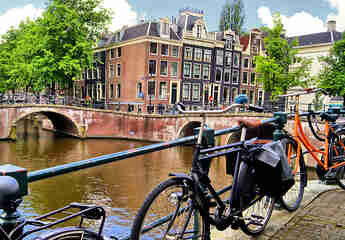
The Anne Frank House museum (Anne Frank Huis) is a house in Amsterdam on the Prinsengracht canal, in the back rooms of which the Jewish girl Anne Frank hid with her family from the Nazis. It was here that she wrote her diary. The house was built in 1635 by Dirk Van Delft. Originally there was a mansion here, then a warehouse. At the beginning of the 20th century, household appliances were manufactured here. On 1 December 1940, the company Opekta, which produced jam-making additives and where Anne's father Otto Frank worked, moved here. On 6 July 1942, Anne Frank's family moved into the "Secret Annex," set up by the company's employees in the back rooms of the house. The entrance was disguised as a filing cabinet. Here Anne wrote her diary "The Annex" in 1942—1944. In 1944, the Nazi authorities received a tip-off, and on 4 August they searched the house. The Frank family was arrested and sent to concentration camps.
Westerkerk

Flickr, alamsterdam
Westerkerk (Dutch: Westerkerk — Western Church) is a Calvinist church in Amsterdam, built in 1620—1631 to a design by Hendrick de Keyser. It is located on the bank of the Prinsengracht canal. The church spire is the tallest church spire in Amsterdam, at 85 meters high. It is crowned by a model of the crown of Emperor Maximilian I of the Austrian Empire. The church bells were cast by Pierre and François Hemony. The organ shutters were painted by Gerard de Lairesse. Rembrandt was buried in the church on 8 October 1669. The exact place of his burial is unknown, but it is believed to be near the north wall of the church. Hendrickje Stoffels, cartographer Jan Blaeu, painter Nicolaes Pietersz Berchem and, possibly, Rembrandt's son Titus van Rijn are also buried in the church. On 10 March 1966, Princess Beatrix and Claus von Amsberg were married in the church. Westerkerk is located near the Anne Frank House and was described in her diary. A statue of Anne Frank stands in the church square.
Homomonument

Flickr, Chiara Lalli
The Homomonument (Dutch: Homomonument) is a memorial in the historic center of Amsterdam, erected in memory of all gays and lesbians who were oppressed and persecuted because of their sexual orientation. The monument was created to support and inspire homosexual men and women in their struggle against discrimination and repression. The monument, built to a design by the Dutch artist Karin Daan, was officially unveiled on 5 September 1987 on Westermarkt square (Dutch: Westermarkt). The Homomonument is an abstract composition of three triangles of pink granite. This symbolism has historical roots — the pink triangle served as a badge for homosexual prisoners in Nazi concentration camps. Moreover, unlike similar signs for other categories of prisoners, it was larger than the others, so that their belonging to one of the most despised groups could be seen from afar.

Flickr, vgm8383
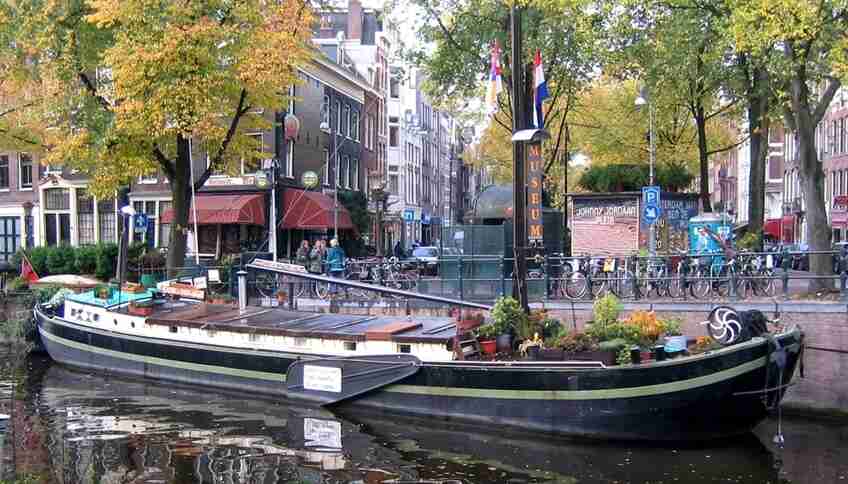
Once upon a time there was a Dutchman named Vincent van Loon. He lived happily, bought himself his own house, and not just an ordinary one, but a floating one. And then it all began… Every passerby considered it their duty to ask Vincent anything at all: What is it like to live there? Doesn't it sway? Where do you get gas, water, and electricity? Is your house damp, cold, and dark? And where does the sewage water go? The good-natured Dutchman grew tired of answering countless questions, and then he decided simply to invite people over so they could see for themselves that living in a floating house can be just as comfortable as in an ordinary apartment. Thus, in 1997, the first and only floating house-museum in the world opened in Amsterdam.
The former cargo vessel bearing the double name Hendrika-Maria was built in 1914, and in 1960 it was turned into a house on the water.
The area of this unusual dwelling is quite large, about 80 sq.m. The living room is decorated in the style of the 50s, and the kitchen and other rooms fully reflect the everyday life and household routine of an ordinary Dutch home.
When visiting the Houseboat Museum, you will be able to touch everything, learn about the особенностями of living in houseboats, have tea or coffee in the cozy kitchen, and breathe the air of Amsterdam's canals while admiring the museum's own garden located on the deck…
The Houseboat Museum lies at anchor in the city center, not far from the Anne Frank House and the Jordaan quarter.

antiekcentrumamsterdam.nl
Antiekcentrum is a popular antique market in Amsterdam, formerly known as De Looier. It occupies almost an entire block and brings together about 80 antique shops under one roof.
This is a true paradise for collectors, antique dealers, lovers of unusual and unique things, and simply for those who are tired of the solemnity and silence of museums.
The cozy atmosphere, the lively hum of a European market, the local color — all this promises you several delightful hours and a wealth of impressions.
On the counters of the numerous little shops you can find both silver watches from the last century, an exquisite candlestick or a rare and valuable figurine, as well as little things from 20-30 years ago that cannot be bought in modern stores.
But do not let the words "antiques" and "ancient curiosities" frighten you; there is no need to imagine a price tag with lots of zeros — in Antiekcentrum everyone will be able to find something to suit their wallet and, most importantly, their heart. Prices and the assortment are very democratic, and besides, bargaining is customary here. The selection is simply enormous, and you certainly will not be able to leave from under this market's roof without a few purchases that will remind you of the trip for a long time.
By the way, this is a wonderful place to pick out small original souvenirs for friends and relatives; believe me, a trinket bought at Antiekcentrum will have a special charm and soul, which cannot be said of traditional magnets and key rings.

Flickr, Jim Nix / Nomadic Pursuits
The epicenter of Amsterdam's nightlife, where residents and guests of the capital flock every evening, Leidseplein is located in the beautiful historic canal district of Grachtengordel. Previously, this square was the equivalent of a modern freight parking lot — peasants and craftsmen who came from Leiden to sell their goods at the market left their carts there.
Today it is the liveliest place in the city, the abode of partying tourists and a gathering point for the artistic bohemia. In the square itself you will meet many people watching street performers — musicians, actors, mimes, clowns, magicians, and fire-eaters.
In the buildings around Leidseplein and on the adjoining streets there are hundreds of restaurants, pubs, cafes, nightclubs and, of course, coffeeshops, including Amsterdam's most popular coffeeshop, Bulldog Palace. The largest casino, Holland Casino Amsterdam, is also located here.
The architecture of the square deserves a separate mention. For example, Leidseplein is home to the Municipal Theater — a magnificent neo-Gothic palace built in 1894. Local residents tell legends about the American Hotel, built at the beginning of the 20th century, calling it the place where the mysterious spy Mata Hari was married.
Music lovers and theatergoers are also bound straight for Leidseplein: this is where the ticket offices are located, selling tickets to all reasonably decent concerts and performances in Amsterdam. The legendary clubs Paradiso and Melkweg are also located here, regularly hosting rock concerts and festivals.