Before we set off, a quick note: this walk is also part of our mobile app - a travel planner for iPhone and Android. Download it to use this route with offline maps and GPS, and to plan the rest of your time in Milan. Let's go!
Updated for 2026: Central Milan is still easy to explore on foot, but the big sights are busier than ever. Expect security checks, timed entry, and lines around the Duomo, so book major visits ahead if you can.

Flickr, Go Ga
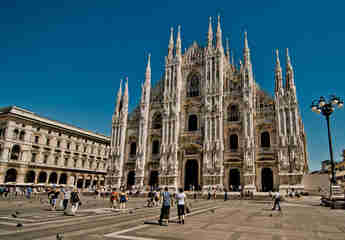
Start this route in the very heart of Milan, beside the city's unmistakable symbol: the cathedral.
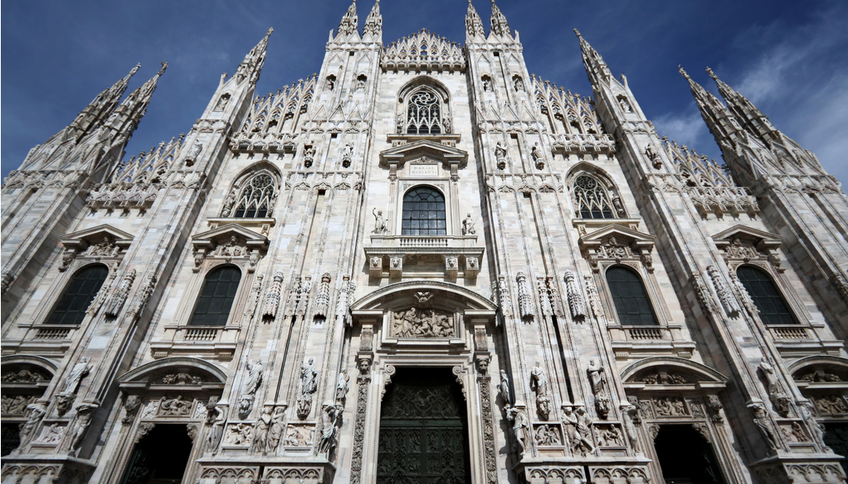
The Duomo is one of the world's largest churches and easily one of its most memorable. Its Gothic facade is faced in pale marble, and its 135 spires rise like a stone forest above the square.
Work on the cathedral began in 1386, before Gothic architecture had truly taken root in Italy, so builders and craftsmen were brought in from farther north. The Duomo reached its final form centuries later, with Napoleon pushing to speed up the facade before his coronation as King of Italy.
Inside, the cathedral is just as impressive. It holds a revered relic traditionally associated with the Crucifixion, an ancient porphyry basin reused for baptisms, and tombs and chapels that reflect centuries of Milanese history.
The statue of the Virgin Mary on the roof is one of Milan's best-loved symbols, watching over the city from above. Locals call her La Madonnina, or "Little Madonna." Inside, do not miss the startling statue of Saint Bartholomew and the extraordinary density of sculpture throughout the church.
And if you download the Ever.Travel mobile app, you will find not only this exact route but also an audio guide to Milan's Duomo. It is a lively introduction to the city's main landmark, full of details, legends, and local stories that are easy to miss on your own.

plus.google.com, Misan Wong
Once you have admired the cathedral, stepped inside, and maybe gone up to the terraces, take a moment to look around as well. Piazza del Duomo is Milan's living room: busy, grand, and surrounded by some of the city's best-known sights. One of them, of course, is the Duomo itself.
Another is Galleria Vittorio Emanuele II, the elegant 19th-century arcade famous for its iron-and-glass roof and high-end boutiques.
Facing the square is the Royal Palace, while the monument at the center honors King Vittorio Emanuele II, one of the main figures of Italian unification.
If you do not need to squeeze all of Milan into one day, plan a slower trip with the interactive city map. Pick the places you want to see, spread them across several days, and keep everything in one simple itinerary.

festour.com.ua
This is one of Europe's great shopping arcades, named after the first king of a united Italy. Vittorio Emanuele II attended its 1877 inauguration. The project ended on a tragic note: architect Giuseppe Mengoni died after a fall from the scaffolding shortly before completion.
The gallery is laid out in the form of a cross and crowned by a spectacular glass-and-iron dome - a bold piece of 19th-century engineering. In the central octagon, look down at the floor mosaics representing Europe, Asia, Africa, and the Americas.
The best-known of those mosaics is the Turin bull. Tradition says that if you place your heel on it and spin three times, good luck will follow.
Superstition aside, the Galleria is worth a stop for the atmosphere alone. Under the dome you will find flagship boutiques, historic cafes, and a steady parade of shoppers, photographers, and fashion fans.
If you are in the mood to keep shopping, read our guide to sales season in Milan, then head on to the boutiques of the Fashion Quadrilateral and Corso Buenos Aires.

Flickr, SpreadTheMagic
Walk straight through the Galleria from Piazza del Duomo and you will come out onto the square in front of La Scala. We will get to the opera house in a moment, but first look at the monument in the middle of the piazza.
Leonardo da Vinci was the ultimate Renaissance polymath: painter, engineer, inventor, architect, scientist, and tireless observer of the world.
He was also famously left-handed and wrote many of his notes in mirror script, a habit that still fascinates historians.
The monument places Leonardo on the pedestal and four of his pupils around the base: Andrea Salai, Marco d'Oggiono, Giovanni Antonio Boltraffio, and Cesare da Sesto.
He may be most closely associated with Florence, but Milan shaped a huge part of his career. Working for Ludovico Sforza, Leonardo painted, designed court spectacles, and even imagined ambitious improvements for the city.
If you want to dig deeper into his story, Milan offers plenty of options, including Santa Maria delle Grazie, home to The Last Supper, and the Leo nardo da Vinci Museum of Science and Technology. Both fit neatly into our route Milan of Leonardo da Vinci. You can also visit them with a professional guide.
Everything you need to know before your first trip to Milan - practical tips for independent travelers

Flickr, View Factory
This is one of the world's great opera houses. Works by Rossini, Verdi, Puccini, and many others have premiered here, and generations of singers and conductors have dreamed of performing on its stage.
Inside, La Scala is all red velvet, gilt, and famously fine acoustics. Outside, it is much more restrained. Architect Giuseppe Piermarini gave it a sober neoclassical facade, partly because the theatre had to rise quickly and partly because it stood among ordinary city buildings rather than in a grand ceremonial setting.
The theatre opened in 1778 on the site of the former church of Santa Maria alla Scala. That is where the name comes from - not from the Italian word for staircase, as people sometimes assume.
Prefer exploring with a guide? Here are a few good options.
- Express Milan Tour
- Historic Milan Walk
- Panoramic Milan by Car

Flickr, jasolo
From La Scala, Via Santa Margherita seems to take you slightly back toward Piazza del Duomo. Do not worry - that is part of the route. Follow the map past the Palace of the Jurisconsults and you will soon arrive in the right place.
In the Middle Ages, Piazza Mercanti was Milan's main square. It began taking shape in the 13th century and was once larger than it looks today, with entrances opening toward streets associated with different guilds and trades.
The buildings around the square are a compact lesson in Milanese history. To the west is Gothic Casa Panigarola. On the north side stands the Town Hall, first built in the 13th century and later remodeled. The south side is defined by a 17th-century Baroque palace designed by Carlo Buzzi.
At the center is a 16th-century well framed by two old columns. From here, continue on to another square that also mattered greatly in Milan's history.
By this point you have probably noticed how compact central Milan really is. If you plan to stay overnight, the historic center is the easiest base.

Flickr, roksoslav
Piazza Cordusio sits right on the edge of central Milan, where the historic core meets the old financial district. Grand headquarters for banks, insurers, and major companies helped give the square its stately character.
Many of those buildings date from the late 19th and early 20th centuries, and they still give the square much of its polished, monumental look.
You will also notice the monument to the poet Giuseppe Parini, created by architect Luca Beltrami.
The name Cordusio is usually linked to the Latin Curia Ducis, or "ducal court," a reminder that this area once had an administrative and judicial role.
Cross the square and you arrive at the start of Via Dante. You are already past the halfway point of this one-day Milan route, but the best views are still ahead.

Flickr, ChrisYunker
Great city streets often come full circle: after years of traffic, they become pleasant places to walk again. That is exactly what happened here when Via Dante was pedestrianized in the 1990s.
Today the street is lined with shops, cafes, and bars, with theatres nearby adding a little extra cultural weight. Not far away, Piccolo Teatro opened with a production of Gorky's The Lower Depths.
Via Dante balances old Milan and modern city life beautifully. Come here for shopping, people-watching, or simply a relaxed walk toward the castle.

Flickr, andlongoni
Via Dante leads straight to Cairoli Square, where a monument honors Giuseppe Garibaldi - soldier, nationalist, and one of the central figures of Italian unification. It is a fitting stop on a route through the heart of Milan.
In the mid-19th century, Italy was still divided and heavily influenced by foreign powers. Garibaldi became one of the most famous leaders of the movement that fought to unite the country.
That is why his name still appears everywhere in Italy - on streets, in squares, and on monuments. In Milan, he is shown returning on horseback, with allegorical figures at the base that echo the monument's patriotic message.
From here, just beyond the Wedding Cake fountain, you can already glimpse another of Milan's great landmarks.

Flickr, R. Alessandro
This imposing castle began in the 14th century under the Visconti and later became the seat of the Sforza dynasty. After political upheaval and heavy damage, it was rebuilt in the 15th century and grew into one of Milan's defining landmarks.
Leonardo da Vinci worked here as well, contributing decorative designs for the ducal apartments. Little of his wall painting survives, but the castle's museums still hold major works and treasures from the Renaissance and beyond.
Today the complex contains several museums, with collections ranging from ancient art and decorative arts to musical instruments and archaeology.
Even if you skip the museums, the castle is worth visiting for the architecture alone. The towers, courtyards, heavy gates, and traces of the old defenses give it real presence.
If parts of it feel oddly familiar, that is not just your imagination: the Kremlin's brick fortifications were influenced by northern Italian military architecture, including examples like Sforza Castle.
You are nearly done - just one stop remains on this one-day Milan route, and it is the perfect place to slow down. If you still have energy, or want ideas for tomorrow, take a look at this self-guided tour of Medieval Milan.

Panaramio
This large park opens up just behind Sforza Castle. What was once a military parade ground was turned at the end of the 19th century into one of Milan's loveliest green spaces.
Along with shady paths, lawns, and fountains, the park is home to the Palace of Art (Palazzo dell'Arte), a longtime venue for exhibitions on design, architecture, fashion, and photography.
You will also find the famous Arch of Peace here, a monumental gateway begun in the Napoleonic era and completed later under Austrian rule.
Another stop in the park is the city aquarium, one of the oldest in Europe and still a pleasant quick visit.
Sports fans may also want to look at Arena Civica, the historic stadium built in the early 19th century.
For a sweeping view over Milan, head up Branca Tower. The lift takes you to the top in seconds, and on a clear day the panorama stretches far beyond the city center.
That is the end of our route - but you can always remix it. Use the Milan attractions map to build your own plan, sync it with the free Ever.Travel app, and make the most of your time in the city.