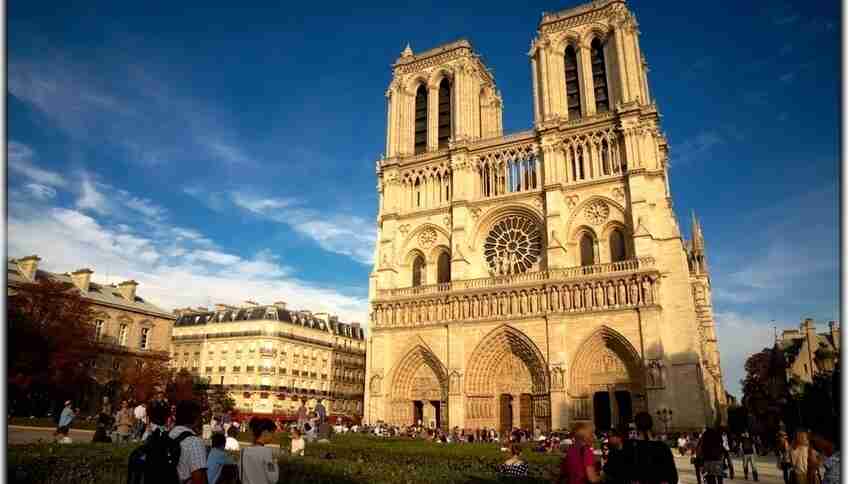
Notre-Dame de Paris

Flickr, Moyan_Brenn
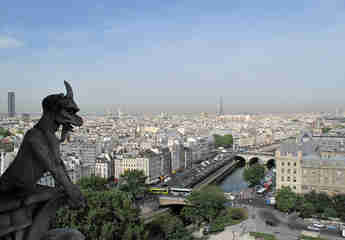
Notre-Dame Cathedral (Notre-Dame de Paris; French: Notre Dame de Paris) is a Catholic cathedral in the center of Paris, the geographic and spiritual 'heart' of the French capital, located in the eastern part of Ile de la Cite, on the site of Paris's first Christian church - the Basilica of Saint Stephen, which in turn was built on the site of the Gallo-Roman Temple of Jupiter. It was built from 1163 to 1345. The cathedral is 35 m high, 130 m long, 48 m wide, the bell towers are 69 m high, the Emmanuel bell in the eastern tower weighs 13 tons, and its clapper weighs 500 kg. The cathedral's architecture reveals a duality of stylistic influences: on the one hand, there are echoes of the Romanesque style of Normandy with its characteristic powerful and dense unity, and on the other, innovative architectural achievements of the Gothic style were used, giving the building lightness and creating an impression of simplicity in the vertical structure.
By the way, we have an excellent audio guide for Notre-Dame Cathedral! Download it in the Ever.Travel mobile app, it costs several times less than the official one ;)

Flickr, eartotherailfotos
Most of this memorial is actually hidden underground. It is a long corridor with a black floor and ceiling, on whose walls many small lights glow, reminding visitors of those who died and were tortured in concentration camps in different countries. In these same walls there are small niches containing ashes and earth from those very camps - Auschwitz, Dachau, Bergen-Belsen. The niches are made in the shape of triangles, like the patches - identification badges on the prisoners' clothing. At the end of the corridor there is a wall with a round opening, in which a light bulb also hangs, symbolizing hope - the light at the end of the tunnel.
A visit to this place has a particularly strong effect because of the contrast with its location on the busy Ile de la Cite, behind Notre-Dame Cathedral, where thousands of tourists flock every day. However, inside this memorial, which resembles a prison corridor more than anything else, it is always very quiet.
The memorial plaque hanging above the exit from the monument reads: 'Forgive us. We will never forget you.' This plea is addressed to 200000 French people, including Jews, who were sent to Nazi camps after being betrayed by their own neighbors and fellow citizens.
The Memorial to the Victims of Deportation was inaugurated in 1962 by General de Gaulle. It was designed by Henri Purgasson. Significantly, in building this monument he used stones from all the provinces of France.

Flickr, motse@yahoo.com
Ile de la Cite is considered the heart of Paris, because this is where its history began. And the fact that fresh flowers are fragrant in the heart of the most romantic city seems highly symbolic.
The flower market on Ile de la Cite has existed for more than 200 years. Roses, tulips, gladioli, irises, divine orchids... What flowers are not found here! And not only cut flowers, but potted plants as well. Seeds and all kinds of garden goods are also sold here. And can you imagine the aromas that float around here? By the way, one of the well-known perfume houses not long ago released a fragrance called 'Marche aux Fleurs' ('Flower Market').
Long ago, flower sellers simply stood in this bazaar with large baskets, but now there is a long covered pavilion with a glass roof. It is open daily from 8 in the morning until 7:30 in the evening. And on weekends it also turns into a bird market. Nightingales, turtle doves, canaries, parrots and many other birds are brought here.
In the run-up to the New Year, the flower market also turns into a Christmas market. Here you can buy souvenirs that cannot be found anywhere else in the city. In short, this place is worth a visit at any time of year. Especially since its location is extremely convenient - very close to Notre-Dame de Paris.
Sainte-Chapelle

Flickr, Luxie P.
The Holy Chapel (Sainte-Chapelle) (French: Sainte Chapelle) is a Gothic reliquary chapel on the grounds of the former Royal Palace (later the Conciergerie) on Ile de la Cite in Paris. It was built by Saint Louis in 1242-1248. It possesses the most complete ensemble of 13th-century stained-glass art and is considered one of the most beautiful small Gothic churches. The chapel was conceived by Saint Louis as a place to keep the sacred relics brought by the Crusaders from Constantinople, which had been plundered during the Crusade. The chief among them was the 'Crown of Thorns, stained with Christ's blood,' possession of which was meant to strengthen the influence of the French kingdom in the Christian world. In 1239 Louis acquired the crown, according to some sources, for the enormous sum of 135 thousand livres from the Latin Emperor Baldwin II. More precisely, Baldwin II had pawned the Crown of Thorns to the Venetians, from whom it was redeemed by Saint Louis.
Place de l'Hotel-de-Ville

Flickr, Barmy Bee
Place de l'Hotel-de-Ville (French: place de l'Hotel-de-Ville) is the square in front of the city hall in Paris's 4th arrondissement. Until 1803 it was called Place de Greve (French: place de Greve), a name derived from the French word greve, which means a flat seashore or riverbank covered with pebbles or sand. At this spot on the right bank of the Seine was Paris's first river port. It was always possible to earn money loading or unloading ships here, hence the French expressions etre en greve and faire (la) greve - 'to work on Place de Greve,' which now mean 'to strike' - the exact opposite of the original meaning. In 1239 Pope Gregory IX ordered all handwritten copies of the Talmud to be seized from the Jews. Although the Pope's instructions were sent to many monarchs and archbishops, only King Louis IX of France carried them out. In the summer of 1240, 20 cartloads of handwritten Talmud books confiscated from French Jews were publicly burned on Place de Greve in Paris.
Stravinsky Fountain

Flickr, CreART Photography
Stravinsky Fountain (French: Fontaine Stravinski), also the Tinguely Fountain, is a fountain on Place Igor Stravinsky next to the Georges Pompidou Centre in Paris. It was created by the Swiss architect Jean Tinguely together with his wife, the French artist Niki de Saint Phalle, in 1982-83. Named after Igor Stravinsky, the fountain consists of 16 moving sculptures (mobiles) placed across the entire fountain basin (1650 cm × 35 cm × 3600 cm). Tinguely made the black wheeled mechanisms out of iron, while Saint Phalle created bright avant-garde figures from polystyrene. The figures stage a performance to Stravinsky's finest works, taking turns releasing jets of water. Beneath Place Stravinsky is the IRCAM Center for Musical Research, created, like the Pompidou Centre, by the architect Renzo Piano.
Georges Pompidou Centre

Flickr, posixeleni
The Georges Pompidou National Centre for Art and Culture (French: Centre national d’art et de culture Georges-Pompidou), colloquially the Georges Pompidou Centre (French: Centre Georges-Pompidou), the Pompidou Centre or Beaubourg, is a cultural center in the Beaubourg quarter of Paris's 4th arrondissement between Les Halles and the Marais. Open since 1977, it was created on the initiative of French President Georges Pompidou. The center's activities are devoted to the study and support of modern art and 20th-century art in its various forms (visual arts, dance, music, etc.) The center is the third most visited cultural attraction in France after the Louvre and the Eiffel Tower. In 2006 the museum was visited by 6.6 million people. The Pompidou Centre includes the Paris Museum of Modern Art, a large library, concert and exhibition halls, and the Institute for Research and Coordination in Acoustics and Music. The vast square in front of the Pompidou Centre is a favorite spot for artists, street performers, musicians and circus performers.
Nicolas Flamel House

Flickr, Christina Storch
Nicolas Flamel (French: Nicolas Flamel or Latin: Nicolas, 1330-22 March 1418) was a French alchemist credited with inventing the philosopher's stone and the elixir of life. Nicolas Flamel was born in 1330 near Pontoise into a poor family. It is believed that his parents died when he was young; after their death Nicolas moved to Paris and became a public scrivener. After marrying Perrenelle, a mature woman and twice a widow, Flamel rented two workshops, one for himself and the other for his apprentices and copyists. All the couple's property passed into joint ownership. In 1357 Flamel, as the owner of a small bookshop, acquired for it a papyrus known as 'The Book of Abraham the Jew.' For 20 years he tried to decipher the 'secret meaning' of the book, part of which was written in Aramaic.
Half-timbered Houses

Flickr, French Moments
Fachwerk (German: Fachwerk - frame construction, half-timbered construction) is a type of building construction in which the load-bearing base is a spatial section made of inclined softwood beams set at various angles. These beams are visible from the outside of the house and give the building its characteristic appearance; the spaces between the beams are filled with adobe, brick, and sometimes wood as well. Half-timbering appeared in Germany in the 15th century and became very popular in Europe, especially in the northern part (from Britain to Poland). In the 20th century this style experienced a new flowering thanks to its medieval flavor and the natural feel of its building materials. In Germany there are historic structures built in the 14th century, one of which, dating from 1347, is in Quedlinburg. In Europe, timber-frame construction saw its greatest development during the Middle Ages. According to some historical sources, half-timbered houses could already be found in Europe in the 11th century.
Place de la Bastille

Flickr, jean-louis zimmermann
Place de la Bastille (French: la place de la Bastille) is a square in Paris that owes its name to the Bastille fortress, destroyed during the French Revolution. It lies on the border of the 3rd, 4th, 11th and 12th arrondissements. It is the point where more than ten streets and boulevards intersect. At the beginning of the French Revolution, on 14 July 1789, the fortress was taken by the revolutionary-minded populace. It took three years to dismantle the fortress. From house No. 5 to house No. 49 on Boulevard Henri IV, a line was laid out in cobblestones marking the outline of the walls of the destroyed fortress. A sign was placed on the vacant lot with the inscription 'Desormais ici dansent,' which means 'From now on people dance here,' and public festivities began to be held here every year. The tradition continues to this day. Following his plans to redesign Paris, Napoleon decided in 1808 to erect a gigantic fountain in the form of an elephant in the square (l'elephant de la Bastille), commemorating his victories in Egypt.