
Flickr, Mr. Dom
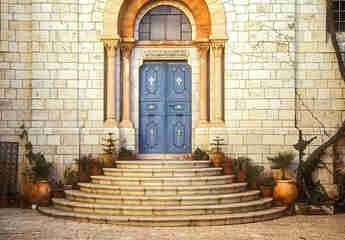
These gates, built in the XVI century by order of the Turkish sultan Suleiman the Magnificent, originally bore the name of the Blessed Virgin Mary, whose tomb is located not far from this entrance to the Old City – on the Mount of Olives. However, later the gates became known as the Lion's Gate because of the bas-relief decorating them with the image of the kings of beasts.
According to legend, the lions, like these gates, appeared in the city after Suleiman the Magnificent had a dream warning him that if he did not build a wall around the city, predators would attack him and the residents of Jerusalem.
Today, traces of more recent history can be seen on Lion's Gate as well – look closely, and you will surely find chips in the stonework left by bullets. These are traces of the battles for East Jerusalem that took place in this area in 1967.
Via Dolorosa

TravelMe, Alina Kovalevich
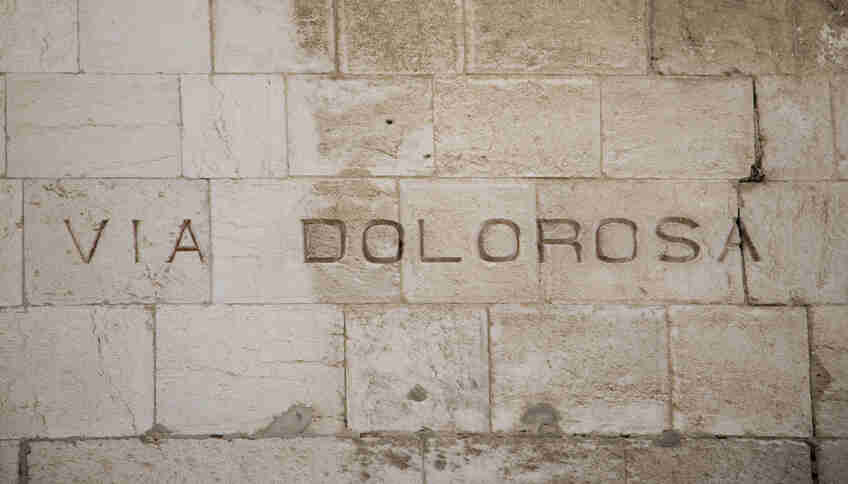
Via Dolorosa (lat. Via Dolorosa, lit. «Way of Sorrow») is a street in the Old City of Jerusalem along which, it is believed, Jesus Christ walked to the place of crucifixion. On the Via Dolorosa there are nine of the fourteen stations of Christ's Way of the Cross. The last five stations are located on the grounds of the Church of the Holy Sepulchre.The route of the Way of the Cross begins at the Al-Omariya school (en:Umariya Elementary School), at the place where the Roman Antonia Fortress once stood, and leads west through Old Jerusalem to the Church of the Holy Sepulchre[1]. A description of this route was first given at the end of the XIII century by the Dominican missionary Riccoldo da Monte di Croce[2], and it was established in the XIV century by Franciscan monks from the Custody of the Holy Land. It is known, however, that Jerusalem itself was completely destroyed back in the I century after the Jewish uprising of 66—71, described by Josephus Flavius[3]. The ruins remained abandoned for several decades.

Flickr, israeltourism
Via Dolorosa begins with the Praetorium - the residence and workplace of the Roman procurator of Judea. It is believed that this is where Pontius Pilate sentenced Christ to death.
Today, nothing remains of the fortress except the foundation. It, like all of Jerusalem, was destroyed in the 70s AD by the Roman emperor Titus Flavius Vespasian.
Immediately behind the Praetorium is Christ's Prison. It must be admitted that it is rarely open, but if you are lucky, be sure to look inside.

Flickr, Derek N Winterburn
It is believed that at this place Jesus was subjected to scourging. Here the Roman soldiers mockingly placed a crown of thorns on His head, and nailed to the cross a plaque with the words «Jesus of Nazareth, King of the Jews». It was from here that Christ began His journey, carrying the cross to the place of execution.
«Then Pilate took Jesus and had Him beaten. And the soldiers, having woven a crown of thorns, put it on His head, and dressed Him in purple, and said: Hail, King of the Jews! And they struck Him on the cheeks».

Flickr, Ema Cresc
This very place is associated with the first fall of Jesus Christ under the weight of the cross. Historians suggest that His burden weighed about 150 kg! Even for a healthy person this is a very heavy load, and if we also remember that on the eve of the execution Christ was held in prison, beaten, and tortured, then the definition of Via Dolorosa as the «path of suffering» becomes even more understandable.
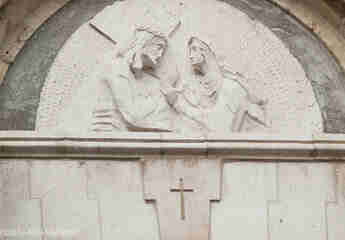
Today, near this place stands a chapel of the Armenian Patriarchate. In its tympanum there is a magnificent bas-relief by the Polish sculptor Tadeusz Zielinski, depicting the falling Christ.

Flickr, ThomasChamberlin
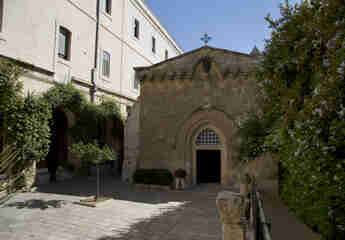
According to tradition, on the site where the chapel of the Armenian Patriarchate stands today, Jesus, while on the way to execution, met His mother. If you step inside the church, on the beautiful mosaic floor you will find the place where the footprints of the Virgin's sandals were imprinted.
Station V: House of Simon of Cyrene

Flickr, EG | Heliomedia
Simon of Cyrene (Heb. שמעון, Greek Σίμων ο Κυρηναίος) is a character of the New Testament who carried the Cross for the crucifixion of Jesus Christ during part of the Way of the Cross.About Simon of Cyrene it is reported:Based on the absence in John the Theologian of any mention of Simon, Augustine the Blessed writes: «up to the ascent to Golgotha Jesus Himself carried His own cross; Simon, however, as the previous three (evangelists) recall, was compelled to do this already on the way, while lifting (the cross) to the (place of the Skull)».[1]The Holy Scripture contains no other information about Simon. It is assumed that he belonged to the Jewish community of the Libyan city of Cyrene and came to Jerusalem for Passover, like other Jews living in the Diaspora.[2] A version is put forward that he may have been a follower of Jesus Christ because, in the opinion of Johann Bengel, «neither a Jew nor a Roman would have wished to bear the burden of the cross».[3]Sacred Tradition contains additional information about Simon.
Station VI: House of Veronica

Flickr, israeltourism
Saint Veronica is a Christian saint. Her commemoration is observed in the Orthodox Church on July 12 (according to the Julian calendar), and in the Catholic Church on February 4.Church tradition holds that she offered Jesus a cloth so that He could wipe His face when He stumbled and fell on His way to the place of crucifixion. On the cloth she received the miraculous «true image» (lat. icona vera) of the face of Jesus. In addition to this tradition common to Christianity, the Orthodox Church considers Veronica to be the woman with the flow of blood who received healing by touching the hem of Christ's garments (Matt. 9:20-22).There are a number of traditions intended to give the image of Saint Veronica historical features. According to one legend, she later preached Christianity in southern Gaul. In other legends she is called a Greek princess or identified with Martha, the sister of Lazarus. In Italy there was a legend according to which she healed Emperor Tiberius with the help of her veil bearing the miraculous image of the Savior.

Flickr, The Holy Land: A Spiritual Pilgrimage
The seventh station of Via Dolorosa is marked by a Franciscan chapel entrusted to the Coptic Catholics. The door leading into it is located, according to Catholic tradition, directly above the threshold of the Judgment Gate, over which, according to legend, Jesus stumbled.
The gates were called «Judgment» because once the condemned person crossed them, he could no longer appeal the sentence.

Flickr, kudumomo
The eighth station of the Sorrowful Way is located somewhat aside from the route and is marked by a round stone built into the wall of the Greek Orthodox Monastery of Saint Charalampus. Historians assume that, most likely, this is a fragment of a column, on the end of which a cross and an inscription in Greek are depicted: «Jesus Christ – Victor».
In the Gospel it is written that at this place the Savior met weeping women and said to them: «Do not weep for Me, but weep for yourselves and for your children...», thus making a prophecy about the destruction of Jerusalem. And indeed, 40 years later the Roman troops destroyed the Jewish Temple, and the city was practically razed to the ground…

Flickr, Derek N Winterburn
In the narrow alley that ends at three gates and is marked by wooden crosses, you will find the place of Christ's third fall, as well as the Ethiopian and Coptic monasteries.
The place is easy to recognize by the wooden crosses standing by the wall. These are the very crosses that take part in the city's 'Way of the Cross' processions.
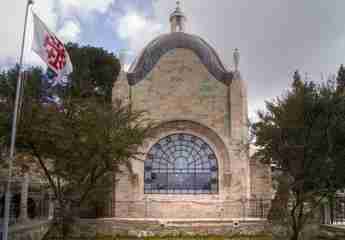
If you go a little farther, you will run into the gates of the Coptic Orthodox Patriarchate, and if you turn left, you will pass through a small gate into the courtyard of the Ethiopian monastery, which, no more and no less, is located on the roof of Saint Helena's Chapel. It is the dome of this chapel that you will see in the center of the monastery courtyard.
Few people know this, but through an inconspicuous open door in the depth of the courtyard you can enter the courtyard of the Church of the Holy Sepulchre.

Flickr, israeltourism
The last stations of Via Dolorosa are located directly in the Church of the Holy Sepulchre. Immediately to the right of the entrance is the ascent to Golgotha, to the «Chapel of the Nails», near which the Roman soldiers first divided and cast lots for Christ's garments, and then nailed the Savior to the Cross.
Station XII: Golgotha

Flickr, spinfly
Golgotha or Calvary (Greek Γολγόθα, Κρανίου Τοπος; Heb. גולגלתא, «place of the skull» from Aram. gûlgaltâ, lit. «skull»; lat. Calvaria) is a small rock or hill where Jesus Christ was crucified. Along with the Holy Sepulchre, it is one of the two main shrines of Christianity.According to tradition, at the beginning of the I century Golgotha was located outside the city walls of Jerusalem, northwest of the city. At present it is part of the Church of the Holy Sepulchre in the Christian Quarter of the Old City of Jerusalem. Beginning in the late XIX century, some researchers put forward other versions of its location, for example the Garden Tomb in the north of Jerusalem near the Damascus Gate[1].It is believed that Golgotha owes its name to the skulls that were piled at the place where criminals were executed in ancient Jerusalem. There is also a tradition that Adam was buried at the site of Golgotha.

Flickr, israeltourism
According to Jewish tradition, a dead body is considered unclean, and therefore it must be committed to the earth as soon as possible. Try to imagine the time of the execution: evening is falling, the bloodied body of Jesus is taken down from the cross and laid on the nearest stone. It is hastily washed and buried in a nearby cave, so that after returning on Sunday, the full burial rite can be performed.
Of course, today pilgrims do not touch the very stone on which Christ was washed. This is only a covering necessary to protect the shrine from fanatical pilgrims. However, the stream of those wishing to touch the Stone of Anointing and bless their crosses, candles, or icons on it never becomes smaller…

Flickr, JohnKuriyan
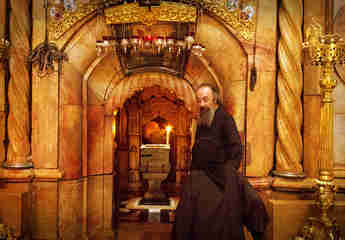
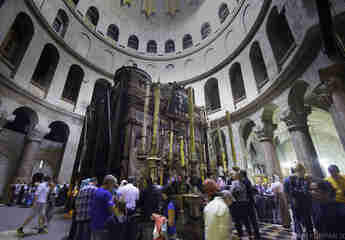
The chapel concealing the cave of the Holy Sepulchre is commonly called Kuvuklia, which is translated from Greek as chamber or bedchamber. As a rule, a large queue of pilgrims always forms to it, passing through the Chapel of the Angel to the Holy Sepulchre.
According to the customs of those times, the body of Christ was placed on a stone burial bed measuring about two meters in length, one in width, and half a meter in height from the floor. Since ancient times this Bed has been heavily damaged by pilgrims who sought to chip off and carry away a piece of the relic…