St James's Park

Flickr, L.A. Scowen
St James's Park is a royal park in Westminster that begins the 'green belt' in central London, stretching west from here through Green Park and Hyde Park to Kensington Gardens. To the north of the park lies St James's Palace, to the west Buckingham Palace, and to the east the Foreign Office. St James's Park is considered the oldest in London. Like the nearby palace, it is named in memory of the almshouse of St. James that once stood here. It was acquired for the Crown (from Cardinal Wolsey) by King Henry VIII. Many years passed before James I Stuart ordered the marshes to be drained and placed a menagerie here with exotic animals—camels, crocodiles, and an elephant. Returning from France after the Restoration, Charles II redesigned the park in the style of the gardens of Versailles and laid out a canal. The Prince Regent, finding such a design old-fashioned, ordered John Nash at the beginning of the 19th century to plant trees and turn the canal into a pond. In this form, the park has survived to the present day.
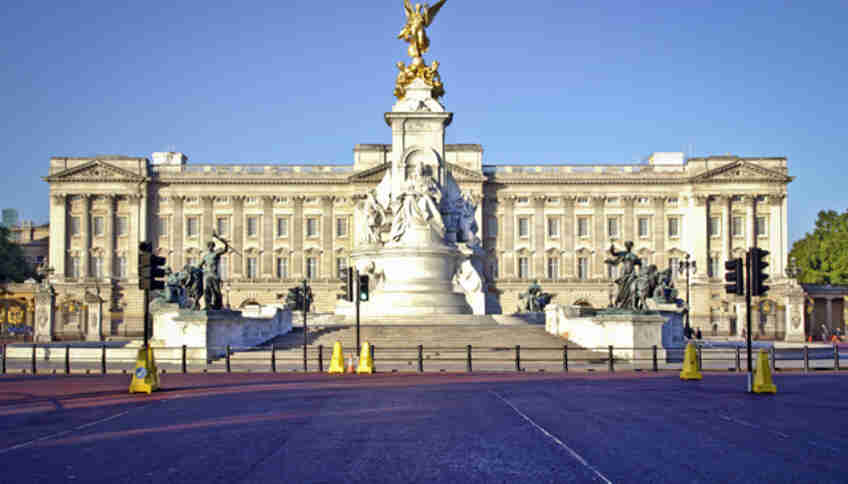
Buckingham Palace

Flickr, 762_AK
Buckingham Palace is the official London residence of the British monarchs (at present, Queen Elizabeth II). It is located opposite Pall Mall and Green Park, with the white marble and gilded Victoria Memorial. When the monarch is in the palace, the Royal Standard flies above the roof of the palace. Originally, Buckingham Palace was known as Buckingham House and was built for the Duke of Buckingham (from 1703). It was acquired by King George III in 1762 as the future private residence of the monarch (the official residence, St James's Palace, no longer suited him either in size or decoration). Over the following 75 years, the architects John Nash and Edward Blore (the creator of the Alupka Palace), using Buckingham House as a basis, built three more similar buildings. Together they form a square in plan, at the center of which is a large inner courtyard.
Green Park

Flickr, jivedanson
Green Park is one of the royal parks of Westminster, serving as a kind of link between Hyde Park (to the northwest) and St James's Park (to the east). The Mall marks the southern boundary of Green Park, while Piccadilly marks the northern one. The history of the park dates back to the time of Henry VIII. For a long time, it was a favorite place for duels among British aristocrats. Unlike other London parks, Green Park has no ponds and almost no monuments, with one exception: at its junction with St James's Park (the so-called Queen's Gardens), opposite Buckingham Palace, stands the famous Victoria Memorial.
Wellington Arch

Flickr, garryknight
Wellington Arch (also known as Constitution Arch or, originally, Green Park Arch) is a triumphal arch located south of Hyde Park in central London and in the northwestern corner of Green Park (it now stands on a traffic island). Built, like Marble Arch north of Hyde Park, in 1825 by order of George IV in honor of Britain's victory in the Napoleonic Wars, Wellington Arch was meant to become the outer gateway leading to Constitution Hill and the ceremonial western entrance to central London. The presence of a gate at this spot in the 18th century created the impression that this was the beginning of London (which is why the nearby residence of the Dukes of Wellington, Apsley House, was nicknamed 'No. 1, London'), and the arch was intended to reflect the importance of the site. Wellington Arch was built in 1826–1830 to a design by Decimus Burton.
Hyde Park

plus.google.com, abel abellera
Hyde Park is a royal park covering 1.4 km² in central London. Kensington Gardens adjoin it on the west. It is a traditional place for political rallies, celebrations, and public festivities. Even before the Norman Conquest, the park belonged to Westminster Abbey; it received its name from an ancient unit of area measurement. With the beginning of the Dissolution of the Monasteries (1536), Henry VIII took it into the royal treasury to use for his own hunting amusements[1]. It was opened to the public under James I, and under Charles II it became a favorite recreation spot for Londoners. The park's main attraction is the Serpentine lake, where swimming is permitted, as well as the gallery of the same name. In the southeastern corner of the park are Apsley House, which houses the Wellington Museum, and Wellington Arch. These sites are a reminder that in 1815 Hyde Park hosted the historic parade celebrating Wellington's victory over Napoleon.

Flickr, Iqbal Aalam
One of the most unusual features of Hyde Park, without any exaggeration, is the fountain built in honor of Princess Diana. Many projects took part in the competition to create it; however, the winning design was by the American landscape designer Kathryn Gustafson.
The memorial fountain has the shape of an oval and resembles an unusual riverbed in which two arched channels are joined together. They are designed in such a way that the water in them flows in different directions. In one direction it runs like a murmuring stream, while in the other it flows, gently rolling over low steps. These two streams seem to remind us that Lady Di's life was at one time calm and happy, and at another turbulent and difficult.
More than five hundred pieces of Cornish granite were used to build the fountain. Today this enormous monument, measuring 50 by 80 meters, is always crowded. Diana's Fountain attracts Londoners and the city's guests with its simplicity and elegance. As a rule, people come here to relax quietly and reflect on life.
Kensington Gardens

Flickr, rbachlec
Kensington Gardens is a royal park in the London district of Kensington, surrounding Kensington Palace. Until 1728, it was part of Hyde Park. Access to the park was opened by Queen Christina in 1728 and only on Sundays. Because of its proximity to Kensington Palace, the grounds of Kensington Gardens remained closed to the public for longer. On the shore of the lake stands the statue of Peter Pan, erected in 1912 at the initiative and expense of J. M. Barrie, the author of the book 'Peter Pan in Kensington Gardens' (1906). Along the western part of the gardens runs Kensington Palace Gardens, where most of the buildings are luxurious mansions and embassies.
Kensington Palace

Flickr, RonDeeView
Kensington Palace is a small and deliberately modest palace in the western part of London. It is the official residence of the Duke and Duchess of Gloucester (currently Duke Richard and Duchess Birgitte), as well as the Duke and Duchess of Kent (currently Duke Edward and Duchess Katharine) and their children. It began as the suburban mansion of the Earl of Nottingham. King William III of Orange, who had grown tired of river journeys to distant Hampton Court, bought the palace from the Earl and commissioned Christopher Wren to remodel it. His wife Mary died in this palace in 1694, and a couple of years later Peter the Great visited the king in Kensington. Under Queen Anne, a formal park of 30 acres was laid out and an orangery was built (architect John Vanbrugh, 1704). The first kings of the Hanoverian dynasty considered the urban St James's Palace too crowded and lived in Kensington almost continuously. After the death of George II in 1760, the palace was mainly inhabited by representatives of the younger branches of the ruling dynasty.