
Flickr, Mr. Dom
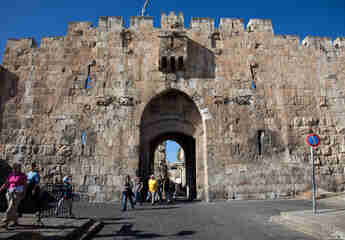
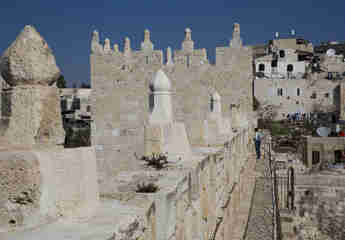
These gates, built in the 16th century by order of the Turkish Sultan Suleiman the Magnificent, were originally named after the Most Holy Virgin Mary, whose tomb is located not far from this entrance to the Old City - on the Mount of Olives. However, later the name Lions' Gate became attached to them because of the bas-relief depicting the kings of beasts that adorned them.
According to legend, the lions, like these gates, appeared in the city after Suleiman the Magnificent had a dream warning him that if he did not build a wall around the city, predators would attack him and the residents of Jerusalem.
Today, you can also notice traces of more recent history on Lions' Gate - look closely, and you will surely find chips in the masonry left by bullets. These are traces of the battles for East Jerusalem that took place in this area in 1967.
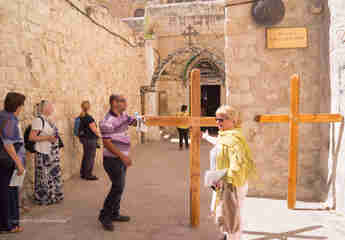
By the way, you can also stroll in the opposite direction from Lions' Gate: the Via Dolorosa begins here. To follow the final path of Jesus Christ without missing a single important station, simply turn on the Jerusalem audio guide.
Tomb of the Virgin Mary

TravelMe, Alina Kovalevich
The Tomb of the Virgin Mary is a Christian shrine in the Holy Land where, according to tradition, the Most Holy Mother of God was buried by the apostles. It is located in Gethsemane, at the foot of the western slope of the Mount of Olives, in the Kidron Valley, in Jerusalem (East Jerusalem). Above the tomb stands the cave Church of the Assumption of the Virgin. The church (grotto) is owned by the Jerusalem Greek Orthodox Patriarchate; the Armenian Church also has rights to use it, and other Christian denominations have access to hold services there. According to a tradition known since the 4th century, the Mother of God died in Jerusalem and the apostles buried Her in Gethsemane in the tomb where her parents Joachim and Anna, as well as Joseph the Betrothed, had previously been buried. However, the apocryphon “The Dormition of Mary” (written no earlier than the 4th century) reports that the Mother of God was buried by the apostles “in Gethsemane in a new tomb”.
Church of Mary Magdalene

Panaramio, eek mulder
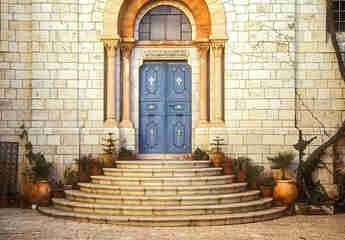
The Church of Saint Mary Magdalene in Gethsemane is a Russian Orthodox church in East Jerusalem. It is located in Gethsemane, not far from the Tomb of the Virgin Mary, on the slope of the Mount of Olives. It was built by the Imperial Orthodox Palestine Society with funds from the Imperial family, in memory of Empress Maria Alexandrovna. It was consecrated in 1888 in honor of Saint Mary Magdalene. Since 1921, the relics of the holy martyrs Grand Duchess Elizabeth Feodorovna and Nun Barbara have been kept in the church. The church belongs to the ROCOR of the Moscow Patriarchate and is the main church of the women's Gethsemane Monastery of the Bethany Community of the Resurrection of Christ. The construction of a church in memory of Empress Maria Alexandrovna was proposed by the head of the Russian Ecclesiastical Mission in Jerusalem, Archimandrite Antonin (Kapustin). He also proposed the site for the church on the slope of the Mount of Olives, and soon, by the autumn of 1882, the land was purchased. Architect D. A. Grimm drew up the design, and the church was founded on January 21, 1885.

Flickr, Derek N Winterburn
The name of this church is translated from Latin as “The Lord Wept.” An unusual description, isn't it? You will be even more surprised when you learn that this church is built in the shape of a tear! - something quite rare and completely uncanonical in church architecture.
It is also interesting that the church's altar is oriented not to the east, as is customary in churches, but toward the Temple Mount. This was done deliberately so that during the liturgy parishioners could see what Christ saw about 2000 years ago.
And what did he see, you ask? We will tell you a very beautiful but sad story.
This happened even before Christ entered Jerusalem. In those days, a simple Jewish family lived on this spot and gave shelter to a traveler for the night. It is believed that in his sleep Jesus had a vision of the city engulfed in flames, Solomon's Temple destroyed, and thousands of residents dead. Christ, sensing that what he saw could not be avoided, weeps.
Forty years later, hundreds of thousands of Jews would weep as well. After the brutal suppression of the revolt by the future Roman emperor Titus Flavius Vespasian, almost nothing of Jerusalem truly remained...

TravelMe, Alina Kovalevich
For any religious Jew, it is considered a great honor to be buried in this ancient cemetery, because its holiness is determined by its immediate proximity to the Kidron Valley and the Temple Mount. And as it is written in the Book of the Prophet Zechariah, at the end of days the Messiah will ascend the Mount of Olives, and from there, at the sound of Ezekiel's trumpet, the resurrection of the dead will begin. And since it is believed that everyone buried in this cemetery will be among the first to be resurrected, a place here costs as much as a decent apartment in the city of Moscow. Burials here began as early as the First Temple period, as evidenced by the many catacombs between and beneath the houses of the Arab quarter of Silwan, or Shiloah. In the Second Temple period, the cemetery shifted north, covering the slopes of the Mount of Olives. The remaining monuments mostly date from the last centuries. At present, there are at least 150,000 graves on the mountain, some of which are attributed to Old Testament figures. For example, the Tomb of Absalom - the third son of David, who rebelled against his father.