Taksim Gezi Park

Taksim Gezi Park (Turkish: Taksim Gezi Parkı) is an urban park on Taksim Square in the Beyoglu district in the center of Istanbul, one of the smallest parks in the city. Laid out on the site of former barracks, in 2013 the park became the scene of clashes between Turkish police and demonstrators protesting the government's intention to rebuild the barracks and cut down the park, constructing a shopping center in its place.
On the site where the park now stands, barracks known as the Halil Pasha Artillery Barracks (Turkish: Halil Paşa Topçu Kışlası) were built in 1806. The majestic building, combining elements of Ottoman, Russian, and Indian architecture, was badly damaged during the March 31 Incident in 1909 and required repairs. Over time, the inner courtyard of the barracks was rebuilt and became the first stadium in the city. At Taksim Stadium on October 26, 1923, the Turkish national football team played its first official match in history — it drew with the Romanian national team (2:2).
Those who download the Istanbul audio guide in the Ever.Travel mobile app will get a multimedia, detailed, and very interesting guide to Taksim Square ;)

Flickr, vlidi
The name of Mustafa Kemal Ataturk, the first president of the Turkish Republic, has a sacred meaning for most residents of the country. It is not surprising that the authorities' plans to demolish the Ataturk Cultural Center, located on Taksim Square, provoked such a strong public reaction, and the center itself became a symbol of the protest movement. For almost the entire summer of 2013, things were tense here — one protest after another was held against the cutting down of trees in Taksim Gezi Park and the demolition of the Ataturk Center. As of today, the unrest has subsided, but the fate of both sites still remains in question.
The building of the Ataturk Cultural Center (or AKM for short – Atatürk Kültür Merkezi) was built in the mid-20th century. Today AKM is a multipurpose and multifunctional center comprising a theater, a large concert hall, exhibition hall, and cinema hall. The venues of this, without exaggeration, iconic place regularly host official receptions, art festivals, congresses, and concerts.
Taksim Square

Taksim Square (Turkish: Taksim Meydanı) is a square in the central part of Istanbul (the Taksim neighborhood of the Beyoglu district). This square is home to a number of prestigious hotels and many shops. The square is a place for mass gatherings for both local residents and tourists. The name comes from the Arabic تقسيم, “division.” Taksim Square was built on the site of the former Surb Hakob Armenian cemetery (Saint Hakob), founded in the 16th century during the reign of Sultan Suleiman I. During the ongoing construction on Taksim Square, 16 Armenian graves and the remains of 19th-century building walls were discovered. At the end of May 2013, the square became the site of clashes between Turkish police and demonstrators opposing the cutting down of trees in Taksim Gezi Park and the construction of a shopping center there.

Flickr, ümit uzun
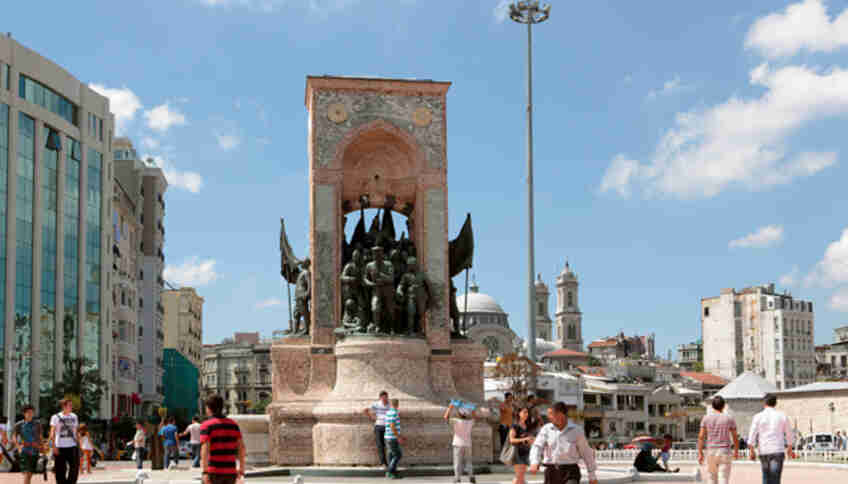
In the very heart of Taksim Square stands the 12-meter Cumhuriyet Anıtı – better known to tourists as the Republic Monument. It was erected after the end of the Turkish War of Independence based on the design of the Italian architect Pietro Canonica. As is easy to guess, the monument symbolizes the liberating army and, in fact, the establishment of the republic.
The monument is quite original: from a majestic stone arch in an eastern style, bronze figures “fly out” in both directions like arrows. On one side are soldiers, on the other, peaceful citizens. Both are led by the father of all Turks, Mustafa Kemal Ataturk. In addition to him, the monument also includes the figures of his associates — Mustafa Inonu, who succeeded Ataturk as president of Turkey, and Mustafa Cakmak, field marshal of the Turkish Republic.
It is curious that the sculptural group of the monument also includes figures of Soviet military and statesmen — Semyon Aralov and Kliment Voroshilov. Their placement in the composition of the monument became a sign of gratitude to Soviet Russia for its military assistance in 1920.

Flickr, Feras.Qadoura
The Taksim Art Gallery is located in the building of a former water pumping station, built back in 1732 under Sultan Mahmud I. You will easily find it on the southern side of Taksim Square, right at the beginning of Istiklal Street. This structure is a long reservoir building ending in a two-story octagonal tower with a conical roof and the inactive wall fountain Taksim Cesmesi.
At one time, this station was part of an old system supplying several districts of the city with water coming from the Belgrad Forest. After the thorough reconstruction of the interior of the structure completed in 2008, it was initially planned to open the Museum of the Republic here. However, the decision was reconsidered, and premises with a total area of about 1000 square meters were given over to the exhibition halls of the art gallery.
Now this museum, operating under the auspices of the Istanbul Municipality, hosts various themed exhibitions.