
The easiest way to explore London's sights is by downloading the free Ever.Travel mobile app. Inside, you'll find the guide below as well as a map with the route marked out for a self-guided walk. So in the text that follows we won't explain how to get from one stop to the next – everything is within walking distance and easy to find with the map in our mobile app. Let's begin!

Flickr, life_moments
A magnificent panorama of one of the world's most beautiful cities opens up from the third-largest Ferris wheel on the planet. The London Eye, which became one of the symbols of the British capital in the new millennium, was built to celebrate the arrival of the Millennium and at the time was the tallest attraction of its kind.
At the very top you'll be 135 metres above the ground – about the height of a 45-storey building. London unfolds before you like the palm of your hand, and on a clear day you can even see the outskirts of the capital. And what a thrill it is to look down on the majestic Palace of Westminster, the bridge of the same name, and Big Ben right beneath your feet!
You can admire all of old London, with its elegant architecture and world-famous buildings, through the transparent walls of the capsules. By the way, the number of capsules on the London Eye is symbolic – there are 32, matching the number of boroughs in the capital.
The capsules are sleek transparent pods, each holding about 25 passengers, and as many as 800 people can ride the wheel at once. One full rotation of the London Eye takes 30 minutes, giving you magical views of the vast city from ever-changing heights. The wheel moves quite slowly, so you'll have plenty of time to take everything in.
What else should you see in London? Our interactive attractions map will help. Mark the places you'd like to visit and build your walking routes! How? It's very easy!

Flickr, renegade1488
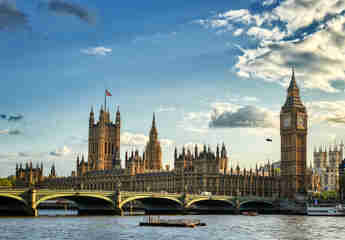
The largest and oldest of London's bridges connects Westminster and Lambeth, and it forms the route from the London Eye to Big Ben. The bridge blends harmoniously into the architectural ensemble of one of the capital's grandest landmarks and London's calling card – the Palace of Westminster.
The first bridge on this site appeared in 1750 and became the second bridge across the Thames within the city. Ferrymen and city authorities protested its construction for years: the former lost income from river crossings, while the latter could no longer charge people to cross the river as they had when London had only one bridge. Ordinary Londoners, however, were genuinely delighted to see another bridge appear in the city.
The first Westminster Bridge was stone and had many more arches. The current iron bridge with seven arches was designed by Thomas Page and built in 1862. Its design matches the palace rebuilt after the fire – in the same Gothic style and with details approved by the architect of the Palace of Westminster.
The elegant light-green color was chosen deliberately: it echoes the upholstery of the House of Commons, which meets in the palace. Lambeth Bridge upstream, incidentally, is painted red – the color of the benches in the House of Lords.
Westminster Bridge offers beautiful views of the Thames, London's palaces and its cathedrals. The surrounding panorama inspired Wordsworth to write sonnets, and the creators of "Doctor Who" and "Monty Python" used these locations for filming.
Everything you need to know before a trip to London – tips for independent travelers

Flickr, lfeng1014
The famous clock tower of the Palace of Westminster is the first image that comes to mind when London is mentioned. First Big Ben, and only then the red double-deckers and black cabs, Tower Bridge, and guards in their amusing hats.
For a century and a half this tower has remained an enduring symbol of the British capital, an embodiment of everything English: elegance, precision, refinement and style. And the clock itself feels like the beginning of all time on Earth, because it keeps Greenwich time exactly. New Year on our planet begins with the chimes of Big Ben.
Interesting fact: the clock has kept remarkably accurate time since 1859, with an error of only fractions of a second per day. The mechanism weighs about five tons, and its pace is adjusted with a one-penny coin. Place the coin on the pendulum and the clock runs 0.4 seconds faster; remove it and the clock slows down. This method was discovered quite by accident by the clock keeper after an aerial bomb damaged the mechanism during World War II.
The origin of the tower's familiar name, which also houses the country's second-largest bell, is still debated. Some say Big Ben was the nickname of the contractor who built the tower. Supposedly the 13.8-ton bell was named after him, and in turn it gave its unofficial name to the tower and the clock. Another version says the bell was nicknamed after the boxer Ben Caunt.
The official name – Elizabeth Tower – was given to Big Ben in 2012 to mark the 60th anniversary of the Queen's reign.
London attractions – the top 10 most interesting places

Flickr, \ Ryan
The Palace of Westminster rises above the waters of the Thames. Its incredible beauty combined with its grand scale makes it the most famous and recognizable palace in the United Kingdom, and perhaps in the world. It is like a symphony in stone – monumental and yet refined.
The palace's neo-Gothic forms are beautiful even from afar, and up close you realize that it is covered in stone lace made up of hundreds of slender turrets, carved ornaments, arched windows and stained glass.
The story began a thousand years ago, when a castle for Edward the Confessor was built here on reclaimed marshland. In 1097 Westminster Hall was built – a hall of gigantic size unique for the Middle Ages. The first meeting of the English Parliament was held there in 1265, although until the 16th century lawmakers met sometimes in the chapel and sometimes in other halls, while the palace remained a royal residence. In 1529 the building was handed over to the legislature, and to this day the fate of Great Britain is decided here in the House of Lords and the House of Commons.
The Palace of Westminster survived plenty of destruction, fires and even bombings. Its present appearance took shape after a devastating fire in 1835, when only the hall, chapel and a few other buildings survived. The new palace, with 1,200 rooms, five kilometers of corridors and more than a hundred staircases, was designed by architect Charles Barry.
See also these other London guides:

Flickr, Mallady
Across the road from the Palace of Westminster stands the nearly 700-year-old Jewel Tower. Despite its name, you won't see any jewels here today. Now it is a place where visitors learn about the history of Parliament and its buildings. The valuable treasures themselves have been kept in the Tower of London for centuries.
This tower was built in 1365 as a storage place for the personal belongings of King Edward III. At times it was even called the King's Privy Wardrobe. But since gemstones made up the bulk of the monarch's wealth, the name Jewel Tower stuck.
After the London fire of 1834, when almost all of the Palace of Westminster was destroyed, the tower remained unharmed. Although this building was part of the fortress wall, it stood away from the palace complex – in the corner of the royal garden – and was protected by high walls and a moat.
Since then and to this day, the Jewel Tower has been remarkably well preserved and is certainly worth a visit, at least out of respect for and curiosity about the age of this building.
By the way, have you already decided where to stay in London? If not, our travel expert Anatoly Selyaninov is ready to suggest a couple of good options ;) But of course, you'll find the widest choice of hotels on Booking.com!

plus.google.com, almonkey
St. Peter's Collegiate Church, better known as Westminster Abbey, is not just one of Europe's oldest and most beautiful churches – it is the quintessence of British history and culture, a shrine, museum and mausoleum in a single building.
The abbey's history began in 960 with a community of Benedictine monks, and the magnificent building was constructed from 1245 to 1745. Since 1308 every monarch of Great Britain has been crowned here, and on the same throne each time. Members of the royal family often marry here too; the most recent high-profile wedding was that of Prince William and Kate Middleton.
British monarchs and people who made a significant contribution to the country's history and culture find eternal rest within the abbey's walls. The church's necropolis includes more than 3,300 burials, among them Winston Churchill and Lady Diana. In Poets' Corner lie Shakespeare, Byron, Wilde, Dickens, Newton and Darwin. Memorial plaques and monuments are everywhere inside the church, and outside there is a relief with statues of 20th-century martyrs. The relics of this unique place could be listed endlessly, but it is better to see it once for yourself.
Even if history is not your thing, Westminster Abbey is still worth visiting because it is breathtakingly beautiful from the tips of its Gothic towers to its carved stone walls. The interior is a true treasure house of art, created by some of the finest painters, artists and sculptors.
By the way, many people put off a trip to the UK because they think getting a visa is difficult. In fact, it's quite straightforward. But if you're not confident or simply don't want to deal with the bureaucracy, use the VisaToHome service. Their specialists will handle everything for you, so you won't even need to leave home to get your visa!

Flickr, pomphorhynchus
Number 10 Downing Street is London's most famous address – home to every sitting Prime Minister of the United Kingdom, who also serves as First Lord of the Treasury.
This house became the official residence of prime ministers in 1905, although it was built back in 1730. Three adjacent properties were combined for the residence of the First Lord of the Treasury, the largest of them being Number 10.
At first the keepers of Whitehall Palace lived here, then members of the royal family, and only in the 17th century was the building handed over to the Treasury, after which statesmen began living here.
The famous house has about 100 rooms, including living quarters, offices and reception rooms. Here the Prime Minister holds official meetings with leaders of other states, and this is where his office works.
You can only go inside the residence if you work there or belong to a diplomatic mission – it is not open for tours. Still, you can admire the black oak front door, perhaps the most recognizable door in the world, with hundreds of top-level meetings and handshakes captured against it.
The Chief Mouser to the Cabinet Office also lives at 10 Downing Street – the title held by the cats who live in the Prime Minister's residence. They are kept at public expense and expected to take their duties seriously: in 2012, for example, the cat Larry was reportedly disgraced for catching only one mouse during his time in office.
That brings our story about London's attractions to an end. Let us remind you that instead of walking around with printouts, it's better to load this guide into the free Ever.Travel mobile app. Never planned a trip this way before? Take a look at our overview – it's incredibly convenient, easy and free!