
You will find this small sculpture in Tallinn's Old Town, at the intersection of Lai and Nunne streets. Not far from here begins the ascent from the Lower Town to the Upper Town, and the location of the monument exactly here is no accident.
When the crusaders came to these lands at the beginning of the 13th century, their leader, King Valdemar II, settled in the fortress built on the hill where Toompea now stands. At that time, far from all of this hill had been built up; on one of its slopes there was the most ordinary forest. It was precisely there that Valdemar II liked to go hunting.
And then one day, the king saw a beautiful roe deer among the trees and ordered his retinue to catch it alive so that he could place it in his personal zoo. However, the animal did not wish to submit to captivity, and when it was driven to the edge of the hill, it threw itself down the cliff. “Reh fall!” was all Valdemar II exclaimed, which translated from Low German means “the roe deer fell.” But the Estonians wandering nearby did not know the language of the foreigners and thought that “reh fall” must be the name of this place. Later, the designation transformed into “Reval,” the former name of Tallinn. However, the sculpture of the roe deer, installed at the foot of the Upper Town, still reminds us of the origins of the Estonian capital's original name.
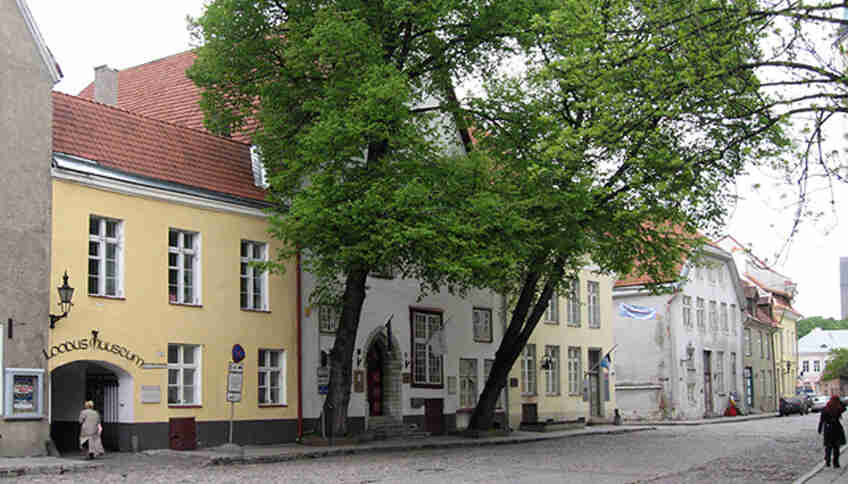
While walking through Tallinn's Old Town, you will surely notice that there are practically no trees to be found here. This is explained by a ban dating back to 1443—in those days fires in Reval were not uncommon, and dry leaves only contributed to their outbreak and spread. Small wooden houses standing close together flared up one after another like matches. Therefore, a decision was made: to avoid fires, no trees were to be planted within the fortress walls.
The only exception was two lindens, which you can find next to one of the houses on Lai Street. The mansion beside which they stand once belonged to Burgomaster Johann Huk, a close friend of Peter I. They say that the great sovereign often dropped by Huk's place for a cup of tea or coffee during his visits to Estonia. And once his arrival happened to fall on a hot day: the friends were drinking tea on the terrace near the house, and the tsar complained that the sun was beating down far too strongly—why, he wondered, was there not a single tree nearby that could provide shade? To this Burgomaster Huk complained about the old ban, but what bans could there be for the Russian emperor? Peter I granted Huk special privileges and personally allowed—no, even ordered—two lindens to be planted by the house!
Years passed, the trees were already dying of old age, however, in memory of that unusual royal gift it was decided to plant new lindens in their place, and they still give shade today to everyone strolling along Lai Street.
Learn 10 times more fascinating stories about the city's sights by downloading the Tallinn audio guide!
St. Olaf's Church

Flickr, cbrutel
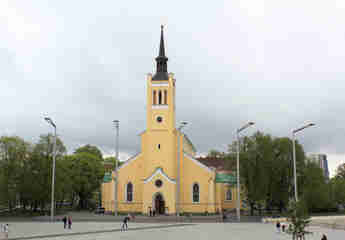
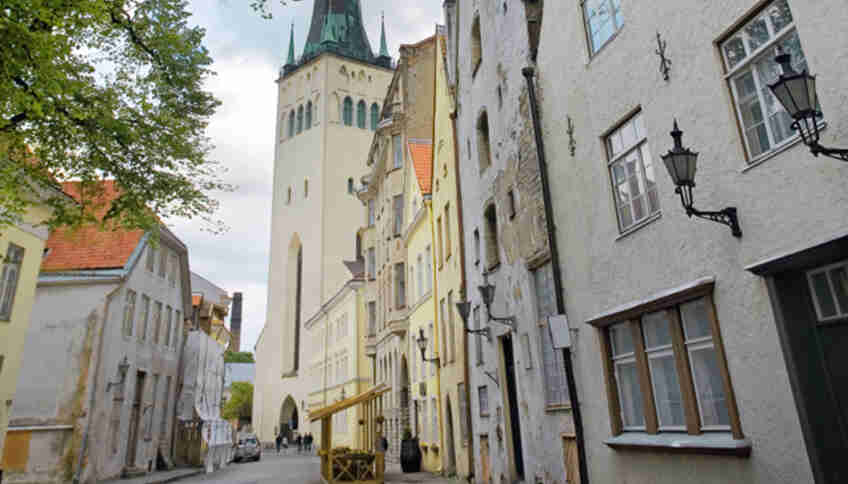
St. Olaf's Church, Oleviste Church (Est. Oleviste kirik), is a Baptist church located in Tallinn, on the site where in the 12th century there was a trading yard of Scandinavian merchants. The earliest mentions of the church date back to 1267. In the 15th century the church was heavily rebuilt: new choir sections were constructed, and the longitudinal part was turned into a basilica with four-sided pillars. The vaults of the main nave became star-shaped, and the side ones cross-vaulted. There is a tall window on the western facade of the tower. In 1513—1523 the Chapel of the Virgin Mary was added. The unification of the eight evangelical churches of the city of Tallinn into Oleviste Church in September 1950 was one of the most significant events in the life of the Estonian brotherhood. Oleviste Church was named after the Norwegian king Olaf Haraldsson (995—1030), later declared a saint. The first information about Oleviste Church dates back to 1267. At first the building was constructed for the Catholic Church; after the Reformation the church became Lutheran.
“The Three Sisters” Hotel

Flickr, Kaoloon
“The Three Sisters” (Est. Kolm Õde) is a 14th-century architectural ensemble in the historic center of Tallinn, now an upscale hotel. It is located in Tallinn's Old Town, at Pikk Street 71/ Tolli 2, 10133 Tallinn, Estonia (Pikk 71/Tolli 2, Tallinn 10133, Еstonia). The complex is situated near the former artillery tower Fat Margaret and Oleviste Church. Pikk Street, on which “The Three Sisters” stand, was one of the main streets of medieval Reval (now Tallinn). It was paved in the 15th century during Tallinn's economic and cultural flourishing as part of the Hanseatic League, and there was brisk trade in fish, grain, salt, meat, and spices. The first mention of the three houses on Pikk Street dates back to 1362, and since then the names of all the owners have been known; they were the most distinguished townspeople: wealthy merchants, elders of merchant guilds, city councillors, and burgomasters. The exterior has largely been preserved since the 15th century, although the interiors have been reconstructed more than once.
Fat Margaret Tower

Flickr, LeoKoolhoven
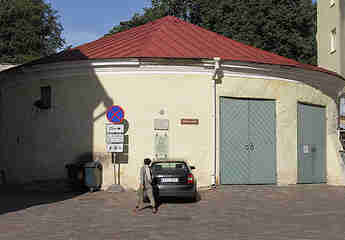
Fat Margaret (Est. Paks Margareeta) is a tower of the Tallinn city wall, located at the end of Pikk Street. The artillery tower with 155 loopholes was built at the beginning of the 16th century in front of the Great Coastal Gate. It received its name because of its impressive size—25 meters in diameter and 20 meters in height. The tower received its current name in 1842, and before that it was simply called the New Tower. From 1830 the tower began to be used as a prison. An annex was added in 1884—1885 (the first building in Tallinn originally intended for a prison). In March 1917 the tower was burned down. In 1930 a History Museum was set up in the empty tower. At present the tower has been rebuilt, restored, and houses the Estonian Maritime Museum.