
Flickr, oxfordblues84
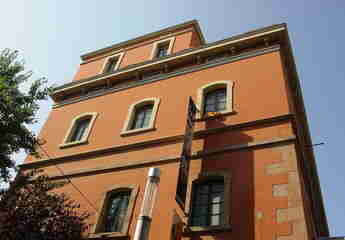
We suggest starting on La Rambla, where the mansion Antonio Gaudi built in 1885-90 especially for his patron and friend Eusebi Guell stands.
If you picture the famous Casa Mila or Casa Batllo, it may be hard to recognize Gaudi's hand in Guell Palace. But step back a little and look up – on the roof you will see chimneys disguised as colorful turrets, and everything becomes clear – this is unmistakably Gaudi. Guell Palace was simply one of his earliest works, when the architect was only beginning to shape his distinctive style.
The mansion's main facade looks truly regal and strongly recalls Venetian palazzi. Two large arches with delicate wrought-iron grilles served as gates for horse-drawn carriages. Guests stepped out inside the building and then climbed upstairs by way of the beautiful staircases.
Among the wrought-iron patterns decorating the arches, you can even spot the patron's initials, “E” and “G”. In the middle stands a two-meter iron lantern adorned with the striped coat of arms of Catalonia and topped with a forged helmet crowned by an eagle with outstretched wings. With this symbol, Gaudi emphasized his patriotism, as he grew up in a region that was desperately trying to defend its independence from Spain at the time. In truth, not much has changed since then – strikes in the streets of Barcelona are still a common sight ;)
Please note that you can do more than just read or print this article – you can also find it in the free Ever.Travel mobile app. It is much more convenient: while walking around the city, you can check an offline map and read descriptions right on your smartphone. No more printouts or paper maps. Everything you need fits in your phone and takes up no extra room in your luggage. Look for the “Barcelona – Antonio Gaudi” tour in the Ever.Travel trip planner.
One more tip: we also have an audio guide for one of the city's most popular promenades – La Rambla. It will tell you much more about Guell Palace and many other sights, including the medieval Boqueria market, the Liceu opera house, one of the best in the world, the grand Christopher Columbus monument, and more. Download the Barcelona audio guide in the Ever.Travel mobile app.

Flickr, blythe me, blythe me not
Now we raise the bar ;) Walk up La Rambla to Plaça de Catalunya, then continue to Carrer de Casp. There you will find another, less flashy work by Antonio Gaudi in Barcelona – though in 1900 it was named the city's best building.
By then already famous, the architect built it for the widow of the late industrialist Pere Calvet. Together with her sons, she wanted a house where the ground floor could be used for shops or offices, the second floor would be reserved for the family itself, and the upper levels would be rented out to tenants.
And that is exactly what happened: the architect took all their wishes into account, paying special attention to the principal floor, where the Calvet family lived. Gaudi personally designed the patterns for the floors, ceilings, and even the wallpaper. He also created furniture that would fit the interior perfectly. Today it is kept in the museum at Park Guell.
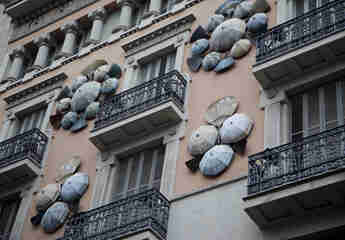
In the facade, Antonio Gaudi used Baroque elements he had already tested before, along with plant motifs and various symbolic details. For example, in the decoration of the main-floor bay window you can spot mushroom caps, hinting at the owners' favorite hobby, as well as a cypress whose trunk rests against the letter “C,” the first letter of the family name “Calvet.”
The most observant visitors will also notice a cornucopia and an olive tree, unusual knockers on the entrance doors, and columns that resemble stacked spools – a symbol of the textile business in which the Calvet family was engaged.
If this is your first time on our site, here is something worth knowing: Ever.Travel is not just a place to read about interesting destinations around the world – it is a full-fledged trip planner. You can map out your future journey using the Barcelona attractions map. It is easy to mark the places you want to see and then sync the plan with the Ever.Travel mobile app. That way you get a personal guide to Barcelona, available to download completely free.

lolapi.ru, Lola Pidluskaya
From Casa Calvet, head toward Passeig de Gràcia. Here, at last, begin the landmarks that even people who have never been to Spain have probably seen at least once in their lives.
Casa Batllo is one of the jewels in the architectural “necklace” adorning vibrant, irresistible Barcelona. Yet Antonio Gaudi originally took on the reconstruction of a house that had nothing remarkable about it. He completely redesigned the outer and inner facades, added an attic and a basement level, transformed the interior, designed the furniture and staircase himself, and carefully thought through the natural lighting and ventilation system.
Today Casa Batllo is considered a monument of national importance and is included on the UNESCO World Heritage List. Read more about this remarkable building in a separate article.
What is fascinating is how many extraordinary buildings surround Casa Batllo: Casa Amatller and Casa Lleo Morera among them. Together they form the so-called “Block of Discord” – a small corner where buildings of strikingly different architectural styles stand side by side. Then again, anyone who has spent time in modern megacities such as Moscow, Tokyo, or New York will know that such “blocks of discord” seem to appear on nearly every corner =))
See also these other Barcelona guides:

TravelMe, Alina Kovalevich
Just a five-minute walk away lies another of Antonio Gaudi's masterpieces in Barcelona. Casa Mila is unique not only for its outward appearance, but also for the engineering solutions that were highly innovative for the time. As in all his works, Gaudi thought through every detail here: natural ventilation that still allows the building to do without air conditioning in the summer heat; movable interior partitions that let owners change the layout whenever they wish; an underground floor, though cars were still rare at the time; and elevators, which were installed a little later. This house also has no load-bearing walls at all – instead, the “wizard” Gaudi used supporting columns. And there are countless artistic touches and decorative discoveries besides. Read more here.
Everything you need to know before a trip to Barcelona – helpful tips for independent travelers.

photo.lolapi.ru, Lola Pidluskaya
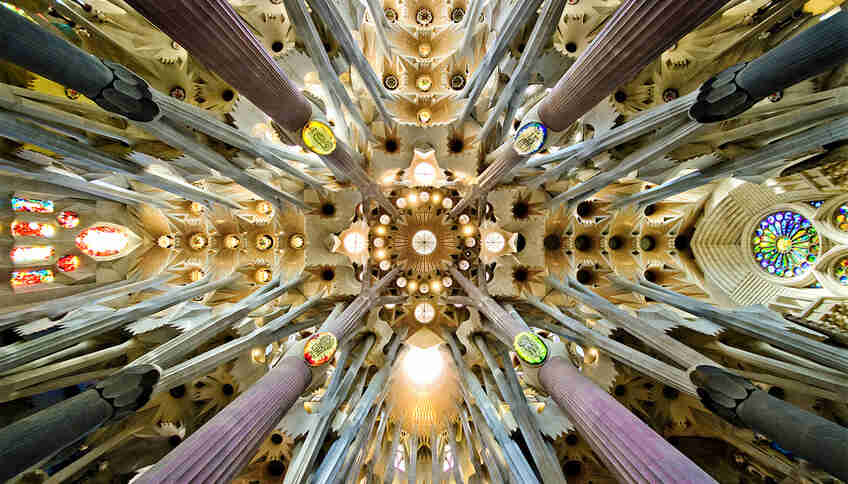
Walking from Casa Mila along Carrer de Provença, you will arrive at the legendary Sagrada Familia, rightly considered one of Barcelona's main attractions and, at the same time, one of the world's most famous long-running construction projects. It has been under construction for more than 130 years.
The first stone was laid by the architect Francisco de Villar in 1882, but just a year later Antonio Gaudi took over the project. The famous Catalan master drastically reworked the original design, giving it a distinctive style that no one has been able to replicate to this day. He devoted more than 40 years of his life to this temple, but never managed to complete it. Construction continues even now, funded entirely by charitable donations, which is probably why it has taken so long. Of course, it is impossible to do Sagrada Familia justice in just a couple of paragraphs, so we recommend reading the separate article about this landmark.
As a rule, the lines at Sagrada Familia are enormous, and you can easily spend several hours waiting. We strongly recommend buying tickets in advance.
And one more thing, just between us and the readers of Ever.Travel ;) Take the “Sagrada Familia through the service entrance” tour. You will get to meet the architects currently working on the legendary temple and even climb up onto the scaffolding. Most tourists would not dare dream of that.

Shutterstock
It is definitely worth setting aside a separate day for Park Guell. It is large, beautiful, and not the kind of place you want to rush through.
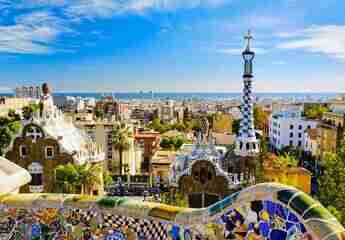
It is hard to imagine that all this splendor was once meant to become a private residential development. Yet that was exactly what the Catalan patron Eusebi Guell had in mind when he invited his friend, by then already a celebrated architect, Antonio Gaudi, to join the project.
But fate had other plans: because of the rocky terrain and the distance from the city, buyers showed no interest in the future villas. Only two houses were sold. The rest of the area was filled with gardens, columns, beautiful sculptures, porticoes, and much more.
Today, however, thousands of travelers come here to see with their own eyes the famous serpent bench, the salamander, and the two enchanting little houses at the park entrance created by the extraordinary master Antonio Gaudi. Read more about Park Guell…

Flickr, Magic Ketchup
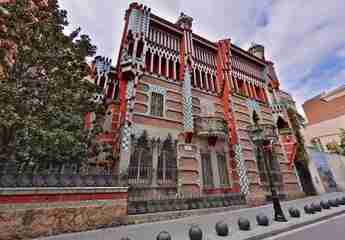
Casa Vicens can without exaggeration be called the brightest landmark in Barcelona's Gracia district. It used to be a small town made up mostly of factories and workshops, but in 1897 it became part of the Catalan capital. This beautiful house appeared a little earlier, commissioned by one of the district's most successful manufacturers – Manuel Vicens.
Look closely at the building's design and try to guess what Senor Vicens did for a living. Exactly – he produced bricks and ceramic tiles. That is why the house is so richly decorated with all kinds of tiles and vivid ceramic ornament. And the person who created all this beauty was none other than Antonio Gaudi – the world-famous Spanish architect. Casa Vicens became his first major commission after graduation, yet even here you can already sense a fresh and highly unusual Art Nouveau style for its time.
The construction of Casa Vicens lasted five years. In 1888, the Vicens family's summer residence was finally complete. Beside the house, Gaudi planned a garden, a rotunda, and even a fountain; he personally designed the gate grilles, balconies, windows, and the interior decoration of the rooms.
After the 1925 reconstruction, the garden, fountain, and rotunda were lost, but the exterior of the building did not change at all. Today any passerby can admire it, though entry inside is allowed only once a year, on May 22, the feast day of Saint Rita.
That brings our Barcelona – Antonio Gaudi tour to an end. But the city still has plenty more to offer. Explore the interactive attractions map, plan your trip, use the Ever.Travel mobile guide, and make your journey even richer and more memorable.