
Flickr, dkmurphypr
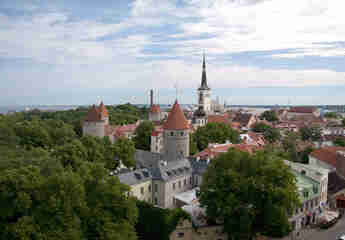
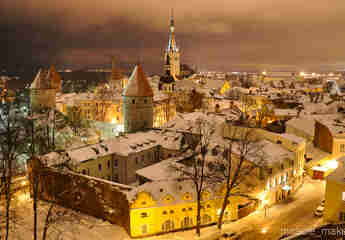
Despite the fact that the viewpoint on Kohtu Street is considered Tallinn's best viewing platform, the observation deck near the Patkuli stairs is no less popular with travelers. From here, a panorama of the mainly industrial part of the city opens up, but it would be hard to imagine a better view of St. Olaf's Church and the preserved fortress wall. Just count them - from here you can see 9 medieval towers at once!
If you look to the left, on the horizon you will be able to see the islands located at the entrance to Tallinn Bay in the Gulf of Finland. On the same side are the city's green districts, where wooden apartment buildings constructed in the 1920s and 1930s have still been preserved.
And if you turn around and walk a little deeper into the Upper Town, Stenbock House, built in the classical style and now serving as the residence of the Prime Minister of Estonia, will soon open before your eyes.
Learn more about these and many other city attractions by downloading the Tallinn audio guide!

Flickr, Laine Markus
The observation deck located on Kohtu Street, along with Tallinn's most popular landmarks, is one of the most visited places in the city. The view from here really is stunning!
So that you do not just idly "gaze" around, but also understand exactly what you are seeing before you, here is a small hint - let your eyes move from right to left, and you will see:
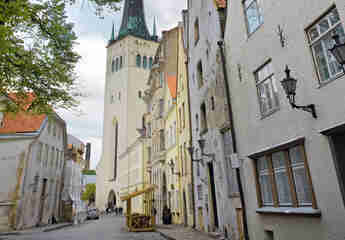
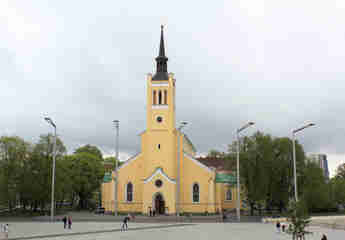
The tall spire of Niguliste - a former Lutheran church that today houses a museum and an organ concert hall. The tower of Tallinn Town Hall - to this day, a weather vane that townspeople nicknamed "Old Thomas" is fixed on top of the former city administration building. The Church of the Holy Spirit - one of Tallinn's oldest churches. St. Olaf's Church - from 1550 to 1625, at a height of 159 meters, it was the tallest building in the world! Today this church is 124 meters high, which, you must admit, is also quite a lot for the low-rise development of the Old Town. The Church of the Transfiguration - you will recognize it by its semicircular dome and baroque spire decorated with golden spheres.
St. Mary's Church

Flickr, blind.willow
Dome Cathedral is a Lutheran cathedral located in Tallinn's Old Town. It is dedicated to the Blessed Virgin Mary (Est. Püha Neitsi Maarja). Dome Cathedral is one of Tallinn's oldest churches. It acquired its present appearance after numerous reconstructions. Earlier, there was a wooden church on this site; according to historians, it was built in 1219. The cathedral tower belongs to the Baroque era, while its chapel annexes belong to later architectural styles. Inside the church are burials from the 13th-18th centuries, as well as various noble coats of arms and epitaphs dedicated to famous people of that era and dating from the 12th-20th centuries. The church was founded at the beginning of the 13th century and consecrated in 1240 as the cathedral of Northern Estonia. In the second half of the 13th century, the first reconstruction was carried out. In the 14th century, the building was rebuilt as a basilica. At the beginning of the 15th century, the vaulting of the naves was finally completed.
Alexander Nevsky Cathedral

Flickr, kpmst7
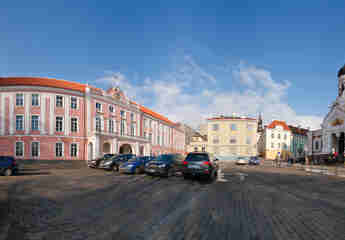
Alexander Nevsky Cathedral in Tallinn is a stauropegial Orthodox cathedral under the jurisdiction of the Estonian Orthodox Church of the Moscow Patriarchate (since May 1945). It is located in Tallinn, on Toompea (the Upper Town), popularly nicknamed the grave of Kalevipoeg. Construction was completed in 1900; the author of the project was architect M. T. Preobrazhensky. It was erected by 1900 in memory of the miraculous rescue of Emperor Alexander III in the railway catastrophe of October 17, 1888. Of the eight options proposed for building the cathedral, the square in front of the governor's palace (now the parliament building) proved to be the best place. On February 19, 1887, the Orthodox clergy of Reval submitted a memorandum to the Governor of Estonia, Prince Sergei Vladimirovich Shakhovskoy, explaining the need to build a new cathedral. The Synod recognized the construction of the new church as truly necessary and allocated 60 thousand rubles.
Parliament of Estonia

Flickr, Suomen Joutsen
Riigikogu (Est. Riigikogu, literally translated as "State Assembly"[3][4][5]) is the highest representative and legislative authority in the Republic of Estonia, which also elects the head of state and exercises control over the executive branch represented by the Government of the Republic. The Riigikogu consists of 101 deputies, who are elected for a 4-year term by citizens of Estonia who have reached the age of 18. Any citizen of Estonia who has reached the age of 21 may be a candidate for deputy. The main voting day is the first Sunday of March in the fourth year following the year of the previous elections. Electronic voting is held several days earlier. Elections are conducted according to a proportional system, although the vote-counting system has some majoritarian elements. For example, a candidate who receives a certain quota of votes in their district (the so-called
Long Hermann Tower

Flickr, blind.willow
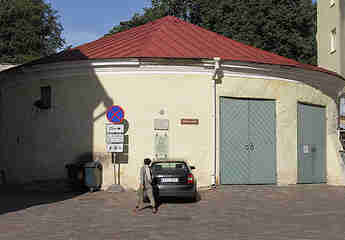
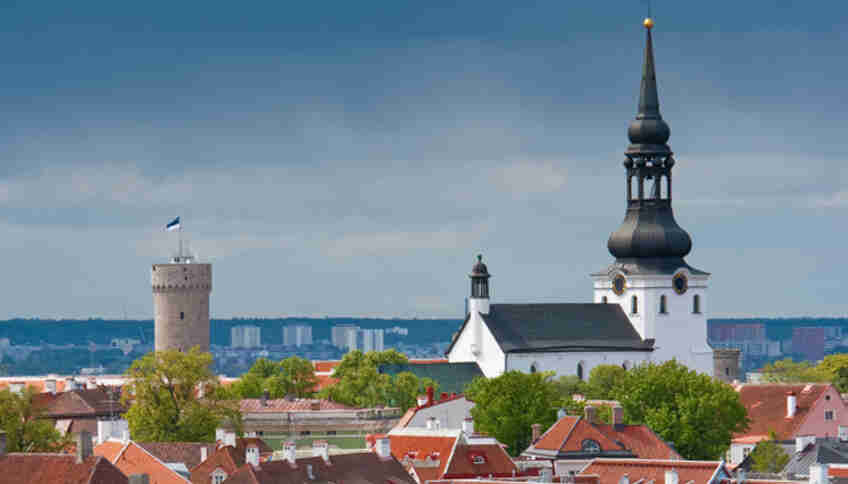
Long Hermann Tower is located next to the Estonian Parliament building, and the flag at the top of the tower at a height of 95 meters[1] above sea level is one of the symbols of Estonia. The national flag, measuring 191 cm by 300 cm, is raised simultaneously with the playing of the national anthem of Estonia at sunrise (but not earlier than 7 a.m.) and lowered at sunset (but not later than 10 p.m.). When it is lowered, you can hear the song "My Native Land, My Joy and Happiness."