

Flickr, Della Flor
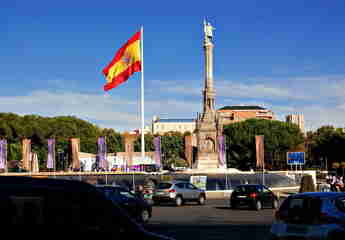
One of the most beautiful squares of the Spanish capital lies at the intersection of the famous Prado avenue, Alcala Street, and Recoletos Boulevard.
At the center of Plaza de Cibeles stands the Cibeles Fountain, made in the form of a marble sculpture of the ancient Greek goddess of fertility. The majestic Cybele, seated in a chariot drawn by two lions, is surrounded by jets of water shooting upward. The monument symbolizes Spain's striving for prosperity. It is no coincidence that Real Madrid players bathe in this fountain after major victories.
The ensemble of the square includes astonishingly beautiful buildings — the Communications Palace, Linares Palace, Buenavista Palace, and the Bank of Spain. The Communications Palace deserves a story of its own, but the other three buildings are worth mentioning at least briefly.
The place where the mansion of the Marquis of Linares stands today was once considered cursed. During the War of Independence, the French built a prison building here where captives languished and executions were carried out. Nowadays this is home to the cultural center Casa de America, or the 'House of America,' which serves to maintain Spain's cultural ties with Latin American countries.
Buenavista Palace, one of the oldest buildings on the square, was erected in 1777 as the family residence of the Duchess of Alba. Today it houses the Spanish Ministry of Defense. As for the Bank of Spain, rumors persist that a tunnel leading to the Cibeles Fountain runs from this building, where the country's gold reserves are stored!
In fact, this guide provides only a rather brief overview. You will learn much more interesting things by downloading the Madrid audio guide in the Ever.Travel mobile app.
Puerta del Sol

Flickr, multisanti
Puerta del Sol is the central square of the Spanish capital, one of Madrid's most famous sights. In ancient times, one of the entrances in the wall surrounding Madrid stood on this site. Medieval cities usually had one central square, but some open space was left along the city walls for defensive maneuvering. It was in such a space near the 'Gate of the Sun' that a square resembling an ordinary wide street gradually formed. The name of the square in Madrid is connected with the fact that the 'Sun Gate' once stood between Alcala Street and Carrera de San Jeronimo. The gate was built during the reign of Emperor Charles V at his command. Historians have not come to a consensus about the origin of the name of the gate itself (which gave the entire square its name).
Plaza Mayor

Flickr, dalbera
Plaza Mayor (Spanish: Plaza Mayor — 'Main Square') is one of the central squares of the Spanish capital. It is located in the area commonly called 'Austrian Madrid.' It competes with Puerta del Sol for the right to be called the main square of the Spanish capital, but unlike the democratic Puerta del Sol, Plaza Mayor is a status square, 'the navel of Spain,' as Lope de Vega said. The square in the Madrid Baroque style, one of the few monuments of the Habsburg era, was built from the design of the architect Juan Gomez de Mora. Originally, in the time of King Henry II of Castile and Leon, the square stood outside the city wall, just beyond the 'Guadalajara Gate,' where the two roads (now streets) of Toledo and Atocha met. Gradually it acquired the status of the most important market, and under Philip III it was substantially rebuilt. Throughout history, the name of the square changed repeatedly: from the 'Suburban Square' to the 'Main Square.'