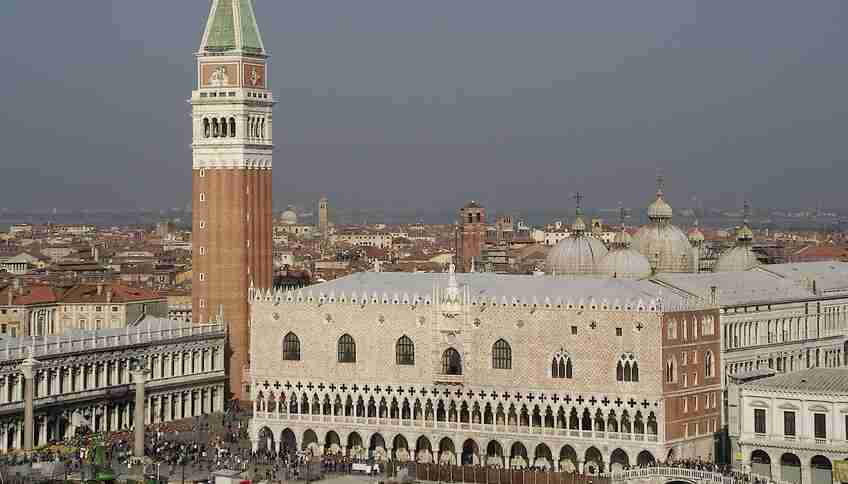
Piazza San Marco

Flickr, Scott Ingram
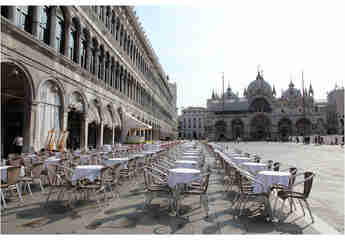
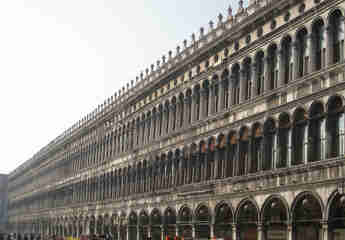
Piazza San Marco (Italian: Piazza San Marco), or St. Mark's Square, is the main city square of Venice, Italy. Logically, it consists of two parts: the Piazzetta - the area from the Grand Canal to the bell tower, and the Piazza itself (the square). The square took shape in the IX century as a small space in front of St. Mark's Basilica. In 1777 it was expanded to its present size.
You can learn a detailed and very interesting story about Piazza San Marco and all its sights, by downloading the Venice audio guide in the Ever.Travel mobile app.
Campanile

Flickr, minoir
The Campanile of St. Mark's Basilica (Italian: Campanile di San Marco) is the bell tower of St. Mark's Basilica in Venice. It is located on Piazza San Marco. A clock tower was first built on this site in the VIII century. In its current form, the bell tower was built in 1514. The tower served as a watchtower and a lighthouse for ships entering the lagoon. The tower, almost 100 meters high, consisted of: The tower is crowned with a pyramidal spire with a weather vane in the form of a golden angel, which was installed at the beginning of the XVI century. Next to the bell tower is the loggetta, which housed the guards of the Doge's Palace. The loggetta was built by Jacopo Sansovino. On 14 July 1902, the bell tower completely collapsed. The causes of the collapse were earthquakes, lightning strikes, and the general wear of the structure. When the tower fell, it also destroyed the loggetta and the nearest corner of the Doge's Palace. When the tower collapsed, not a single person was hurt; only the caretaker's cat disappeared.
St. Mark's Basilica

Flickr, l plater
St. Mark's Basilica (Italian: Basilica di San Marco - "Basilica of San Marco") is the cathedral of Venice (until 1807, the court chapel at the Doge's Palace), representing a rare example of Byzantine architecture in Western Europe. It is located on St. Mark's Square, next to the Doge's Palace. The cathedral, decorated with numerous mosaics executed in the Byzantine style, is home to the relics of the Apostle Mark and many valuable works of art brought from Constantinople during the Crusades. In 1987, the cathedral, along with other Venetian monuments, was included in the UNESCO World Heritage List. The basilica was built to house the relics of the Apostle Mark, which were brought from Alexandria to Venice on 31 January 829. The relics were brought by the Venetian merchants Buono and Rustico, who, upon arriving in Alexandria in 828, learned that Muslims had begun destroying Christian churches to build mosques.
Doge's Palace

Flickr, D200-PAUL
Doge's Palace (Italian: Palazzo Ducale) in Venice is a great monument of Italian Gothic architecture, one of the city's main attractions. It is located on St. Mark's Square next to the basilica of the same name. Although the first structure on this site stood as early as the IX century, construction of the present building was carried out between 1309 and 1424, presumably by the architect Filippo Calendario. In 1577, part of the palace was destroyed by fire, and the restoration of the building was undertaken by Antonio de Ponti, the creator of the Rialto Bridge. This main building of Venice was, first and foremost, the residence of the doges of the republic. The Great Council and the Senate met in the palace, the Supreme Court worked there, and the secret police conducted their affairs. On the ground floor there were also lawyers' offices, the chancellery, the censors' services, and the maritime department. The balcony built above served as a kind of ceremonial tribune from which the doge presented himself to the people.
Columns of St. Mark and St. Theodore

Flickr, adrian.haisan
Columns of St. Mark and St. Theodore (Italian: Colonne di San Marco e San Todaro) are two granite columns installed in Venice, standing on the Piazzetta - a small square adjoining Piazza San Marco and opening onto the San Marco Canal[1]. In 1099, Venice provided military assistance to Constantinople by sending the Venetian fleet to the war against the king of Tyre, and the allies won a brilliant victory. As war trophies, among other things, Venice received three huge monolithic granite columns. These columns were delivered by sea to Venice in 1125. During unloading, one of the three columns fell into the sea, sank, and was lost because it sank into the silty bottom of the lagoon. Despite numerous attempts, this column has still not been found. The other two columns were successfully moved ashore, but remained there until 1196, because no one undertook to erect them - each of the columns weighed about one hundred tons. Finally, the engineer and architect Niccolo Barattieri undertook the installation of the columns.