Plaça de Catalunya

kugarov.ru, Ivan Ganin
Plaça de Catalunya (Catalan: Plaça de Catalunya) is a square located in the central part of Barcelona (Catalonia). It covers more than 50 000 m2.
La Rambla

Flickr, monkichichan
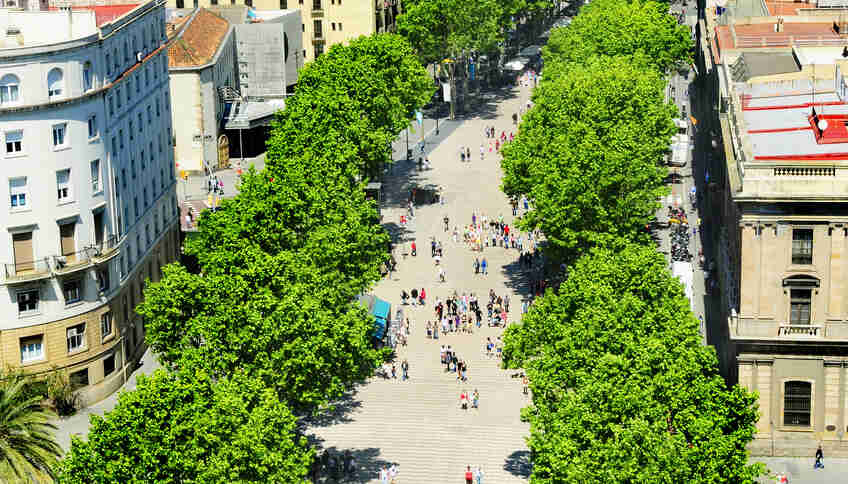
La Rambla (Las Ramblas) (Catalan: Rambles) is a pedestrian street in central Barcelona. It forms the boundary between the Gothic Quarter and El Raval. It runs from Plaça de Catalunya to Plaça del Portal de la Pau. Its length is 1,2 km[1]. La Rambla actually consists of 5 separate boulevards flowing into one another: Rambla de Canaletes, Rambla dels Estudis, Rambla de les Flors, Rambla dels Caputxins, and Rambla de Santa Mònica. Sometimes the so-called Maritime Rambla is also considered part of La Rambla. The 'Canaletes' boulevard (Catalan: Canaletes) is located next to Plaça de Catalunya. It got its name from a 19th-century cast-iron drinking fountain. This fountain is popular with tourists, because a small plaque on it says that 'anyone who drinks water from this fountain will fall in love with Barcelona and will return here again.' In addition, this fountain is the gathering place for fans of FC Barcelona.

TravelMe, Alina Kovalevich
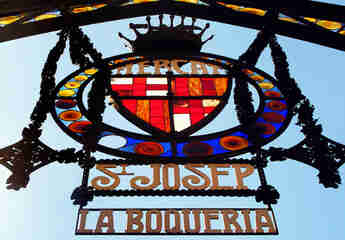
Boqueria Market (Catalan: Mercat de la Boqueria), also known as Sant Josep (Catalan: Sant Josep), is a city market in Barcelona (Spain) with an entrance from Las Ramblas. The market building occupies an area of 2583 m² and is constructed of glass and steel, and is also decorated with mosaics. The first mentions of the market date back to 1217, when tables for selling meat were set up not far from the former Boqueria city gate. From December 1470, pigs were sold here. Back then, the market was outside the city gates, so other traders could also sell their goods. At that time the market was called Mercat Bornet or (until 1794) Mercat de la Palla ('straw market'). The open market square was initially surrounded by columns and was supposed to be built up, but the market had no official status and was considered merely an extension of the market on Plaça Nova, stretching as far as Plaça del Pi.
Learn even more interesting things about Boqueria Market, Liceu Theatre, Palau Güell, and many other attractions of La Rambla by downloading the Barcelona audio guide!

TravelMe, Alina Kovalevich
Football fans will surely immediately think that this is the house of the footballer of the same name, but that is not the case. Bruno Cuadros was the owner of the shop that was once located in this building. Judging by its original decor, it is easy to guess that it was an umbrella shop.
They say that after returning from a trip to Asia, Bruno was so impressed by Eastern culture that he asked architect Josep Vilaseca to transform the building. Thus, at the end of the 19th century, the most ordinary house on La Rambla changed beyond recognition.
Since then and to this day, its facade has been adorned with colorful umbrellas, Asian fans, and even a wrought-iron dragon figure on the corner. In the windows of the house, you can make out characters from Japanese prints. And the design of the balconies shows Egyptian motifs.
In 1980, the former Casa Bruno Cuadros was restored; today it houses a bank branch. Its interior is very ordinary, so you can quite reasonably limit yourself to admiring the exterior beauty of this amazing house.

panoramio, GEORGINA
Despite the rather modest facade of the theatre building, the Liceu is rightly considered one of the best opera stages not only in Spain, but in the whole world! So many world stars have performed here: Placido Domingo, Montserrat Caballe, Jose Carreras, Alfredo Kraus, Fyodor Chaliapin, Maxim Mikhailov... However, the history of the Liceu has not always been as brilliant as its fame.
Originally, the building of this theatre was constructed with patrons' money back in 1847. It was erected on the site of a ruined monastery, and it is believed that this repeatedly turned out most sadly for the theatre.
In 1893, all of Spain was shaken by the terrorist attack that occurred at the Liceu. Right during the performance, 20 people were killed by the explosion of a bomb planted by an unknown person. The hall was, of course, repaired, but for a long time no one wanted to take those 20 seats...
In addition, over a century and a half the theatre building burned many times and was rebuilt again, but the most terrible fire, which burned everything to the ground, happened not so long ago - in 1994. In the literal sense, only a charred shell remained of the Liceu. This event caused worldwide resonance and, fortunately, the funds to restore the theatre were raised quite quickly.
To appreciate all the grandeur of this place, be sure to step inside - for a tour of the theatre, but even better, for an opera. Only then will you be able to see the Liceu's luxurious painted ceilings, magnificent crystal chandeliers, marble staircases, snow-white columns adorned with golden patterns, and cozy boxes with crimson velvet seats...

Flickr, Inquietos Blog
L'Opera is one of the oldest establishments in Barcelona. The cafe opened back in 1920, but its interior remains unchanged to this day. The same simple lacquered wooden tables, wall panels and mirrors in elegant frames, waiters dressed in black and white, antique cabinets displaying various curious drinks are all still here. Cafes like this have their own inimitable atmosphere, which is loved not only by locals, but also by visitors.
Cafe de l'Opera is located not far from the Liceu Theatre, so in earlier times it was mainly the aristocracy who gathered here. People came to have a cup of coffee before a performance or, conversely, discussed the theatre productions they had just seen over a glass of something stronger. Over the cafe's almost century-long history, many stars, artists, and politicians have been here; even King Alfonso III himself visited! Remarkably, the establishment never closed, not even during the Civil War.
As soon as you take the menu in hand, you can immediately tell that the selection of spirits here is simply enormous. From time to time, the cafe holds tastings of strong alcohol. It is even added to coffee here. Seasoned travelers recommend trying carajillo - a coffee drink with rum, whiskey, or brandy added (your choice).
In addition, the cafe sells chocolates with its signature symbols, which you can later give to friends as sweet souvenirs.

FLICKR, OXFORDBLUES84
If you can picture the famous Casa Mila or Casa Batllo, it may be difficult to recognize Gaudi's hand in Palau Güell. However, step a little farther back and lift your head - you will see chimney stacks on the roof disguised as colorful turrets, and everything will immediately become clear - this really is Gaudi! Palau Güell was simply one of his earliest works, in which the architect was only beginning to develop his unique style.
The main facade of the mansion truly looks regal; it strongly resembles Venetian palazzi. Two large arches with delicate wrought-iron grilles served as gates for the entry of horse-drawn carriages. Guests arriving in them stepped out already inside the building and climbed upstairs by beautiful staircases.
By the way, among the wrought-iron patterns decorating the arches, you can make out the patron's initials 'E' and 'G'. And in the middle stands a two-meter iron lantern decorated with the striped coat of arms of Catalonia, crowned by a wrought-iron helmet with an eagle spreading its wings. With this symbol, Gaudi emphasized his patriotism, because he grew up in a region that in those days was desperately trying to defend its independence from Spain. However, little has changed since then - strikes on the streets of Barcelona are a common thing ;)

wikimapia.org
This museum presents many exhibits by which one can judge how maritime affairs developed in Spain. Here you will see both an ordinary fishing boat and a model of a modern cruise liner. But the museum's main pride is its models of old boats.
In one of the halls, you can find a copy of the royal sailing galley that took part in the naval battle with the Turkish fleet in 1571. This is not just a ship, but a true masterpiece of shipbuilding! In addition to technical characteristics impressive for its time, it has original ornamental decoration adorning the bow of the galley.
A separate part of the exhibition is devoted to the figures placed on the bow of the ship, because each of them had its own special meaning.
You can also see how sailors' everyday life was arranged - there is a captain's cabin, quarters for sailors, all kinds of instruments and devices, as well as old maps of countries from all over the world. The oldest documents of the Barcelona Maritime Museum date back to the 15th century!
At the exit from the building stands an old bathyscaphe - a kind of prototype submarine. Such vessels were built here in the mid-19th century.
And after the museum tour, be sure to visit Columbus - or rather, his majestic statue, installed not far from here on Plaça del Portal de la Pau.
Christopher Columbus Monument

photo.lolapi.ru, Lola Pidluskaya
The Columbus Monument (Catalan: Monument a Colom, Spanish: Monumento a Colón or Spanish: Mirador de Colón) is a 60-meter-high monument dedicated to Christopher Columbus and located in Barcelona (Spain) by La Rambla. The monument was built for the 1888 World's Fair (Eng.) and is located on the spot where Columbus returned from his first voyage to America. The monument is a reminder that Columbus visited Queen Isabella I and King Ferdinand II in Barcelona.