
Ca' d'Oro

photoextract.com, Lubomir Baramov
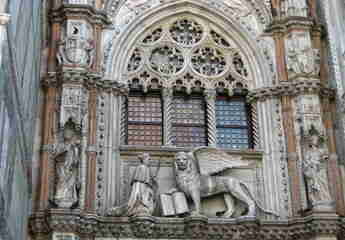
Ca' d'Oro, or Palazzo Santa Sofia (Ital. Ca' d'Oro), is a palace in Venice, on the Grand Canal in the Cannaregio district. The palace's second name is the “Golden House,” because gold leaf was used in its original decoration. Vermilion and ultramarine were also used in the decoration. The palace is considered an example of Venetian Gothic. The Gothic-style building was constructed in the 15th century, between 1425 and 1440, based on the design of the architects Giovanni Bona and his son Bartolomeo Bona, commissioned by the patrician Marino Contarini. Previously, a Byzantine-style palace, palazzo Zeno, stood on this site; Marino Contarini received it with his wife Sora Zeno's dowry. The old palace was demolished, but fragments of it were preserved in the facade of Ca' d'Oro. The palace changed many owners and was rebuilt more than once. In 1894 the palace was acquired by Baron Giorgio Franchetti. The baron reconstructed the building according to surviving drawings and paintings, restoring its historic appearance as far as possible.
Are you interested in Cannaregio? And have you already visited Piazza San Marco? And can you tell absolutely everything about it? ;) Download the Ever.Travel audio guide to Venice and be sure that when you return home you will excitedly tell your friends and acquaintances amazing stories about the Italian city on the water!

Flickr, albireo2006
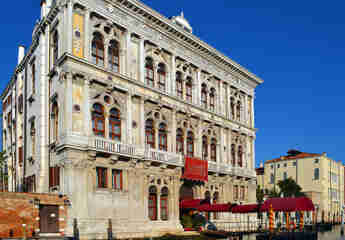
Palazzo Ca' Vendramin Calergi was built on the Grand Canal as early as the beginning of the 19th century. This magnificently beautiful palace passed from one owner to another for a long time.
Its first owner was Doge Leonardo Loredan, after him Julius Braunschweig-Wolfenbüttel, who sold it to the nobleman Vittore Calergi, whose name the palazzo still bears to this day. After him, the palace remained in the possession of the Vendramin family for a full 100 years, and in 1946 the palazzo was bought by the city municipality.
Among the townspeople and guests of Venice, this place is famous for the fact that the great composer Richard Wagner spent his last years here. Since 1995, his museum (Museo Wagner) has been located here.
However, this palace is even more popular because the famous Venetian Casino is located here. It is quite easy to get in — flyers granting the right of entry can be found at the reception desk of almost any hotel. Do not miss the chance to visit this unique place — even if you do not win millions, you will at least admire the interiors of a luxurious Venetian palazzo ;)

Flickr, howmanyidsdoineed
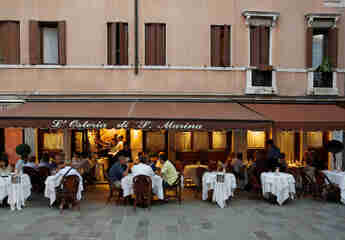
Paradiso Perduto is a very authentic and, at the same time, quite unpretentious place to spend an evening. It opened in the Cannaregio district in 1979 and has since been very popular with local residents. They say that its owner, Maurizio Adamo, is very fond of Russian poetry, contemporary art, and jazz, and therefore poetry evenings, performances, and concerts by students of the local conservatory are often held in the bar.
Large tables for groups, treats of fried seafood, delicious homemade pasta, live music, and genuine merriment attract not only locals but also guests of Venice. It is not uncommon to see young moms and dads with strollers in Paradiso Perduto. The locals treat this as completely normal, but tourists are usually very surprised by it.
Quite often all the tables and seats at the bar are occupied, but this usually does not bother guests, because you can always settle near the entrance, dangling your legs over the canal - in the light of the evening lanterns this is not only unusual, but also very romantic. The helpful bar staff will gladly bring you whatever you like there as well.
In short, it is a very pleasant and welcoming place, so be sure to stop by if you are nearby.
Madonna dell'Orto Church

photoshelter.com, Paolo De Faveri
Madonna dell'Orto Church (Ital. Chiesa della Madonna dell'Orto) is a church in Venice, located in the Cannaregio district on the square of the same name. Originally, the church was dedicated to Saint Christopher, and it received its current name after a statue of the Madonna and Child was found in a nearby garden (orto). The statue, which is credited with miraculous properties, was installed in the church. The church was built in the Gothic style, and its distinctive feature is the bulbous dome. The facade is made of pink brick and decorated with rich carvings. The carved portal, executed at the junction of Gothic and Renaissance styles, is crowned with a statue of Saint Christopher. In November 1966, the church was severely damaged as a result of a catastrophic flood. In addition to the building, the interior decoration of the church was damaged, including paintings by Tintoretto. As part of the Save Venice program, the church and the paintings were among the first to be restored.
Venetian Ghetto

Flickr, panter58
The Venetian Ghetto (Ital. Ghetto di Venezia) is a stretch of land isolated by canals in the Cannaregio district of Venice. Jews appeared in Venice at the beginning of the 12th century and settled mainly on the island of Giudecca. In 1516, in response to the pope's demand to expel the Jews from Venice, the Council of Ten made a compromise decision to settle them all on an island in the Cannaregio district known as Getto Nuovo — the “new smelter” or “new foundry.” Later, the name began to be used for other Jewish enclaves as well (see ghetto). The Venetian Ghetto is surrounded by canals and connected to the rest of Venice by three bridges, which were closed with gates in the evening. Jews, with the exception of doctors, were forbidden to leave the Ghetto at night, and the gates and surrounding canals were guarded by a Christian watch. Over time, Jews were allowed to leave the Ghetto wearing special headgear and yellow distinguishing marks. The ban on professions for Jews did not extend to manufacturing, moneylending, and medicine.