
anywaytrip.ru
This ancient historical monument is located on Barcelona's Royal Square. The palace was built in the 11th century by order of King Pedro the Ceremonious. The monarch received this nickname because he always tried to follow etiquette, although he was known for his hypocrisy. Be that as it may, the palace turned out very beautiful and majestic. There is not the slightest hint of the Renaissance in its architecture. It was built exclusively in the Gothic, Romanesque, and Visigothic styles.
In 1039, the same Pedro the Ceremonious ordered the construction of the Throne Hall (Tinell) in the palace, where sessions of the Holy Inquisition were later held. A curious fact: the tribunal of the Inquisition claimed that false testimony during the hearings could lead to the collapse of the Tinell. Of course, nobody wanted that, so everyone - both the condemned and the judges - tried to speak only the truth.
In addition, it is believed that it was in this hall, though already in the 15th century, that Christopher Columbus spoke about his discovery of America, having arrived with a report to the Spanish monarchs who had provided money for his voyages.
For several centuries this palace served as the counts' residence, but later became the permanent abode of kings. During that time it turned into a true palace complex: the Tower of King Marti was added to it, serving as a defensive watch fortification, and the Chapel of Saint Agatha, which became a fine example of elegant Gothic.
Frederic Mares Museum

TravelMe, Alina Kovalevich
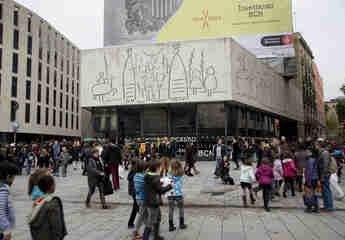
Frederic Mares Museum is a sculpture museum in Barcelona. It is located on the grounds of the old Royal Palace of the Counts of Barcelona in the Gothic Quarter. The museum was created thanks to the Catalan sculptor and collector Frederic Mares, who in 1946 donated his sculpture collection, which included a huge number of exhibits from the pre-Roman period to the 19th century, to the city authorities, who opened a museum based on it two years later. The museum occupies two floors: on the first are exhibits from Iberian times to the beginning of the 15th century, including works by famous sculptors of Castile and Aragon and a large collection of Gothic-style crosses and crucifixes; on the second are sculptures and paintings created in the 15th-19th centuries, mostly on religious themes. The museum also has a section called the 'Sentimental Museum,' which is a collection of various objects of Catalan daily life from the 15th-20th centuries (toys, clocks, and so on).

Flickr, freak&do
This castle was built in the middle of the 16th century especially for the king's viceroy. In the 17th century it also served as the residence of the ruler himself, who liked to visit these parts. His royal treasures were also kept here.
The architectural style of the Viceroy's Palace is quite rare - late Gothic with Renaissance elements. The castle has 3 facades. All of them face different directions: the first toward the royal square, the second 'looks' onto Santa Clara Lane, and the third opens onto Carrer del Comtes. In addition, the windows of the palace offer a magnificent view of the Cathedral of the Holy Cross and Saint Eulalia.
Be sure to notice how unusually the palace architect designed the drainpipes. He created them in the form of sculptures of mythical creatures. They seem to watch the guests from under the roof, and each of them is a small masterpiece.
Inside the castle there is a small courtyard with a fountain surrounded by palm trees. This place is famous for its extraordinary acoustics, so musical concerts are often held here. And during the Feast of Corpus Christi, a so-called 'dancing egg' is placed on the jet of the fountain, while the fountain itself is richly decorated with flowers.
In the 19th century, the Viceroy's Palace was completely restored, and now it houses the archive of the Aragonese royal dynasty. Some documents from this collection date back to the 12th century! You will be able to see them during a tour of the castle.
Gothic Quarter

TravelMe, Alina Kovalevich
The Gothic Quarter (Cat. El Gòtic, also Cat. Barri Gòtic, Sp. Barrio Gótico) is located in the center of the Old Town in Barcelona. The quarter begins at Catalonia Square and stretches from La Rambla to Via Laietana. The quarter got its name thanks to the surviving buildings erected in the Middle Ages, when Aragon was one of the most powerful powers on the Mediterranean Sea. The chaotic layout typical of medieval cities has also been preserved in the Gothic Quarter. The quarter consists of narrow winding streets, many of which are closed to traffic. Most buildings date from the 14th-15th centuries, although Roman structures have also survived. The quarter was settled during the reign of Octavian Augustus. The Roman forum used to stand on the site of Saint James Square. Remains of the Roman wall have survived between the streets of Carrer de la Tapineria and del Sots-Tinent Navarro. The Cathedral of Saint Eulalia is the central point of the Gothic Quarter.

Flickr, MARIA ROSA FERRE
The Archdeacon's House appeared on the map of Barcelona in the 12th century; it was erected on the foundation of the fortress wall that had remained from the era of the ancient Romans. 400 years later it was almost completely rebuilt, and then renovated more than once. Today it is a rather interesting building with its own history and layered architecture. Here you can see elements of Gothic and Renaissance and, at the same time, catch notes of Modernism.
In the 19th century, the Archdeacon's House acquired an elegant courtyard and a Gothic-styled fountain. Then the bar association was located here, and at its request a very curious letter box appeared at the entrance. It is decorated with a bas-relief depicting three swallows at the top and a turtle below. The meaning of these symbols is not entirely clear. Some interpret them this way: the birds represent freedom and the guarantee of law, while the turtle is bureaucracy with all its slowness and clumsiness. But given that it is, after all, a mailbox, many see another meaning in these symbols: may joyful news fly as fast as birds, while sad news crawl like a turtle. But perhaps the funniest interpretation is the image of a post office that works as slowly as a turtle crawls. It turns out interestingly: the countries are different, but the problems and jokes are the same!
Nowadays the historical archive of Barcelona is located in the former Archdeacon's House.
New Square

Flickr, Panoramyx
New Square (Cat. Plaça Nova) is a square located in Barcelona's Gothic Quarter (Spain). It was formed in 1358. Despite its name, New Square is the oldest in Barcelona. Until the 14th century, the site of the square was an undeveloped space outside the city gates of the Roman settlement of Barcino. The towers of the Bishop's Gate (Portal del Bisbe) have survived to this day. Previously, the decumanus, one of the main streets of Barcino, began here, and two aqueducts supplying the settlement with water converged here. Fragments of the aqueduct have survived by the left gate tower. The decision to build the square was made by the city council in 1355, when it was decided to bring water from the Collserola mountains to Saint James Square. In 1358, the construction was completed, and since then the square has borne its name, except for a short period when it was renamed at the beginning of the 20th century in honor of the Carlist Juan Vazquez de Mella.
Cathedral of the Holy Cross and Saint Eulalia

Flickr, josefrancisco.salgado
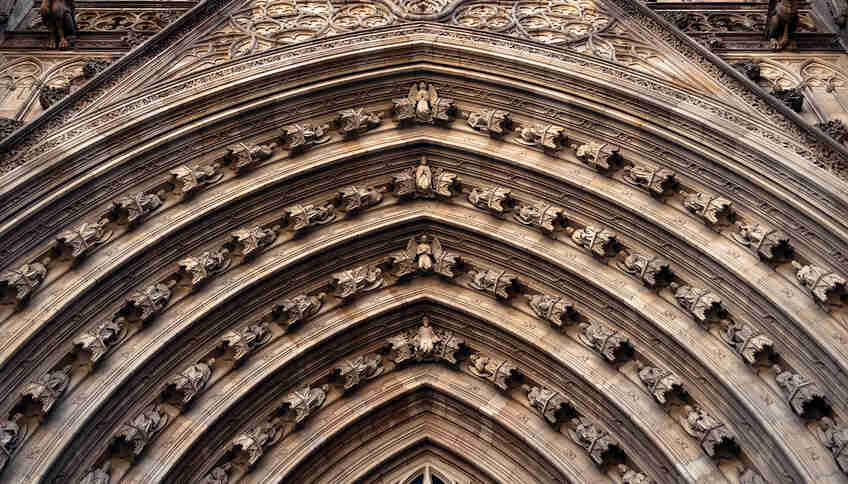
The Cathedral of the Holy Cross and Saint Eulalia (Sp. La Catedral de la Santa Cruz y Santa Eulalia) is the cathedral in Barcelona. It is also known as the Cathedral of Saint Eulalia or simply Barcelona Cathedral. It is dedicated to the Holy Cross and to Saint Eulalia of Barcelona, one of the city's patron saints. It is located in the Gothic Quarter. It is this cathedral, and not, contrary to popular belief, Sagrada Familia, that is the residence of the Archbishop of Barcelona and the main cathedral of Barcelona. Construction lasted from 1298 to 1420 over the crypt of a former Visigothic chapel. The cathedral was built in the Gothic style; later, elements of Neo-Gothic were added. Inside the cathedral there is an inner courtyard open to visitors. Here, in one of the chapels, white geese live. The whiteness of the birds symbolizes the purity of Saint Eulalia[1]. Eulalia was only 13 years old when she met a martyr's death at the hands of pagans, which is why there are exactly thirteen geese here.