Montjuïc Castle

Flickr, ilyasharkov
Before we begin, a quick note: this walk is part of our mobile app, a travel planner for iPhone or Android. Download it to use this route with offline maps and GPS, and to plan the rest of your Barcelona trip. Let's go!
Updated for 2026: Opening hours, ticketing, and the Magic Fountain schedule can change with the season, so check the latest official information before heading up Montjuïc.
In the Middle Ages, Montjuïc Hill was crowned by a watchtower used to monitor the surrounding coastline and plains. The first fort was built here in 1640, and heavy fighting followed almost immediately. A larger fortress with bastions and defensive walls came later, turning the hill into one of Barcelona's key strategic points. Over time, the castle became a loaded symbol for the city, especially after the War of the Spanish Succession and later during the Franco dictatorship, when it was used as a prison and execution site for political prisoners.
Today, the castle's exhibitions help put that history in context, tracing the story of the fortress and its role in Barcelona. Even a short visit makes the setting feel more meaningful as you walk the grounds and ramparts.
The real payoff, though, is outside: from the terraces you get wide-open views over the port, the sea, and the city spread out below.
National Art Museum of Catalonia

lolapi.ru, Lola Pidluskaya
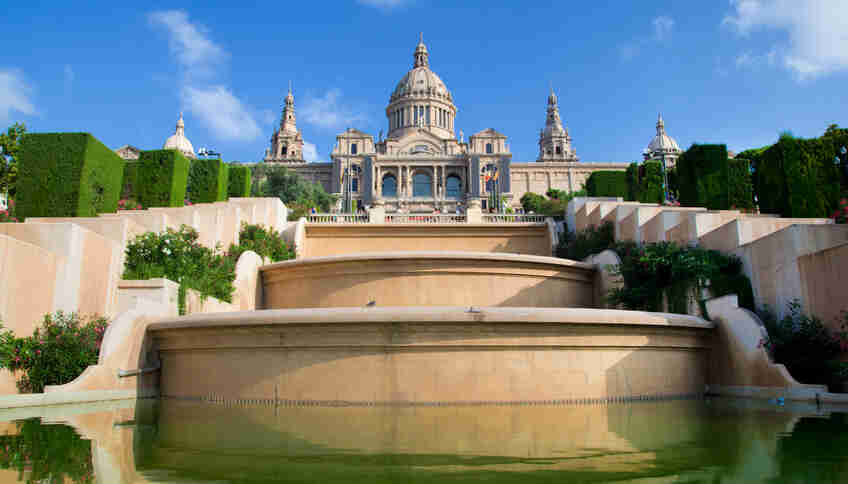
One of Barcelona's essential museums, the National Art Museum of Catalonia (MNAC) is best known for its remarkable Romanesque frescoes and wide-ranging collection of Catalan art. It occupies the grand Palau Nacional at the foot of Montjuïc, which is reason enough to stop even before you step inside.
Inside, the collection runs from medieval wall paintings and Gothic altarpieces to Renaissance and Baroque works, decorative arts, photography, posters, and coins. Many visitors come specifically for the Romanesque galleries, assembled in part from churches in the Pyrenees, and leave surprised by how much else the museum covers.
Even if you are not planning a long museum visit, the setting is worth it. The terraces, staircases, and skyline views over Plaça d'Espanya make this one of the most rewarding stops on the route.
Prefer exploring on your own? Download our travel planner for iPhone or Android. You can save places and ready-made walks, spread them across different days, and share your plans with friends - all in one simple, free app.
Poble Espanyol

Flickr, digrastudio
Poble Espanyol feels like a quick trip across Spain without leaving Barcelona. Created for the 1929 International Exhibition, this open-air museum brings together more than a hundred buildings inspired by different regions of the country, from Andalusian courtyards to Castilian squares and Galician stonework.
The central Plaza Mayor sets the tone, and from there you can wander past workshops, galleries, little museums, and places to eat. Many artisan studios are still active, so this stop is about more than facades - it is a good place to browse, watch craftspeople at work, and slow down for a while.
The Magic Fountain of Montjuïc

Flickr, Raul Ferrero
Barcelona's Magic Fountain earned its name for a reason. When the show is on, water, music, and light turn the avenue below MNAC into one of the city's classic evening scenes. It is undeniably touristy, but it is also genuinely fun - especially after a day spent walking around Montjuïc.
The fountain was created for the 1929 exhibition, and the music-and-light spectacle came later, transforming it from a grand ornamental fountain into a nighttime attraction. If you want a decent view, arrive a little early and expect company.
The technical scale is impressive, but the atmosphere is what people remember. Seen from the steps and terraces nearby, it is one of those Barcelona moments that still feels special.
Plaça d'Espanya

Flickr, marcotirelli
Plaça d'Espanya is one of Barcelona's big urban hubs and the natural gateway to Montjuïc. From here you can head up toward MNAC, walk over to Poble Espanyol, or settle in for the fountain show after dark.
The square's best-known landmarks are the pair of Venetian Towers, built for the 1929 International Exhibition and still framing the broad avenue toward the Palau Nacional.
In the middle stands a monumental fountain with allegorical figures that reference Spain's geography and history, adding to the square's oversized, ceremonial feel.
Look uphill and you will see the National Palace rising above steps, terraces, and cascades of water and greenery - one of the grandest city views in Barcelona.
Today the square is busy, noisy, and practical rather than romantic, but it is still a fitting final stop on this route.
More Barcelona guides and walks: