
Accademia Gallery

ilovevenezia.ru
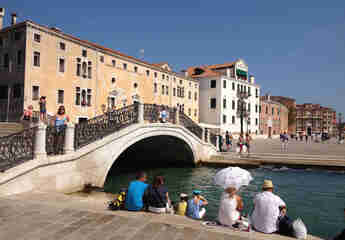
The Accademia Gallery (or, in a more precise translation, the Accademia Galleries) (Italian: Gallerie dell'Accademia), also called the Accademia Museum in Venice, is an art museum that houses the largest collection of Venetian painting of the XIV—XVIII centuries. The Academy and the museum are located on the southern bank of the Grand Canal, which gives its name to one of the four bridges across this canal. The history of the museum dates back to 1750, when the Senate, at the initiative of Giovanni Battista Piazzetta, established the Venetian Academy of Fine Arts (Italian: L'Accademia di Belle Arti di Venezia) — a school of painting, sculpture, and architecture. The purpose of creating such an educational institution was to make Venice one of the centers of art education in Italy, alongside Rome, Florence, Milan, and Bologna. In 1807, the Academy's original name was replaced with a new one — the Royal Academy of Fine Arts (Italian: Accademia Reale di Belle Arti).
Learn more about these and other attractions by downloading the Venice audio guide in the Ever.Travel mobile app.
Peggy Guggenheim Collection

Flickr, SmarTrippin
The Peggy Guggenheim Collection (Italian: Collezione Peggy Guggenheim) is a small museum in Palazzo Venier dei Leoni (Italian: Palazzo Venier dei Leoni) on the Grand Canal in Venice, one of several museums of the Solomon Guggenheim Foundation. The permanent exhibition includes more than 300 works. Most of the exhibition consists of Peggy Guggenheim's personal collection, including works by authors who worked in such movements as modernism, futurism, cubism, surrealism, and abstract expressionism. The museum features works by Picasso, Leger, Severini, Mondrian, Kandinsky, Miro, Klee, Ernst, Magritte, Dali, and other artists. Since September 1997, 26 paintings from the Gianni Mattioli collection have been on display in the museum, including "Flowers" by Giorgio Morandi (1913) and "Portrait of the Painter Frank Haviland" by Amedeo Modigliani (1914).
Santa Maria della Salute

Flickr, Alessandro 1981
The Santa Maria della Salute Basilica (Italian: Basilica di Santa Maria della Salute) is a cathedral in Venice on the Grand Canal in the Dorsoduro district. It is located opposite the Doge's Palace. It was built in honor of the city's deliverance from the plague of 1630—1631. The plague claimed about 100000 lives, which was more than a third of the city's population. In 1631, the young architect Baldassare Longhena began construction with the approval of the Great Council and Doge Nicolo Contarini. Construction lasted more than half a century and was completed in 1681. The cathedral was consecrated only after the architect's death. According to surviving records, more than a million wooden beams were used for the church's foundation, of which more than 100000 were driven into the bottom as piles. Just as in the Church of Il Redentore, a Mass is held every year in the Santa Maria della Salute Basilica as a sign of deliverance from the plague. On November 21, the day when the Catholic Church celebrates the feast of the Presentation of the Blessed Virgin Mary in the Temple, the Festa della Salute is celebrated.