
The best way to start sightseeing in Istanbul is in the Sultanahmet district. First, we suggest heading to Hippodrome Square, then visiting the Blue Mosque, then going out to Sultanahmet Square and crossing over to Hagia Sophia. After that, we recommend grabbing a bite and finishing your walking route at the Yerebatan Basilica – one of the largest reservoirs of Byzantium.

You can not only view this route on Google Maps, but also create it yourself, adding other interesting places with the help of the Ever.Travel interactive map. Mark places you like, spread them across several days of your trip, discuss them with friends. And don't forget to download our mobile app to sync your personal guide to Istanbul with it and stroll around the city with a convenient pocket guide as your companion! Haven't prepared for trips this way yet? Check out our review, it's actually very simple and convenient!
1. Hippodrome Square
We will start our tour at Hippodrome Square, where in ancient times there really was an ancient hippodrome, the construction of which began at the end of the II century under the Roman emperor Septimius Severus. In the IV century, Emperor Constantine, while creating a new capital, completely rebuilt it. For convenience, he even connected his imperial box to the Great Palace. After the reconstruction, the Hippodrome became the second largest after the Roman one and held 100 thousand people. Several objects here are of interest: the Kaiser Wilhelm II Fountain, the Egyptian Obelisk, the Serpent Column, and the Column of Constantine.

Everything you need to know before a trip to Istanbul – tips for independent travelers
2. Wilhelm II Fountain
The German Fountain is a gift to the city from the German Kaiser Wilhelm II, who visited Istanbul in 1898. By the way, approximately here in ancient times was the entrance to the Hippodrome.

Flickr, S.R. Photo
By the way, you can walk around these places without even looking at a guidebook. To do that, all you need is to download the audio guide to Istanbul. It tells 10 times more interesting stories about these and other attractions of the city.
3. Egyptian Obelisk
The next attraction on our way is the Egyptian Obelisk. It is the oldest structure not only on the territory of the Hippodrome, but in the whole city. It dates back to the XVI century BC, which means it is 3500 years old. The Egyptian Obelisk was brought from the Karnak Temple in Luxor in 390 by order of Emperor Theodosius. It was installed at the Hippodrome on a specially made marble pedestal.

See also other guides to Istanbul:
4. Serpent Column
If you walk a little farther, you can see the stump of the Serpent Column. It was brought to New Rome in 324 from the Temple of Apollo at Delphi in Greece. The column was made in the V century BC in honor of the victory of the Greek city-states over the Persians at Plataea. Originally it consisted of three intertwined serpents and was topped with a golden bowl, and its height reached seven meters. The serpents were cast from the bronze shields of the fallen Persians.

By the way, the Sultanahmet district is the very center of Istanbul's Old City. Between attractions with a history stretching back many centuries, countless hotels and hostels are compactly arranged here. Moreover, unlike many other tourist capitals, prices here are quite affordable despite the excellent location. The easiest way to find a room that will be not only comfortable but also pleasant to stay in is on Booking.com, where almost 2000 accommodation options in Istanbul are listed! A few particularly interesting offers are suggested by our travel expert Anatoly Selyaninov.
5. Column of Constantine
It got its name from Emperor Constantine VII Porphyrogenitus, who restored it in the X century. At that time, the height of the column was 32 meters, and it was completely covered with gilded bronze or copper sheets. The valuable sheets were stripped off and melted down by the crusaders during the IV Crusade.

Flickr, jinxsi1960
6. Blue Mosque
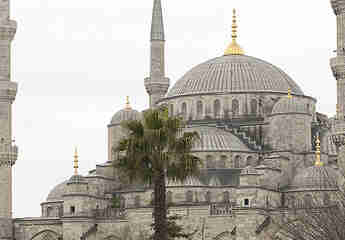
The construction of this mosque began in 1609, when the initiator of its construction, Sultan Ahmed I, was only 19 years old. According to one version, with this structure the young sultan wanted to appease Allah for certain sins, and according to another, to strengthen his authority in the eyes of the people after signing a peace treaty with the Austrian emperor.

7. Sultanahmet Square
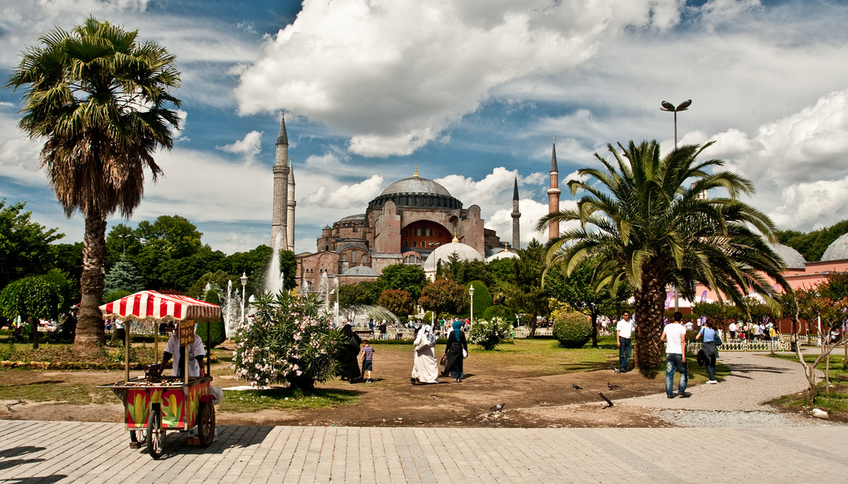
This square is always full of people. If you can tune out the crowds of tourists, this place immediately becomes pleasant. In the center of the square is a fountain surrounded by park benches. This is the perfect time to sit down and not rush anywhere. Great shots of Hagia Sophia, the Blue Mosque, Roxelana's Baths, and the tomb of Sultan Ahmed I turn out if you include the fountain in the composition.

8. Hagia Sophia
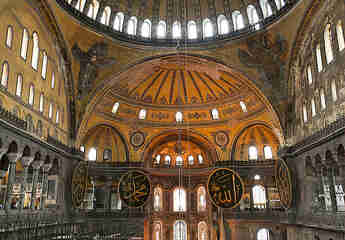
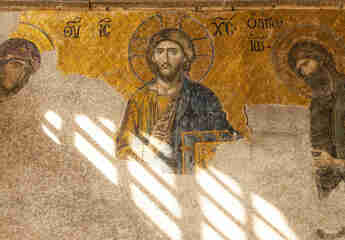
The first cathedral on this site was founded by Emperor Constantine the Great, who, incidentally, accepted Christianity only just before his death. The cathedral burned twice, and what you see today dates back to the VI century AD. As a rule, two lines form at Hagia Sophia. One is at the ticket offices for a ticket. The other is at the entrance to the temple. They move quite quickly, but we advise you to line up in both to save time.

Flickr, Tilkioglu
It is simply impossible to tell about Hagia Sophia in a couple of paragraphs. To get to know this amazing place better, we advise you to read the overview, or better yet download the audio guide!
9. Basilica Cistern
Not far from the exit from Hagia Sophia is an ancient underground reservoir – the Basilica Cistern, or in Turkish «Yerebatan» – the strangest and most mysterious place in the city, inconspicuous on the outside but beautiful inside. Functionally, the cistern served as a reservoir supplying the Great Imperial Palace. However, under the Ottomans it was abandoned and forgotten. Only local residents used to catch carp through holes in its roof, which is what drew attention to the site. At the end of the XX century, the basilica was restored, wooden walkways were laid, red lighting was installed, and carp were released again, which, like fat, well-fed cats, do not swim but lazily move their fins.

Flickr, szeke
In the Basilica Cistern, you absolutely must find two objects – the «weeping column» (you will recognize it by the distinctive decor in the form of peacock feathers) and two heads of Medusa the Gorgon. The origin of the latter is unclear. They were discovered under meter-thick layers of earth deposits during restoration in the 30s of the XX century.