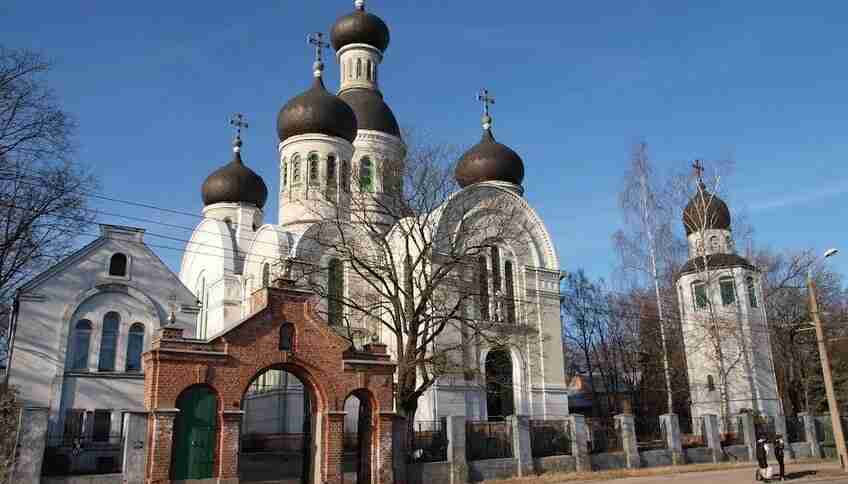
The history of one of Riga's oldest churches is complex and unusual. In the mid-18th century, the need arose for an Orthodox parish in these parts. At that time, in the Latgale Suburb there was only a small old chapel at Ivanovo Cemetery and the Church of All Saints. In 1882 it was decided to move the old wooden All Saints Church to Ivanovo Cemetery to assist the chapel. Within a year, this complex plan was brought to life with the help of the parishioners - the entire parish worked on the relocation. The architectural project was developed by engineer Bauman; thanks to him, the chapel and the relocated church created a harmonious ensemble.
It was possible to build a new church, refresh the interior decoration, and acquire bells and icons entirely through donations. Construction was also carried out by the whole community - since the church did not yet have its own parish, it had no funds, and all income was redirected to the diocese. The main part of the donations was made by the workers and owners of the well-known Kuznetsov porcelain factory, who also created a church choir of more than 100 people.
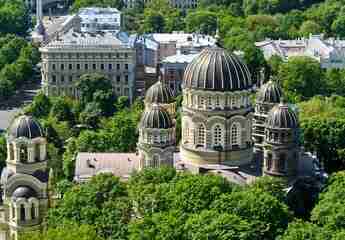
In 1913 it was decided to build a new stone church based on the design of architect Lunsky; construction began, but the war interfered. Work resumed only in 1925. The work was continued by architect Shervinsky, giving the Church of John the Baptist its current majestic appearance. A five-domed church, classical for Orthodoxy, whose domes create the image of a cross with a soaring central dome, was built in the Russian style with elements of eclecticism.
During the Soviet religious repressions, they wanted to take this building away from the parishioners, forcing them into Kazan Church, but the community proved to be just as united as their ancestors who built the church. The people defended their parish, and today the church in the name of the holy prophet John the Baptist is one of the most visited and revered in Riga.