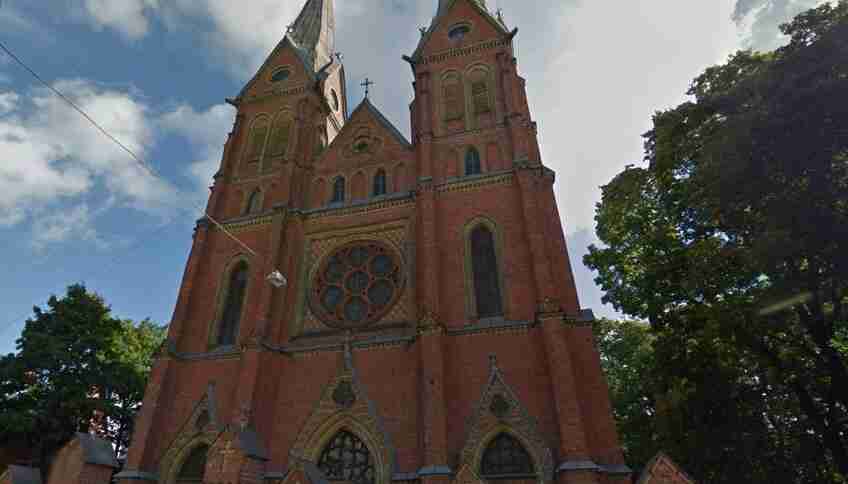
The Roman Catholic Church of Saint Francis in Riga has a complex history. After the conquest of the city in 1621, the Swedish monarch Gustav II Adolf expelled all Catholics and gave their churches to the Lutherans. The expulsion of the Catholic Church from the streets of Riga lasted for a hundred years, until Russia took possession of the city in 1721. Peter I allowed Catholics to hold Mass and ordered the magistrate to provide them with a place for services. The local authorities were not especially favorable toward the Roman Catholic Church, so they allocated a shabby little wooden house with a garden located next to a dump. The Catholic community built a small chapel on its own, where parishioners prayed until the end of the 19th century. Its ruins are still on the original site, behind the newer buildings. The city's only Catholic cemetery was established in the garden, and a century and a half later Miera Garden was laid out there.
By 1889, attitudes toward religion in Riga had become more tolerant, and at the initiative of parish rector Francis Afanasovich, the community began collecting donations for the construction of the church. The design of the future church was created by architecture student Florian von Viganovsky. In 1892, the building was completed and consecrated in honor of Saint Francis of Assisi.
The church was created in the Neo-Gothic style, inheriting features of the North French tradition. St. Francis Church has two tall towers and three arched naves, while the red-brick façade is decorated with a rose window and a wimperg, a decorative portal above the entrance.
During the reconstruction of the church in the mid-20th century, a 1900 fresco was restored — a copy of the frescoes by the Italian icon painter Giotto, and one of the altars was fitted with a painting of Saint John the Baptist by Jacob Mittenleiter, painted back in 1795.