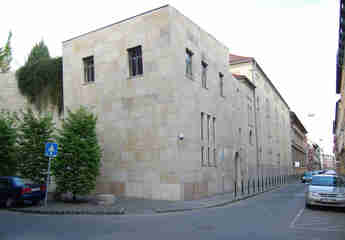

From the outside, it is a completely unremarkable two-story building, but inside is the richest collection of works by Victor Vasarely. The museum is part of Zichy Palace in the Obuda district. It was built in 1746-1757 for Count Miklós Zichy.
Today, only the ceremonial entrance still reminds visitors that this is a palace. After being destroyed during World War II, it was never fully restored. Besides the Vasarely Museum, there is also a cultural center here, the Obuda Museum, and the Lajos Kassák Museum. In summer, opera performances are held here regularly.
But let us return to Victor Vasarely. He was a French artist originally from Hungary who became the founder of a new style in art - ‘op art’ - from the English “optical art,” which means ‘optical art’ in translation. At its core are visual illusions that arise when a person sees a flat image, but the brain ‘fills in’ the volume.
As a result, a contradiction appears between the real form and the visible one. Sometimes, looking at such paintings, a person involuntarily sees the image pulsating, as, for example, in Vasarely's painting ‘Supernovae’. Or moving waves, although in reality these are simply curved lines of varying thickness arranged at a certain distance.