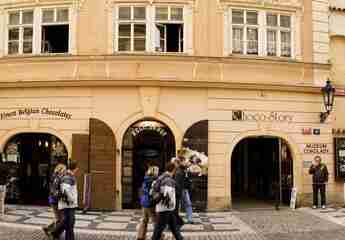
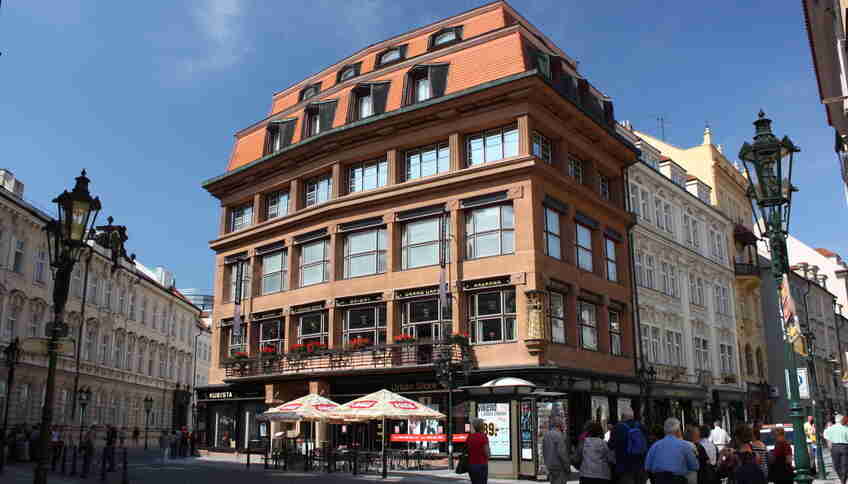
The most famous example of Cubist architecture in Prague is located on Celetna Street. This four-story house was built on the site of a collapsed mansion in 1919. The project was designed by the young and little-known at that time Josef Gocar.
The first floor of this house, completely atypical for Prague, was given over to a shop, the now-iconic Grand-Café Orient opened on the second floor, and the top two floors were used for service premises and living quarters.
Nowadays, the purpose of this house has changed by exactly half: the shop and cafe operate as before, but the third and fourth floors are occupied by the Museum of Cubism, founded not so long ago.
Its collection was assembled from three other Prague museums: the National Museum, the Museum of Decorative Arts, and the National Gallery. As a result, the collection of the Museum of Cubism became the largest among its kind in the entire world. The exhibition features examples of Czech painting, pieces of furniture and decor, as well as a collection of sculpture. Of course, all of it is in the Cubist style.
And the Museum of Cubism bears the name of the house "At the Black Madonna" because on the corner of this building there is a house sign of the Black Madonna with the infant Jesus in her arms, created back in the 16th century!