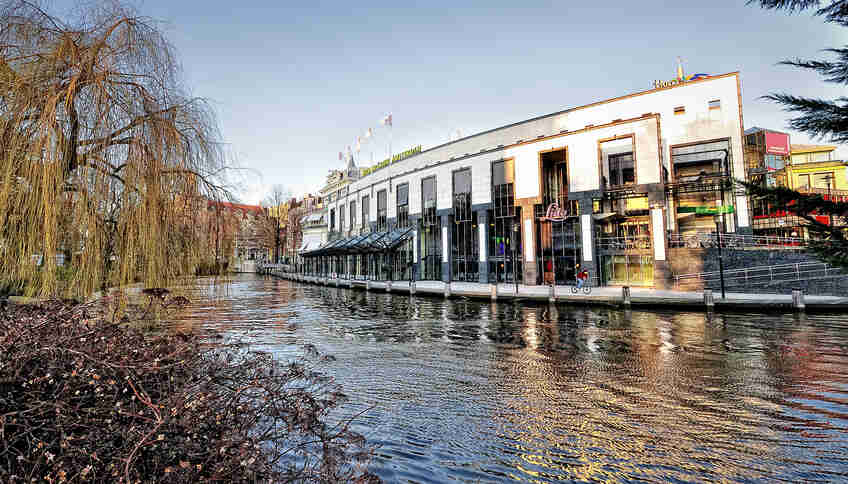
Just a short walk from Leidseplein, tucked between the Singelgracht canal and the Vondelpark, you will find Max Euweplein – a small, oddly cheerful square that is one of central Amsterdam's most photographed public spaces. It was laid out in 1990 and named after Max Euwe (1901–1981), the mathematician who in 1935 became the only Dutch world chess champion.
The square's trademark is a giant outdoor chessboard set into the pavement, with knee-high wooden pieces that locals and visitors cheerfully push around on sunny afternoons. Beside it stands a life-size bronze statue of Euwe himself, hand raised mid-move, watching over every game. If the board is free, grab a piece and play – it is free and open to anyone.
The entrance to the plaza is marked by a striking modernist colonnade whose architrave carries the Latin inscription "Homo sapiens non urinat in ventum" – literally "a wise man does not urinate into the wind." The motto is a tongue-in-cheek nod to the square's history: the site was formerly a prison of the House of Correction, and its new owners wanted a literary-yet-irreverent welcome.
Around the plaza you will find cafés with canal-side terraces, an independent bookshop, a branch of the Dutch Book Library, and a popular gelateria that draws long summer queues. It makes a natural first stop when walking from Leidseplein toward the Rijksmuseum and the Van Gogh Museum.