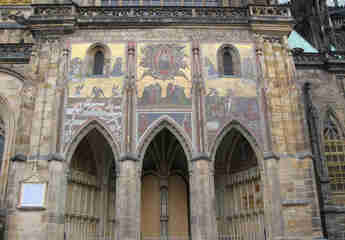

Mihulka Tower was built in 1496, becoming the largest tower of Prague Castle. Its height is 44 m, and its diameter is a full 20 m. About half a century after it was built, the tower was almost completely destroyed in the fire of 1541, but it was then rebuilt. In those days, the weapons workshop of Thomas Jaros was located there; he also, incidentally, created the "Singing Fountain" for Belvedere Square. Prague's largest bell, "Zikmund," was also cast in this workshop. Today it can be seen at St. Vitus Cathedral.
Later, the tower was used as an alchemical laboratory. Emperor Rudolf II, as is well known, hoped for the miraculous transformation of base metals into gold or platinum. Many fraudsters took advantage of this, including Edward Kelley. This hapless alchemist was soon imprisoned in the neighboring White Tower.
This tower was nicknamed the Powder Tower because gunpowder and other explosive substances began to be stored in it. In 1648, whether by accidental negligence or malicious intent (the Thirty Years' War was underway), an explosion occurred in the tower. Not only the walls of the storage facility were damaged, but also the surrounding buildings, including St. Vitus Cathedral. They were restored only with great difficulty, but since then gunpowder has not been brought anywhere near here.
A museum is now open here, where you can see not only the works of medieval craftsmen, but also some items from the time of alchemists, magicians, and astrologers.