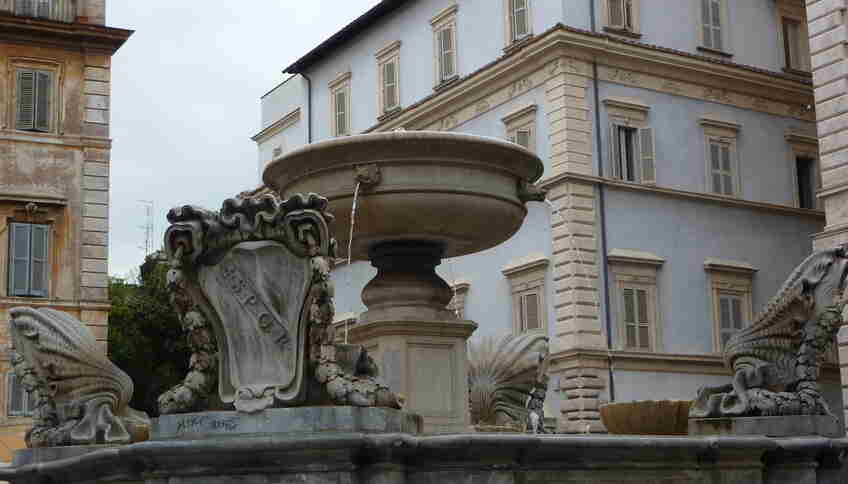
This fountain is considered the oldest in Rome. Its construction dates back to the VIII century. Over its long history it has been restored many times, gradually changing its original appearance. But most importantly, this 'old-timer' is still working, and it is more than 1000 years old!
In 1450, by order of Pope Nicholas V, two basins were installed in the middle of the fountain: first the larger one, and above it a second one - smaller in size. When another pope came to power - Alexander VI, the fountain was remodeled again, with both basins removed. In their place, one appeared, but decorated with wolf heads. Water streamed into the fountain from them. The author of this project is not known for certain, but there are suggestions that it was Donato Bramante, the famous Italian architect of the Renaissance.
We help plan trips to Rome. Download our free mobile app - Travel planner and guide for iPhone or Android. Hundreds of attractions, ready-made walking routes, the ability to create your own routes, an offline map and GPS. Everything you need for an interesting trip.
In 1658, the main basin of the fountain was replaced with an octagonal one and 'raised' onto a four-step pedestal. Double shells were placed inside the fountain, and commemorative epigraphs and the coats of arms of the next Roman pope - Alexander VII - appeared on the outside.
During the subsequent restoration, the shells were turned in the opposite direction, the epigraphs and coats of arms were removed, and instead the abbreviation SPQR was made, which stands for 'The Senate and People of Rome'. In addition, a metal grate was installed to protect the monument. But later it was demolished, and concrete bollards were placed along the edges of the lower steps so that passing cars would not accidentally hit the ancient landmark.
Thank you! Every time you book hotels on Booking.com through our website, you help us describe one more place, create one more route, or develop one more city. Thank you for that!
banner booking
Routes and guides to Rome:
- Guide to Rome
- What to see in Rome in one day
- The first self-guided route in Rome: Vatican and the Vatican Museums
- The second self-guided route in Rome: Castel Sant'Angelo - Piazza Navona - Pantheon - Trevi Fountain
- The third self-guided route in Rome: Colosseum - Roman Forums - Piazza Venezia - Trajan's Column - Imperial Forums
- The fourth self-guided route in Rome: Trastevere district
- Night walk in Rome