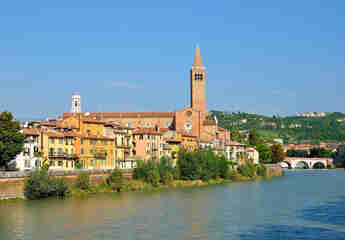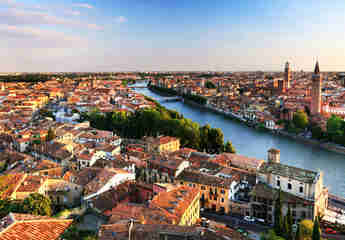

Verona is one of the oldest Italian cities.
Almost nothing is known about the origin of the city or the origin of its name. According to one theory, the settlement on the site of modern Verona was founded by the Euganei tribe. According to another version, the settlement was founded by the Arusnates, a people descended from the Etruscans. In that case, the toponym Verona may mean in Etruscan "city of the Veneti standing on the river".

The residents of Verona, or as they call themselves, the Veronesi, found themselves caught between two fires because of the city's location: barbarian tribes threatened them from the north, while the power of Rome was growing in the south. The Veronesi preferred an alliance with Rome, and at the end of the 2nd century and the beginning of the 1st century BCE the people of Verona fought on the side of the Romans against the Cimbri and Teutons.

Verona reached power and prosperity within the Roman Empire thanks to its key trade and military position in northern Italy. After the fall of the Empire, the city continued to flourish under the rule of barbarian kings and reached a peak in cultural development during the reign of the Della Scala dynasty in the 13th and 14th centuries.

In the 15th century the city passed into the possession of the Venetian Republic. Verona remained under Venetian protection until Napoleon's invasion in 1797. At the beginning of the 19th century the whole Venetian region passed under Austrian rule and was ultimately united with the rest of Italy in 1866.

Verona is located on the banks of the Adige River, 30 kilometers from Lake Garda. Because of this location, the city was regularly flooded until 1956, when the Mori-Torbole tunnel was built, allowing 500 cubic meters of water per second to pass from the Adige River into Lake Garda in the event of flood danger. The tunnel reduced the flood risk from once every seventy years to once every two centuries. The tunnel is almost 10 km long.

The historic center of Verona covers a fairly large area, more than 2 sq km. Administratively, it is divided into four quarters: Old Town, Citadel, San Zeno, and Veronetta.
One of the city's main squares is Piazza delle Erbe (Herb Square). This is Verona's market square, where seasonal products and goods are sold. The city's residents gathered here as far back as the Roman Empire, using the open square as a forum.

On Piazza delle Erbe stands the Gardello Tower (on the left in the photo). It is known that it was erected even before the period of Scaliger rule, but in 1363 it was substantially rebuilt. In the 15th century a clock was installed on the tower. It became the first public mechanical clock in Verona, by which the entire city kept time. The bell housed in the belfry is also of great significance. It was cast by a famous Veronese master in 1370, as evidenced by a plaque installed at the base of the tower. After the clock was installed, the bell was rung by a special mechanism.
On the other side of the square stands the Lamberti Tower (on the right in the photo), built in the Romanesque style. It was constructed in 1172 by the Veronese Lamberti family, from whom it takes its name. In May 1403 it was struck by lightning, which destroyed the upper part of the tower. The tower was repaired only in the second half of the century, and the reconstruction made it taller than the original structure. Today the tower is 84 meters high, making it the tallest structure in Verona. The sections corresponding to the two phases of the tower's construction are visible on its exterior thanks to the different materials used in different eras. At the bottom there are bricks and tuff blocks, then only bricks, and at the top marble. The large clock was installed on the tower in 1779.

Two bells were also installed in Lamberti Tower. The small bell struck the hours and announced fires, while the ringing of the large one gathered people for meetings and warned of the enemy's approach. You can go up by elevator, which is definitely worth doing, since the tower's observation deck offers an excellent view of Verona's historic center.

The walls of Verona, built during the Habsburg period, still exist.
The city can boast walls that were built at different times: in some places the walls of the Roman Empire are still visible, though unfortunately only ruins remain of them.


One of the city's key landmarks is [Arena di Verona](https://ru.wikipedia.org/wiki/%D0%90%D1%80%D0%B5%D0%BD%D0%B0%D0%B4%D0%B8_%D0%92%D0%B5%D1%80%D0%BE%D0%BD%D0%B0)_ — the third largest Roman amphitheater, after the Colosseum and the amphitheater in Santa Maria Capua Vetere. In the Roman Empire era, it stood outside the city limits. The exact date of the amphitheater's construction is unknown. It was probably built in the 1st century CE between the reigns of Emperors Augustus and Claudius.

At that time, gladiator fights, beast hunts, and other mass entertainments typical of the Roman era took place in the arena.
Today the ancient stage continues to be actively used. Since 1913, an annual opera festival has been held on the amphitheater's stage. During the music season, which lasts from June to August, up to 50 opera performances are held here. Until recently the arena's capacity was 20000 guests, but for safety reasons it was reduced to 15000.