
To begin with, here is a bit of introductory information to help you better understand the country. Although Iceland covers almost half the area of Great Britain, its population is only 320000 people (for comparison, 63.5 million people live there). As you understand, the ratio of the country’s area to its population is disproportionate: if you get lost, it may turn out that there will be no one to ask for directions. That is why the trip absolutely must be carefully planned in advance.

You can travel to Iceland at any time of year; however, depending on the season, the impressions will be very different. Without a doubt, the most beautiful and comfortable time of year for exploring the country is summer. The whole country turns green, and the temperature rises on average to +15 °C. However, keep in mind that tourists from all over the world know exactly the same thing, and if you come here in summer, you definitely will not be alone near any attraction in Iceland. You can also come here in autumn or winter, but you need to be ready for a very harsh climate: even at a temperature of -3°C, the winds here are so strong that they will pierce right through you. It is often even difficult to stay on your feet. Therefore, in such weather, be ready not for an easy holiday, but rather for a physical challenge. Do not forget that the capital of Iceland, Reykjavik, is the northernmost capital in Europe. There is only one road running around the entire country, but most of the population lives in the southern part of the island, because in the north the weather conditions are so severe that living there permanently is very difficult.

Know that when you arrive at the airport, you will see nothing around except huge volcanic fields. After all, Iceland lies on the fault line of two tectonic plates and consists mostly of volcanic rock. That is exactly why the trip needs to be planned in advance — figuring things out on the spot will be very problematic: transport runs rarely, and the capital is located 50 km from the airport. Speaking from personal experience, I can share that we had a whole group, and we traveled in two huge off-road vehicles.
You should start preparing for a trip to Iceland by searching for plane tickets. The lowest prices for flights to Reykjavik can be found on Aviasales.ru. No catch — the most выгодный option there is found by comparing the prices offered by various airlines and ticket agencies. And no additional commissions! Let’s see how much plane tickets to Iceland will cost?
The attractions of Iceland that deserve special attention we marked on the map.
Blue Lagoon
First on the list is, of course, the world-famous Blue Lagoon. It is no secret that Iceland is famous for its purest natural resources — air and water. The Blue Lagoon is the place where water goes after heating homes, and from where it is taken for further use. But people come here not only to look at the source, but also to bathe in it. Yes, really, do not be surprised — the water here is so pure that even after secondary use it has healing properties.

Thanks to underground springs, the temperature in the Blue Lagoon stays around +30-60°C all year round. No additional heating is used, and even when the temperature outside drops below zero, you can comfortably swim here under the open sky. This place is recommended for people who have skin problems (various allergies, etc.). It is also believed that the water of the Blue Lagoon has a rejuvenating effect.

Let me give you a small tip: while traveling around Iceland, it is more convenient to book not one hotel, but several at once — located along your route. You can find the optimal combination of price and living conditions on Booking.com. It is especially convenient that you can search for a hotel there not only by list, but also on the map of the island. It is also valuable that the description of each hotel is accompanied by reviews from tourists who stayed there. As a rule, you will not find that on official websites.
Strokkur Geyser
Iceland is one of the rarest places on Earth where you can observe a large number of different kinds of geysers. Moreover, keep in mind that in some places they are quite smelly. The most famous spring in Iceland is the Strokkur geyser. It erupts every 2-6 minutes, sending water up to 20 meters into the air. Sometimes the geyser can erupt quickly up to three times in a row.

Geyser before eruption

Eruption of the Strokkur geyser
Thousands of tourists come to watch this show, because it really is worth seeing. You can observe these “natural fountains” from a distance of at least two meters from the edge of the geyser, because the water it throws out is almost boiling, though it cools quickly. It is recommended to move around the geyser area only on special roads and paths.
By the way, have you already thought about where you will rent a car? To avoid comparing the offers of several companies for too long, use the RentalCars service. It helps you find the best rental price by selecting the car characteristics that are important to you with its filtering system.
Eyjafjallajökull Volcano
As we have already said, Iceland lies on the fault line of two tectonic plates, which means it is predictable to find many volcanoes here. Perhaps the most famous of them is Eyjafjallajökull, which “paralyzed” all of Europe in 2010. You can get there only in off-road vehicles, and not the kind we usually imagine. For an excursion to Eyjafjallajökull, you need to rent a huge jeep together with a driver because, first, the driver will know the road to the volcano perfectly, and second, you most likely simply will not have a license to drive this category of vehicle. Be prepared for the fact that at times you will have to overcome climbs of up to 40 degrees and it will seem that the car is about to overturn. Sometimes you will cross rivers up to half a meter deep, sometimes stop to let air out of the tires and drive over volcanic rock…


The volcano itself is large and stands on a huge glacier. When that famous eruption happened, the lava melted part of the glacier, thereby revealing rock that had been hidden for thousands of years. Now the traces of lava can be recognized by their bright blue color. Believe me, you will be amazed already at the foot of the glacier. If you want to climb to the top, know that you will need to organize a special expedition that will take several days.

To grasp the size of the volcano, look at the tiny dot at its foot - that is our off-road vehicle

Excursion to Eyjafjallajökull volcano

Before the eruption, this place was covered with ice hundreds of meters thick!
Well, if you are not yet ready for an independent trip around Iceland, we advise you to use the services of professional guides. For example, here are several very tempting offers:
- Extraordinary Iceland — a tour of the Golden Circle
- Westman Islands — the pearl of Iceland
- First introduction to Reykjavik
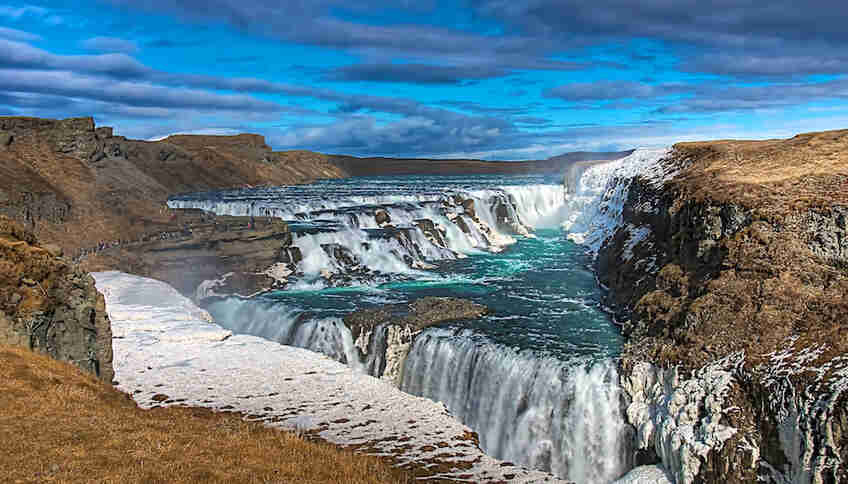
Gullfoss Waterfall
Since the terrain of Iceland includes many rocks and underground springs, waterfalls are quite common here. Sometimes you drive along a cliff and every 10 meters see spring water bursting out of the rock. In some places these springs join together, forming large and beautiful waterfalls. However, getting close to them is extremely difficult, especially in autumn and winter. In the cold season, the winds here are so strong that droplets of water flying off the falling streams, once they land on your clothes, face, or camera equipment, instantly turn into ice.

Be extremely careful when approaching Icelandic waterfalls in winter!
The biggest and most popular waterfall in Iceland is Gullfoss. It is truly huge and incredibly beautiful. You can approach it, but it is also very difficult, because the winds blow away everything in their path, and it is incredibly hard to stay on your feet on a rock covered with a layer of ice. However, this is definitely worth seeing!


Caves of Iceland
Less popular among tourists, but no less interesting in principle, are the caves of Iceland. They appear when, during eruptions, lava breaks through huge tunnels. After it leaves, multi-kilometer caves remain in the rock. We visited one of these — an amazing sight! The cave consists of volcanic rock, has a length of almost 2 km and a diameter of about 20 meters. Realizing that you are standing in a place where lava flowed not so long ago makes you feel the moment in a special way. However, remember that without guides, helmets, and flashlights, it is better not to venture into such places.

Cave carved by lava during a volcanic eruption
Lake Thingvallavatn
And, of course, when traveling to Iceland, you absolutely must visit the area where two tectonic plates meet — the European and the North American. It is truly an unforgettable place where you feel as if you are standing at the edge of the Earth.

The North American tectonic plate comes onto the European one

View of the rift from above
It so happens that this very place is also where Iceland’s largest lake, Thingvallavatn, is located. Its area is 84 km². On the rifts around the lake, you can clearly see how the tectonic plates of Europe and America confront each other. Locals joke that this is the only place in the world where you can take a few steps and move from Europe to America or back again. The lake is truly mesmerizing. If you are lucky with the weather and do not have to fight the wind just to stay on your feet, then you can easily spend several hours there simply admiring this beauty.

Thingvallavatn is the largest natural lake in Iceland
We have listed only a number of attractions of Iceland that are definitely worth visiting and that certainly will not leave you indifferent. It is a truly amazing country. During our expedition, we repeatedly said that this is not Earth, it is like another planet. The nature here is so pure that people who are afraid of heights are even forbidden to swim in some springs whose depth reaches 60 meters — the water is so crystal clear that you can see the bottom and it creates the sensation of flying!
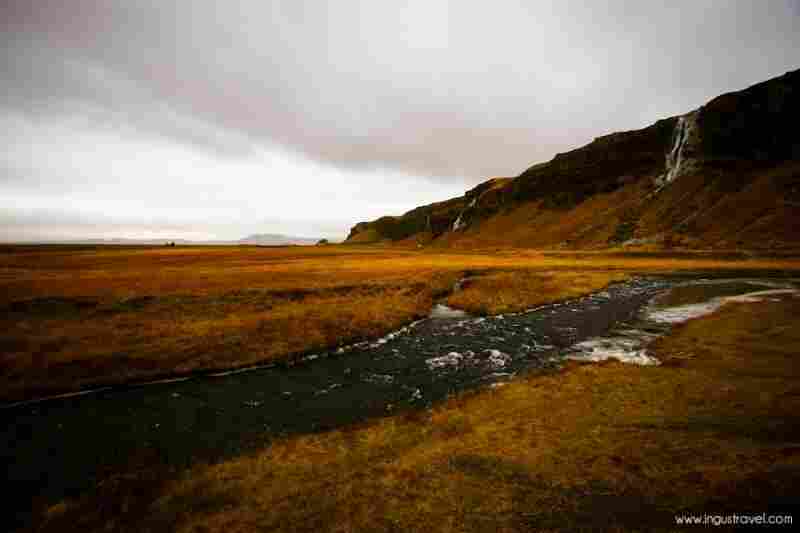
At the same time, nature is woven very organically into human life: heating for homes on the island is provided by hot springs, and the water here can be safely drunk straight from the tap. Curiously, when asked why there is not a single wind turbine on such a wind-blown island, our driver laughed and answered that they would simply be blown away by the wind. In reality, they are simply not needed: the island itself provides all the energy it needs.

There truly is no place on Earth like this: here, if you look straight out to sea, there will be no land for many thousands of kilometers all the way to Antarctica. This cannot be compared with a beach vacation; it is something greater. If you want to avoid crowds of tourists and admire beautiful nature, then autumn-winter is the most suitable time for this. But be prepared for harsh weather! In summer, of course, everything is more beautiful, but in my opinion, that spark of a pioneer and explorer is lost when you have to stand in line to photograph a geyser or a waterfall ;)