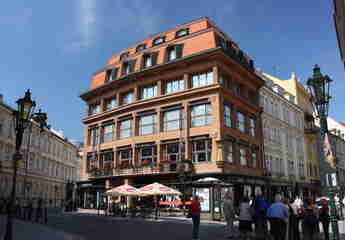
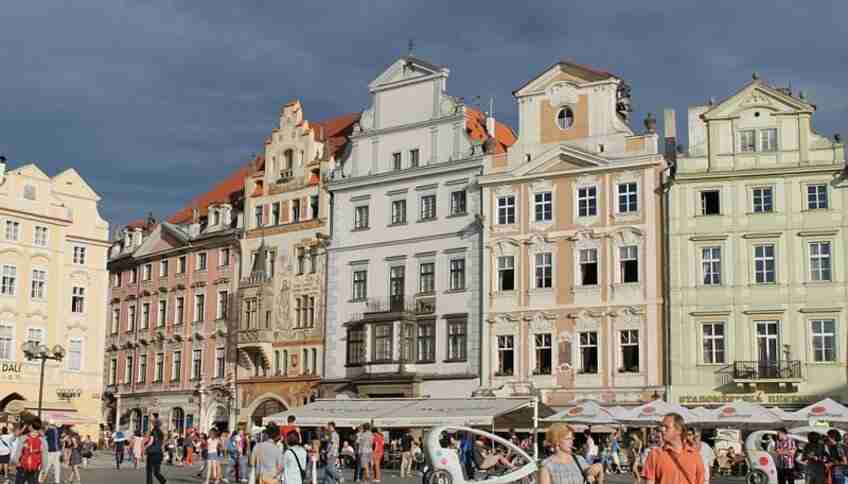
The name of this house traces its history back to the Middle Ages. At that time, many Prague residents, believing in various myths and legends, made medicines from frog legs, powdered spiders, and many other substances unconventional to us, being convinced of the healing power of certain animals. The mysterious white unicorn, which according to legend roamed the eastern forests, seemed to them almost a panacea.
The unicorn's horn supposedly cured many illnesses, including sexual disorders. Resourceful local apothecaries skillfully used this tale to their advantage, calling their establishments "Houses at the White Unicorn." Of course, trusting people went to such pharmacies in the firm belief of a miraculous cure.
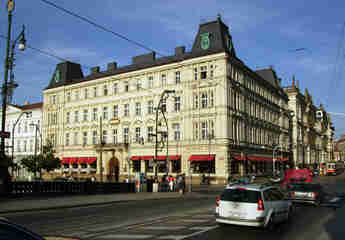
Since then, such houses acquired a special aura. House number 17, on Old Town Square, was built back in the 15th century. Combining different architectural styles, such as Renaissance, Romanesque Gothic, and Classicism, and having the tallest gable among the houses on the square, the "House at the White Unicorn" has long been regarded as the flagship among its kind. And it is the only one whose sign depicting a unicorn has survived to this day.
In addition, the house became famous for being the birthplace of the renowned Czech opera singer Josefina Dushkova, who was friends with Mozart himself, who, incidentally, visited this house more than once.
Also, at the beginning of the 20th century, Albert Einstein lived here, and he often arranged meetings in this house with various famous people, in particular with Franz Kafka.