
First impressions of the city got lost on the sidewalks favored by recently walked dogs. Bags of trash were waiting for their fate by the houses, but apart from dog traces there were no scraps of paper or cigarette butts on the streets at all. It became clear - we were in Europe, albeit a somewhat peculiar one. Contact with the locals did not take long to happen and immediately presented itself with advice on where it was better to go. Oddly enough, there was not even a hint about money, and the whole conversation drifted into an existential-anthropological plane. That is how we learned that 'we are in a very strange city of a very strange country.'

Like almost any big city, and especially a city that was once the stronghold of a great maritime power, Lisbon stands on a river, or rather a strait, leading to the ocean. Landing at night, you can clearly see how its paws spread along the coast and crossed to the other side of the strait, connected by several impressive bridges.
So, what are the attractions of Lisbon? We offer you several options for getting to know the city at once: a walking route through the center (points 1, 2, 3 and 4), a stroll through the Alfama district (marker No. 5) and an excursion around the Belém district (pins 6, 7 and 8). We deliberately did not connect these points with lines, leaving you the opportunity to plan your own route to them and discover new unusual places along the way.
By the way, you can also explore a more detailed, interactive map of the capital of Portugal, where places can be added to favorites! Google Maps doesn't offer that option, but Ever.Travel is famous for exactly this ;)
Lisbon Trams
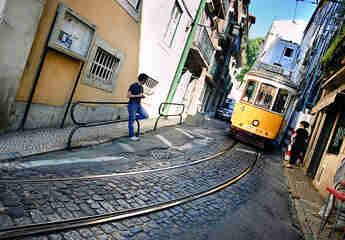
To start, take a ride on the local tram. Not doing so is akin to not visiting the Eiffel Tower in Paris. The attractions of Lisbon cannot be imagined without this means of transport. The tram numbers you need to remember are 15 and 28.
The route of tram 28 is almost legendary; at least, the crowds of tourists at the terminal stop are sure of it. It runs on authentic vintage trams, wandering through the narrow lanes of affluent and less affluent districts. The windows open, and passengers can stick their heads out and fully enjoy the driver's virtuosity with the wind blowing. Incidentally, a local woman advised us to wear the camera strap around our neck, otherwise robbers may run up at a stop and simply snatch it from our hands. But tram No. 28 is not only a tourist route, it is widely used by locals to get around the center, because it is hard to climb up and down the endless city streets.

The yellow tram is considered one of the main and most recognizable symbols of Lisbon
Tram 15 will take eager tourists to the suburban coastal district of Lisbon - Belém. This is already a modern tram model, with the driver separated from the crowd and vending machines that sell tickets only for coins.

Traveling by tram not only shortens travel time, but also offers a chance to rest from the constant ascents and descents while walking around the city
When planning a trip to Portugal, don't forget to download the free Ever.Travel mobile app! By downloading the map of Lisbon attractions, you will be able to use it offline and, while walking around the city, always understand what surrounds you.
Walking Route Through Central Lisbon
Saint George Castle
St. George's Castle rises above the city built on seven hills. It is hard to call it well preserved, although there are no ruins as such. The walls and towers are intact, but, alas, there is no interior to speak of.

The exception is a turret with a 360° view of Lisbon, which we did not get into. But the view from the castle is wonderful too; you can walk around and pet the cats (if you manage to catch them) and peacocks (they are even harder to catch).

From the castle you can clearly see another attraction of Lisbon - the statue of Christ on the other side of the river. He stretches out his arms protectively over the city. Of course, this is somewhat plagiarized from the statue of Christ in Rio de Janeiro, but the Portuguese have the right, since they themselves gifted this statue to the Brazilians.
Lisbon Cathedral
Like any big city, Lisbon has a main cathedral. It is simply called Se. The temple does not evoke many emotions, nevertheless it is impressive that its construction dates back to the 12th century and that several architectural styles are used in its design. In 1755 the main chapel of the cathedral was destroyed by an earthquake, and in the last century the church was almost completely restored. Archaeological excavations are now taking place in the cathedral courtyard, and they have surely already found something interesting from Roman, Arab, or medieval times.

Flickr, ivogomes
ViniPortugal Tasting Rooms
ViniPortugal is an organization engaged in promoting Portuguese wines. It has several tasting rooms around the city that you can visit if you wish. Admission is free, but you cannot just walk in and get drunk. The potential drunk is offered a choice of several regions. Then he chooses the bottles he likes and fills out a form. Voila, with a professional motion of the hand the glasses are filled, and you can enjoy the unique taste qualities of some of the most famous wines. No fortified wines - only natural sweetness. The farther south the grapes are grown, the sweeter they are. In some we even caught the smell of a campfire and smoked sausage!

Let's make your trip more varied! Shall we choose an excursion?
- Lisbon historical and modern. An individual excursion around Lisbon with a Russian-speaking guide will show you all the charms of this ancient city. You will be able to walk through the famous squares, visit two of the seven wonders of Portugal, taste the famous delicacy, hear about the most terrible tragedy of Lisbon's residents. You will have to climb the Statue of Jesus Christ, where you will see the sprawling city laid out before you as if on the palm of your hand. And in the modern part of Lisbon you will enjoy riding the cable car, visiting the oceanarium, or strolling through one of the best shopping centers.
- Sightseeing walking tour of Lisbon. An unforgettable impression will be made on you by a walk with a guide through the city's most famous districts - Baixa and Alfama. You will climb to the viewpoints of São Pedro de Alcantara and Santa Justa, visit the oldest churches of the Jesuits and Dominicans. You will learn many tragic stories about this ancient city and visit Lisbon Cathedral, whose history goes deep into the past.
- Sintra - the pearl of Portuguese cities. It is hard to imagine a city more beautiful and picturesque than Sintra. During the individual excursion you will have the opportunity to visit one of Sintra's famous palaces, stroll through the narrow streets of the ancient city, reconquered from the Arabs in 1154, and taste the most delicious cherry liqueur in a chocolate cup.
Commerce Square
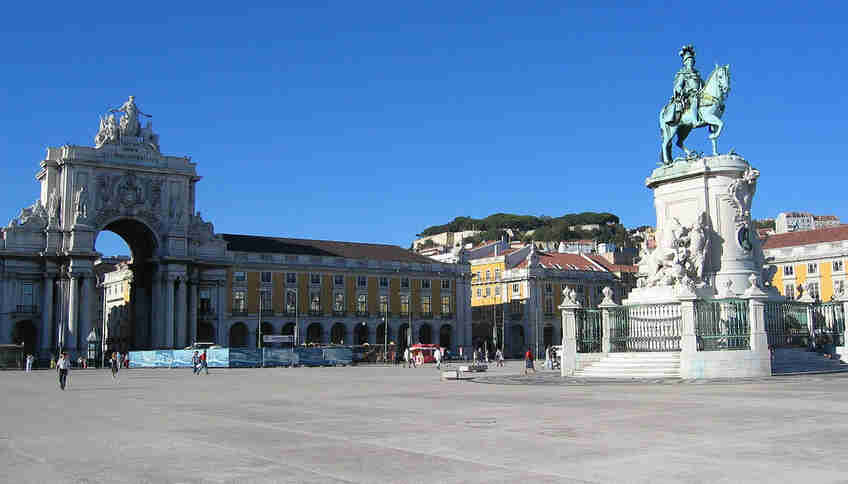
A union of Roman pomp and an incredible amount of sunlight - that is what awaits you at Praca do Commercio. It is no wonder it was chosen as one of the places for the Pope's appearance in 2010. In the past this square greeted sailors, merchants, noblemen, and kings arriving from far abroad. It almost opens into the sea and ends at a small sea terminal, from where townspeople go about their business. This is not just one of the attractions of Lisbon, it is also an important center of city life.

Praca do Comercio is also known as Palace Square or Commerce Square

Equestrian statue of Jose I

A Walk Through the Alfama District
All guidebooks say in one voice: to feel the city, you need to walk through the picturesque Alfama quarter. (Map of Lisbon Attractions, pin No. 5). This district was built in the 18th century after the devastating earthquake that struck the city. Since that time it has not changed much.

The crowd, it seems, remained the same: laborers, voluptuous housewives, children dashing around the neighborhood with toy guns, fathers and grandfathers engrossed in discussions of football and everyday matters. In the evenings all the people of the South gather on the ground floors in communal places that are either restaurants, or cafes, or simply kitchens, creating a unique homely atmosphere that you won't find in the north. Surely the one who wrote that here you can feel the real Lisbon, with its narrow streets, hanging laundry, and azulejos - traditional Portuguese tiles, was right.

There is a separate story about the classic version of these tiles. In Portugal it is a whole art and a point of pride to cover a house with tiles. Azulejos must be hand-painted, usually in a style similar to Gzhel. At almost every corner newly minted Portuguese craftsmen offer exclusive little numbers to mark a house or apartment.

The famous Portuguese azulejos tiles
Safety in Lisbon

Since a carefree tourist has decided to wander through the backstreets of Alfama, they should be sufficiently vigilant, because in places it is unsafe there. Afro-Portuguese run up and grab valuables, then shout that it is a joke, kind children respond to a smile by saying 'I kill you', huge Brazilians hang around on balconies and are clearly smoking something other than tobacco... When evening falls, even the central streets feel ominous, let alone accidentally ending up in an alley.
Excursion Around the Belém District
Jerónimos Monastery
The stunning Hieronymites monastery on the outskirts of Lisbon is worth your visit. The burial place of kings and the traveler Vasco da Gama excites and amazes at first glance.

Not far from the monastery is Pasteis de Nata - one of the oldest bakeries and, according to legend, also the birthplace of very tasty Portuguese pastries.
Berardo Museum
The Berardo Museum is also interesting - it houses an excellent collection of modern art. Works by Warhol, Picasso, and Dali alternate with cheerful and relaxed installations by less famous authors.

Flickr, endless autumn
Belém Tower
No less impressive is Belém Tower, looking out over the Tagus River. It was built in honor of Vasco da Gama's discovery of the route to India, but nevertheless for some time it had a not entirely worthy purpose - it served as a prison and powder magazine. In season, to get into the tower, you have to wait in line, so it is better to come here early. Both the monastery and Belém Tower are UNESCO World Heritage sites.

With this we end our story, and we believe that after reading it you will easily be able to list the main attractions of Lisbon!