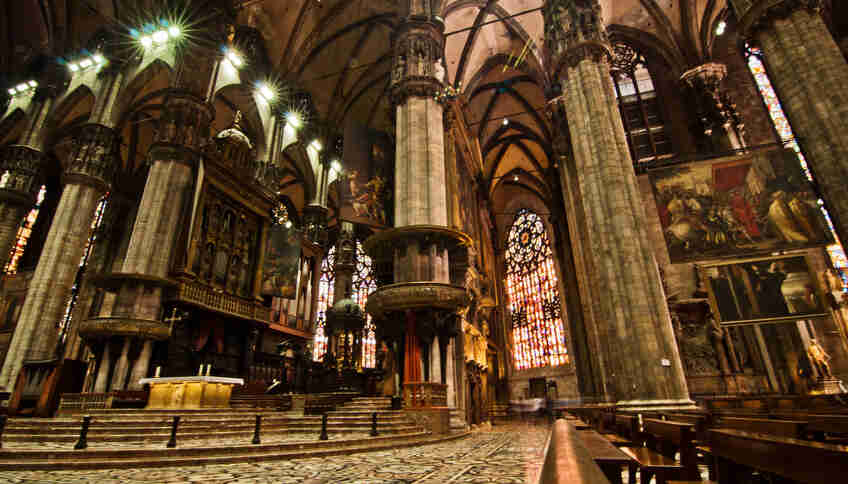
The Duomo altar is the oldest part of the cathedral: it stood in the Basilica of Santa Maria Maggiore, which previously occupied the site of this church. And beginning in the 12th century, all the archbishops of Milan celebrated liturgies at this very altar.
But what is interesting is that during the reconstruction of the cathedral in 1986, it was discovered that two altar slabs have bas-reliefs inside, which made it possible to date the altar back to the 3rd century AD! Both bas-reliefs depict a man dressed in a toga, and for this reason scholars tend toward the version that this altar served as a sarcophagus for the burial of an early Christian martyr and, quite possibly, more than one. Now these two bas-reliefs have been moved to the outside of the altar, and you can see them from the front and reverse sides.
The wooden cross, framed in a silver setting and located above the altar, is somewhat "newer" than the altar itself - the cross is dated to 1565.
Almost immediately behind the altar is the bronze presbytery, or "small temple," which is used for festive worship services. Entry there is open only to presbyters and priests.
On the sides of the presbytery are figures of the patrons of Milan. On the left side is a silver statue of Saint Ambrose of Milan, and on the right is a silver sculpture of Archbishop Carlo Borromeo. You will learn more about the important role of these figures in the history of Milan by downloading the audio guide to the Duomo.