In the 4th-5th centuries, the first settlements of Slavic tribes appeared on the territory of present-day Prague. At the end of the 5th century, a castle rose above the Vltava River, from which the first Czech princely dynasty, the Premyslids, ruled its lands. In the 10th century, another castle was built on the opposite bank — Vysehrad. Merchants and craftsmen settled between the two fortresses.
In the 11th-12th centuries, Prague was already well known to Italian and French merchants. The market located on the site of today's Old Town Square was the intersection point of international trade routes. The capital of the Czech state grew and developed rapidly. By the 13th century, no city in the country could rival Prague in size, population, or wealth. The discovery of large silver deposits further strengthened the capital's position.

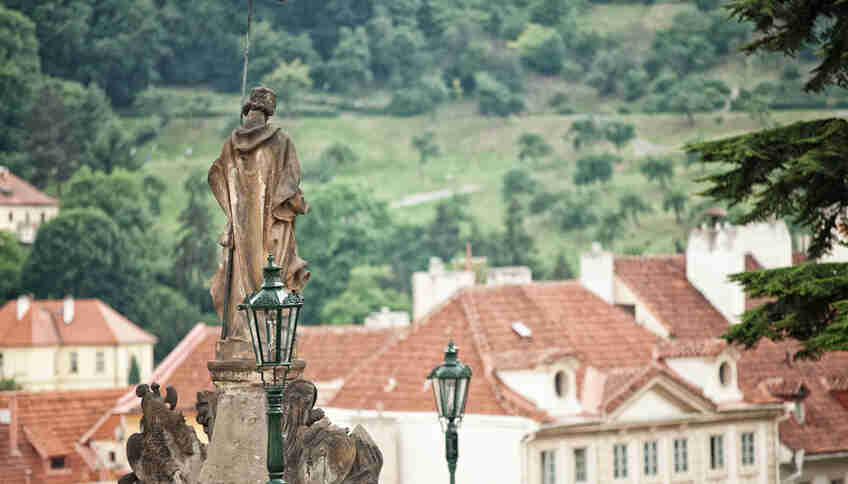
View of the Vltava. Photographer Lola Pidluskaya
All of Prague's attractions are in our free mobile app — a travel planner for iPhone and Android. Detailed information about a hundred places in Russian, ready-made walking routes, offline maps, and GPS. Download it right now and plan your trip on your own!
The powerful Charles IV, who ascended the throne in 1346, did much for the prosperity of Prague. Active construction of residential houses, palaces, and churches got underway. A stone bridge across the Vltava was laid, Vysehrad was rebuilt, and the New Town district appeared. In 1348, the first university in Central Europe was founded.
The clergy held very strong positions in the city, but the ideas of Jan Hus (a master and rector of the university), who called for reforming the Catholic Church, also found broad support. From 1419 to 1437, the country was engulfed by the Hussite Wars, as a result of which Prague lost many historic buildings.
The second "golden age" came during the reign of Rudolf II (1576-1611). The monarch patronized artists and scholars. However, after his death, the city lost its capital status and the advantages associated with it.

View of Charles Bridge. Source: Shutterstock
In 1816, an uprising of the Czech nobility marked the beginning of the Thirty Years' War, during which Prague was repeatedly captured and plundered by French, Swedish, and Prussian troops. Immediately after the end of the war, lavish Baroque and Rococo palaces began to appear on the sites of the ruined small houses. Although Prague had long ceased to be a capital, the local nobility did not want to live modestly. The city's infrastructure also developed: new streets were laid where the old fortress walls had stood, bridges were built, a horse-drawn tram was launched, and gas lighting was installed.
In 1918, the Austro-Hungarian Empire collapsed, and Prague became the capital of independent Czechoslovakia. During World War II, the city was occupied by Nazi German troops. Since 1948, the country and the city have been governed by the Communist Party of the Czech Republic. In 1968, in response to the "Prague Spring," Soviet tanks entered the city. In 1989, the communist regime was overthrown as a result of the "Velvet Revolution."
In January 1993, Czechoslovakia split into two independent states, and Prague became the capital of the Czech Republic. In the same year, five historic districts of the city were included among UNESCO World Cultural Heritage sites.
Exploring Prague's historic sites on your own
Check out the free walking routes around Prague:
As well as descriptions of Prague attractions and their locations on the city's interactive map.