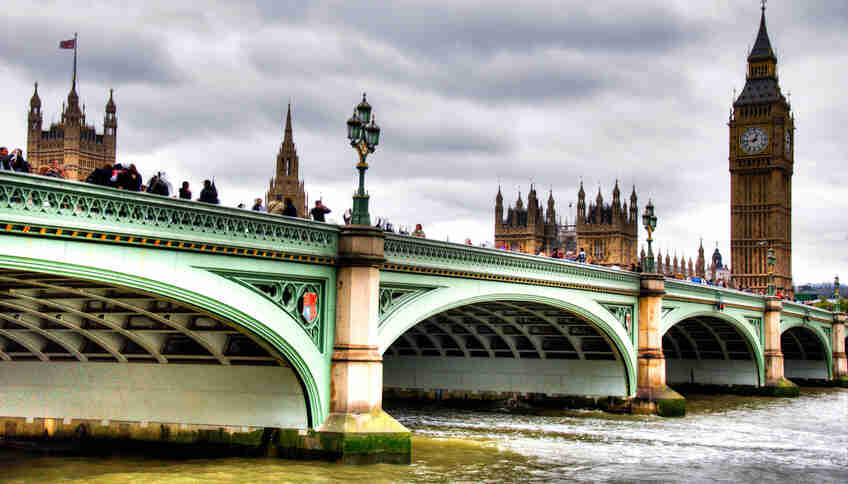
The largest and oldest of London's bridges connects the Westminster and Lambeth districts; it is the route from the London Eye to Big Ben. The bridge blends harmoniously into the architectural ensemble of one of the capital's main landmarks and London's calling card, Westminster Palace.
The first bridge on this site appeared as early as 1750 and became the second bridge across the Thames within the city. Ferrymen and the city authorities protested against its construction for many years, because the former were losing income from crossings, while the latter could no longer charge people for crossing the river, as had been practiced when there was only one bridge in London. Ordinary Londoners, however, were genuinely delighted by the appearance of another bridge in the city.
The first Westminster Bridge was stone and had many more arched spans. The current iron version with 7 arches was designed by Thomas Page and built in 1862. The project was carried out in keeping with the palace rebuilt after the fire, in the same Gothic style and with a design approved by the architect of Westminster Palace.
The elegant light green color of the bridge was chosen deliberately: it echoes the shade of the seats in the House of Commons, which meets in the palace. Lambeth Bridge, located upstream, by the way, is painted red, matching the seats in the House of Lords chamber.
Westminster Bridge offers a wonderful view of the waters of the Thames, the palaces, and the cathedrals of London. The surrounding panorama inspired Wordsworth to write sonnets, and the creators of Doctor Who and Monty Python to film episodes here.