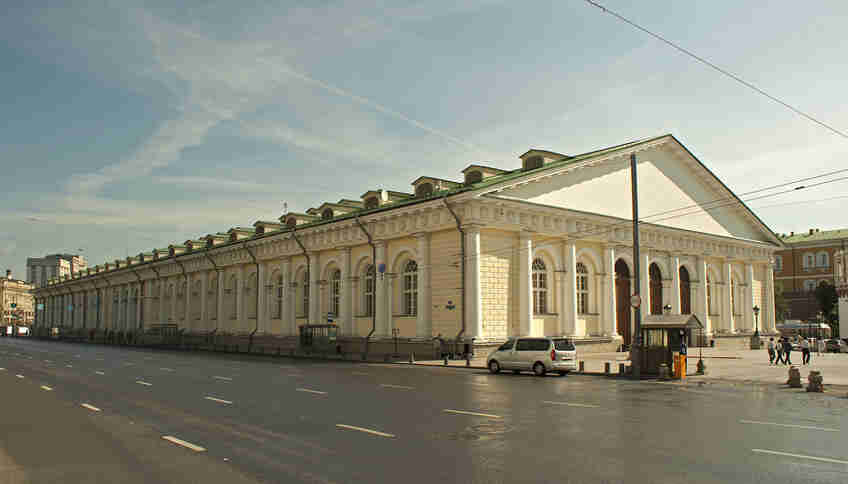
The Moscow Manege is a historic building that today is one of the largest museum and exhibition centers. After the major fire of 2004, which destroyed the interiors and damaged the building's exterior, the Manege was extensively rebuilt. Before that, the most large-scale restoration work had been carried out there in the 1930s.
Over the entire course of its existence, the Manege, originally conceived as an exclusively militaristic project where soldiers were to undergo drill, served the army for only a few years.
From 1831, various exhibitions began to be held here - both cultural and technical in nature: the enormous hall could accommodate an entire cavalry regiment, so there was enough space for any exhibits.
After the fall of the tsarist regime, the Soviet authorities, and later the Russian Federation, continued the practice of using the Manege as an exhibition pavilion. However, in the first half of the 20th century, the historic building housed a garage for government cars for some time.
The architectural style of the Manege leans toward strict classicism, which in its time was the symbolic opposite of the earlier medieval buildings destroyed in the fires of the war of 1812. The project was proposed by the architect Augustin Betancourt, and the Empire-style facades were designed by Osip Bove.