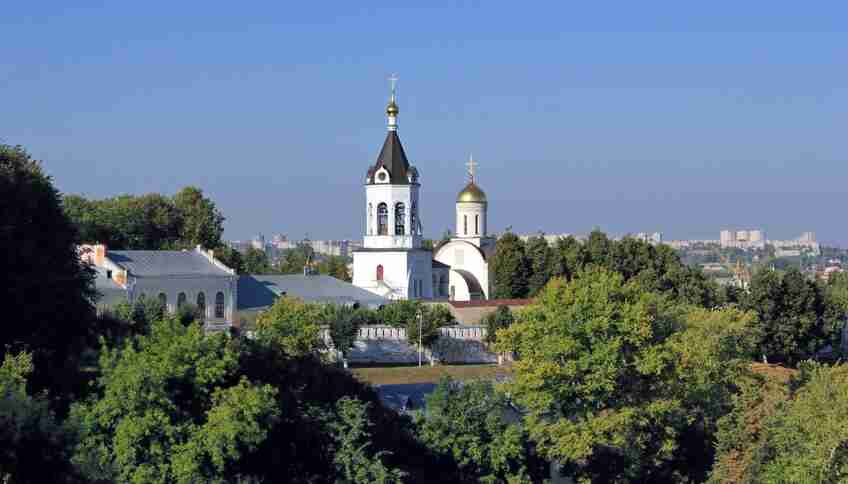
Bogoroditse-Rozhdestvensky Monastery, founded in 1175 by Prince Andrei Bogolyubsky, is situated on a hill practically in the center of Vladimir.
His younger brother, Vsevolod Yuryevich, arranged the holy cloister by building housing for the monks and a single-domed church that has not survived to the present day. Alexander Nevsky was buried here in 1263, but several centuries later, in 1724, his relics were transferred to St. Petersburg by order of Peter I.
Over the monastery's long history, it was expanded and rebuilt more than once. In the 17th century, stone buildings of the state cells, the bell tower, the gate Church of the Nativity of Christ, and other structures appeared here.
Since the Bishop's House of the Vladimir diocese was also located here at that time, the Bishop's Chambers appeared as well. Later, during the reign of Alexander II, a major reconstruction of the monastery and its cathedral was carried out. In 1930, the cathedral and the bell tower were destroyed.
Today, the complex of Bogoroditse-Rozhdestvensky Monastery is a magnificent architectural monument combining many styles and trends of architecture. The walls and towers, the state cells, the brotherly cells, and the Bishop's Chambers deserve special attention.
The monastery largely defines the recognizable silhouette of Vladimir, especially when viewed from the valley of the Klyazma River.