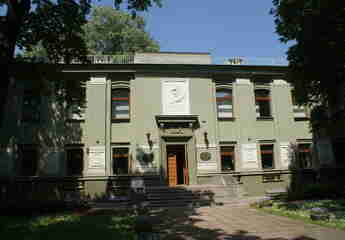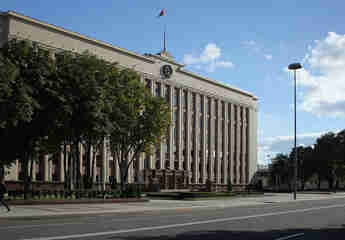

The District House of Officers arose on the site of the Pokrovskaya Church, destroyed in 1920. The church and the adjacent Bishop's Compound were partially demolished – the domes, crosses, and everything that reminded of religion were removed, but the buildings themselves were left. When architect Langbard took up the construction of the House of Officers in 1934, he incorporated parts of the old structures into his project.
Construction lasted 6 years, as the idea was truly grandiose – 7 floors, 3 of them underground, 100 halls, the most modern stage in Belarus, a theater hall with 1000 seats, an indoor swimming pool, and rooms for various sports.
This complex became the embodiment of the power of the Soviet Union and all its slogans about benefits for the people. The interiors were decorated with wall paintings and monumental panels.
But barely had the District House of Officers been completed when the Great Patriotic War began. A bomb damaged the right wing of the palace, and the Germans occupied the left wing, opening an infirmary, a cinema, a casino, and a brothel there. In 1943, Minsk militiamen carried out a sabotage operation by detonating a mine in the theater hall. Another explosion thundered after the liberation of Minsk — as they retreated, the Germans mined the halls. The building was badly burned out, but survived.
In postwar Minsk, still half-ruined, the House of Officers became the center of social and party life. Nowadays it remains an important cultural center of the city: cinemas, dozens of sports and creative clubs, a huge library, and a theater operate here.