
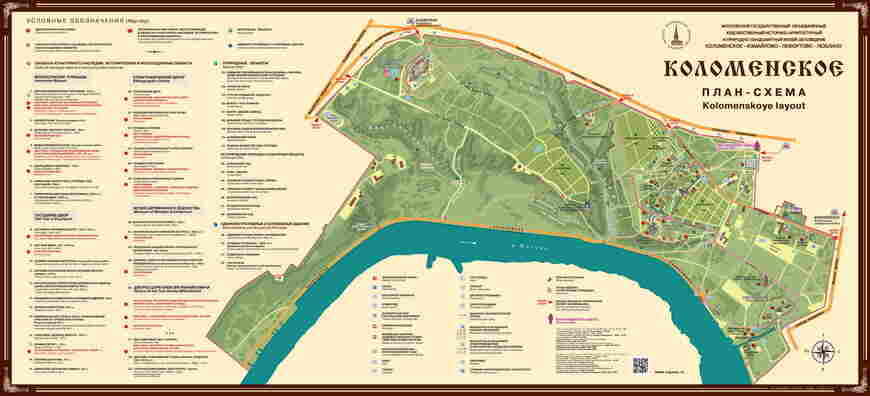
In some of the more remote corners of Kolomenskoye Park, the feeling of being in a bustling metropolis disappears completely. It seems as if this is not 21st-century Moscow at all, but a small settlement on the riverbank back in the days when untouched forests and scattered villages surrounded it. Only when your eye catches a high-rise apartment block or factory chimney again does reality return.
The landscape here is wonderfully varied – you will find hills, picnic meadows, ravines, a river embankment, woodland, and groves. There is room for everyone: couples looking for peace and privacy, as well as fans of active leisure. You can go jogging, cycle, rollerblade, or play frisbee here.

Kolomenskoye flourished during the reign of Alexei Mikhailovich, the second Russian tsar of the Romanov dynasty. It was one of the monarch's favorite retreats, so it is no surprise that a palace was built for him here. Yet traces of Stone Age settlement (5th–3rd centuries BC) point to a much earlier human presence. Kolomenskoye is one of the oldest inhabited places in Moscow.
It is easy to get here by metro. You can get off either at Kolomenskaya or Kashirskaya on the same green line – the park lies between them. We will begin this tour from Kashirskaya metro station, near one of the landmark sights of this famous museum-reserve.
Tsar Alexei Mikhailovich's Palace
The opening of the palace at Kolomenskoye in the autumn of 2010 was one of the last major events overseen by Yuri Luzhkov as mayor. Whatever one thinks of the former mayor of Moscow, it is hard to deny that under him Kolomenskoye became a true jewel of the Russian capital. Moscow gained a fascinating attraction that fits the city's image perfectly.

And even though the wooden palace of Alexei Mikhailovich is only a recently built replica with partially recreated interiors, its astonishing, deeply Russian beauty delights both visitors and Muscovites alike. Carved window frames, tsarist coats of arms, icon copies, lanterns with mica panes, painted ceilings and doors, towers and cupolas – even seasoned travelers will be impressed by the palace's lavish exterior and interior decoration.

You will find even more Moscow attractions on the interactive city map. Plan walking routes and sync them with the free Ever.Travel mobile app. Never planned a trip this way before? Then take a look at our guide!
Church of the Ascension
Another masterpiece of world architecture – and this one is authentic – stands almost on the opposite side of the park. You can walk there from Alexei Mikhailovich's Palace or save it for another day and enter from Kolomenskaya metro station.

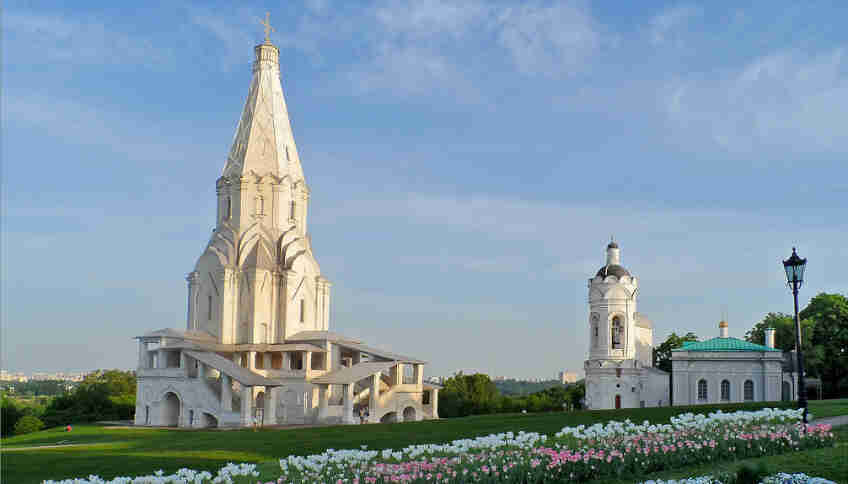
Before you is the Church of the Ascension. Dating from the first half of the 16th century, it is believed to be one of Russia's first stone tent-roofed churches. It was built by order of Grand Prince Vasily III of Moscow to mark the birth of the long-awaited heir Ivan, the future Ivan the Terrible – the first Russian tsar.
Its snow-white, surprisingly airy silhouette reaching into the sky symbolizes the Ascension. In 1994, the church was included on the UNESCO World Heritage List.
Ready-made walking routes around Moscow:
Tsar's Court
The Tsar's Court was the official royal residence. For a long time it was located in the Moscow Kremlin and occupied most of Borovitsky Hill. In summer, the tsar would usually move to one of his country residences, most often Kolomenskoye. For security, the Tsar's Court here was enclosed by a wall with passage gates. Some were ceremonial, while others served practical and service functions.

There are plenty of fascinating sights within the Tsar's Court at Kolomenskoye, each with a story of its own: the Sytny Courtyard, the Church of the Kazan Icon of the Mother of God, the foundations of the Khlebny and Kormovoy courts, and the Petition Column… Still, a few of them deserve a closer look.
Top 10 Moscow Attractions. A must-see on your first visit to the capital!
Peter I's House
In fact, there are two Peter I houses on display at Kolomenskoye. One is a replica, while the other is original. But let us take it step by step.
First, there is a full-scale exterior-and-interior replica of Peter I's house. It stands in the southeastern part of the park, almost on the edge. This model was presented to Moscow by the Dutch government during the cross-year of Russian-Dutch cooperation in 2013.

The second Peter I house at Kolomenskoye is the authentic one. It stands within the Tsar's Court and was built in the very early 18th century during the tsar's visit to the Novodvinsk Fortress. In the second half of the 19th century, the house was moved to Arkhangelsk, and later, in Soviet times, it was transferred to Kolomenskoye and turned into a museum exhibit.

Golosov Ravine
Golosov Ravine divides Kolomenskoye into two roughly equal parts. It is one of Moscow's most mysterious and enigmatic places. According to one version, its name is linked to Veles, a pagan deity.

People say supernatural events often happened here, preceded by the appearance of a green mist. At various times, people supposedly vanished in the ravine and reappeared many years later. Some legends even tell of strange creatures. Whether these stories are true or invented is hard to say, but perhaps it is still wise to beware of the green mist in Kolomenskoye.
Events at Kolomenskoye
Kolomenskoye often hosts fairs, festivals, and various public events. In summer there is a sand sculpture exhibition here, while in autumn the park holds a honey fair.
This is also the long-time home of the historical festival Times and Epochs. Each year, its organizers bring one period of Russian history vividly to life. The 2014 festival, for example, marked the 100th anniversary of the outbreak of World War I.

Since 2007, Kolomenskoye has also hosted Afisha Picnic, the iconic annual music festival. Its concerts and activity zones draw around 50,000 people.

Kolomenskoye Park in Moscow is a definite must-see for anyone interested in Russian history and culture. It is also a wonderful place for walks, outdoor activities, and a relaxing time in nature.
Photos by Nataliya Belitskaya, K.Evchenko, Konstantin, galamk, egor-savintsev were used in preparing this article.