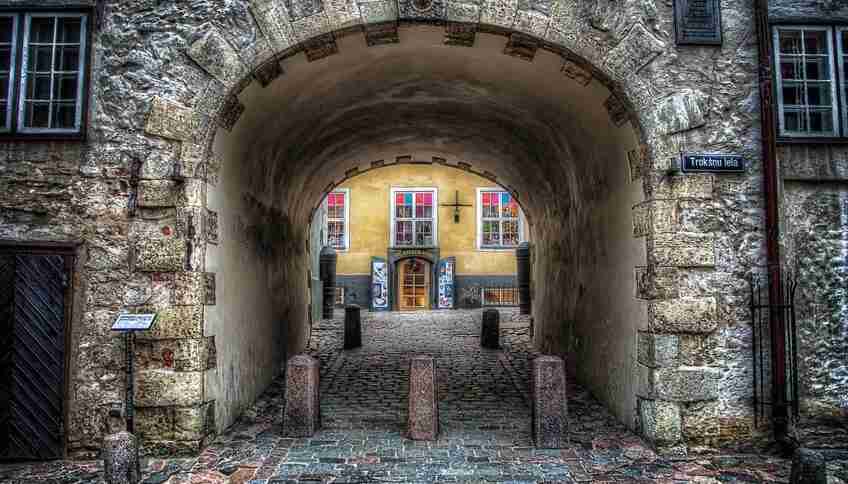
The Swedish Gate in Riga appeared as an alternative to the main entrance to the city. In the XVII century, the fortress walls were being actively built up, and some enterprising residents made passages in the walls themselves so as not to have to go around half the city and not pay a tax on transporting goods.
Possibly, this was done with the permission of the city authorities, who in any case received a share from the owners of the houses with gates. At night they were locked and opened only during daylight hours. Of the eight such gates located in Riga, only one has survived to the present day.
There are no ancient places without a legend. The Swedish Gate also has a mystical and gloomy story. Once, a young girl used to slip out through the gate at night to meet her beloved – a Swedish soldier. But when she began to speak to him about marriage, he became frightened and betrayed her. The girl was brought before the city court and, as punishment for her forbidden love, was walled up in the wall. Since then, a young woman's sobbing and the laugh of the treacherous soldier have been heard in the archway at night.
The Swedish Gate was reconstructed several times. In the 1920s, 50s, and 80s, many lost Baroque elements were recreated. In addition, three buildings were combined into a single architectural complex. Today, it houses a library, a studio, and the Architects' Union.