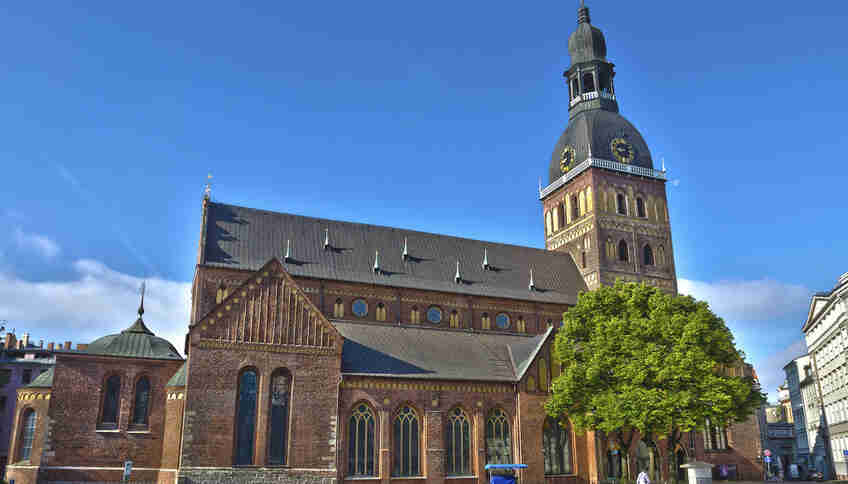
Riga Cathedral is a significant architectural landmark not only of the capital, but of all Latvia. Its construction began in the 13th century and continued for several centuries, resulting in several transformations of the design with transitions from one style to another. In the end, the grand cathedral, on which whole generations of architects and builders worked, was completed only in the 18th century.
The original design was understated and laconic, leaning toward the Romanesque style. At the turn of the 14th and 15th centuries, the volume of the building was increased by adding naves and chapels to it, and a bit of height was added with a tall octagonal spire – and Riga Cathedral became a basilica with a Gothic spire.
In the 18th century, after the siege of Riga by Russian troops, the church was damaged and had to be restored. A little later, the Gothic spire was demolished and a Baroque one was installed in its place. Riga Cathedral has survived in this form to this day, apart from minor changes.
But this church is famous not only for its architecture. It houses a unique organ made by the German company E.F. Walcker & Co, installed in 1883-1884. The instrument is 25 meters high and has about seven thousand pipes. The organ is decorated with ornamental carvings from the 16th-17th centuries. It is now considered the largest in the Baltics and the former USSR, and at the time of its installation it was the largest in the world.