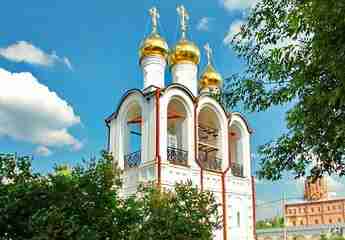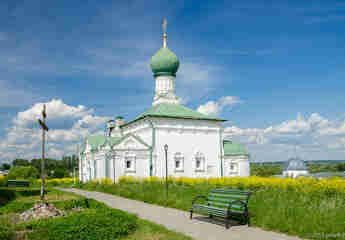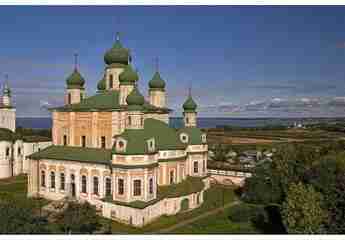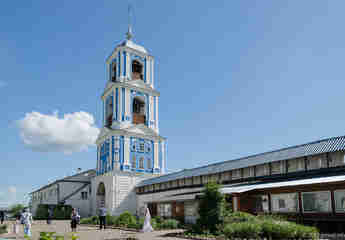
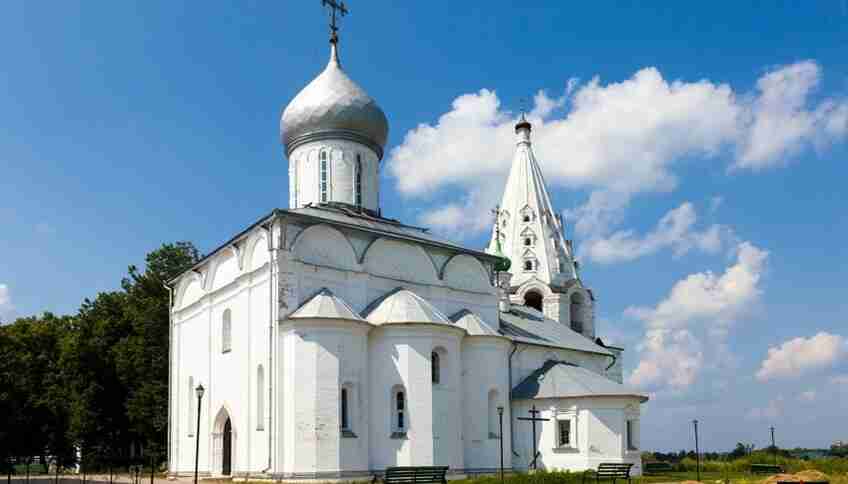
The Cathedral of the Life-Giving Trinity, the first stone church of the Trinity Danilov Monastery, was built in 1530-1532 to mark the birth of an heir to Vasily III and Elena Glinskaya - the future Tsar Ivan IV the Terrible. Later, Ivan the Terrible himself often visited Pereslavl and donated substantial sums of money to the development of the monastery, especially since Saint Daniel was his godfather.
The Time of Troubles in Russia at the turn of the 16th and 17th centuries nearly ruined the monastery. Its subsequent revival in the second half of the 17th century is associated with the name of Prince Ivan Petrovich Baryatinsky, who rebuilt almost the entire monastery compound at his own expense and, being a very old man, took monastic vows himself under the name Efrem.
At that time, in 1660, a new annex was added to the cathedral - a side chapel on the site where Saint Daniel was buried. As a result, a small church appeared, and it still stands next to its older neighbor - the Cathedral of the Life-Giving Trinity.
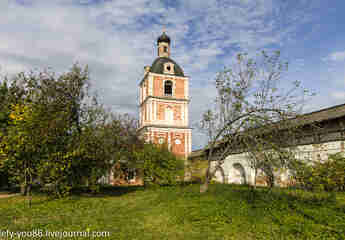
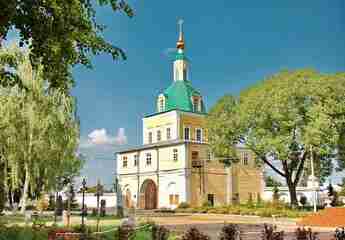
Later still, in 1689, a tent-roof bell tower was erected on the north side of the chapel. To this day, the cathedral retains some unique wall paintings created in 1662-1668 by the workshop of Gury Nikitin, also known for his work in Borisoglebsky Monastery.
The cathedral is built of brick, with three apses and one dome on a high drum. The modest single-domed Church of Daniel is somewhat overshadowed by the more massive structures.
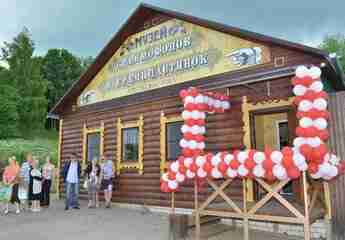
Since 1954, the church was under the control of the Pereslavl-Zalessky Museum of History and Architecture, and now it is shared by the museum and the diocese.