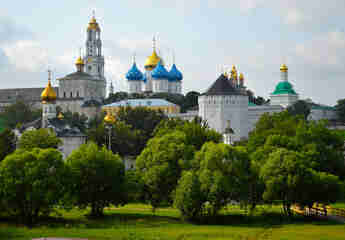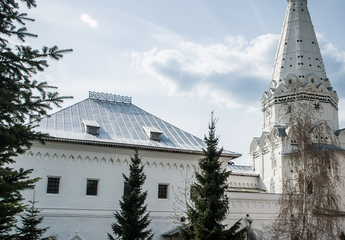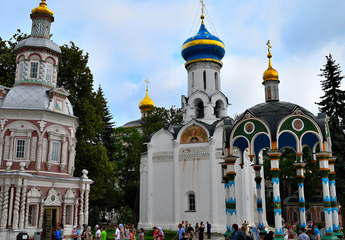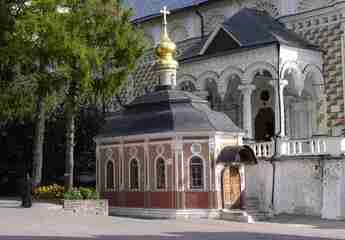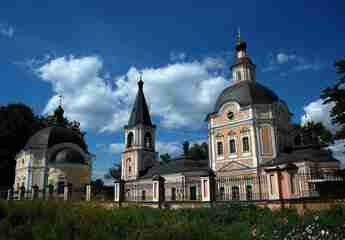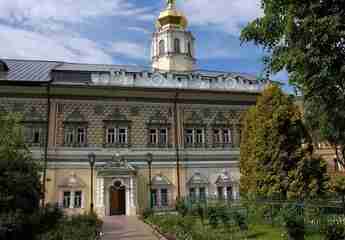
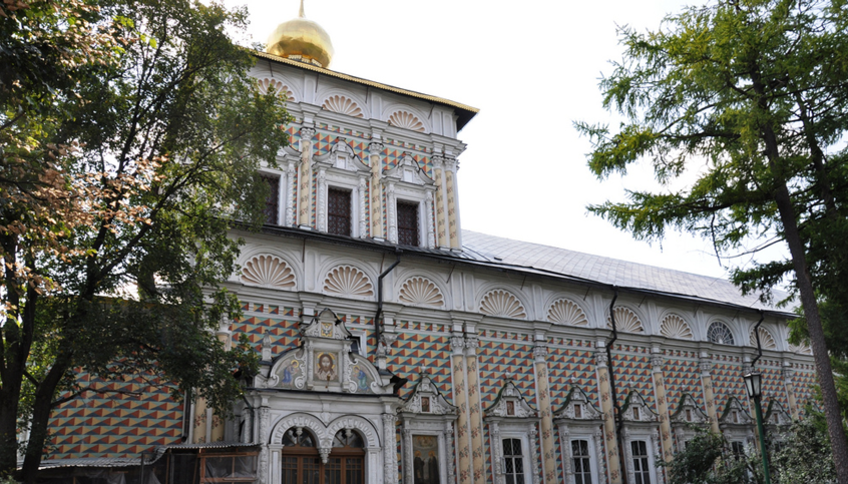
One of the most beautiful and largest churches of the Trinity Lavra of St. Sergius is the Church of St. Sergius with the Refectory Chamber. A magnificent example of Moscow Baroque, the Refectory Church is richly decorated both outside and inside. In addition to architectural refinements such as carved columns, a frieze of stucco shells beneath the roofs, and ornate window wimpergs, even the walls themselves are a decoration here—they are covered with polychrome painting and give the church a special charm.
By royal decree, the Refectory Church was founded in 1686 and built in the then-fashionable Naryshkin style, which marked the debut of Russian Baroque. The Refectory Chamber became the largest pillarless space of its time—this hall, with an area of 500 sq.m, has no intermediate supports.
The vaults and walls of the Refectory Chamber are covered with beautiful paintings, featuring images of saints, scenes from the Bible, and angels with cherubim. Some parts of the painting date back to 1780, while others were completed a little later.
The decoration of St. Sergius Church impresses with its wealth of ornamentation: the walls are covered with stucco garlands of flowers and curls, finished with gold and silver. Between the stucco work is the exquisite painting by the artist Yankovsky, created in 1778.
The main decoration of the Refectory Church is the carved iconostasis of 1688, executed in the traditional "uzorochye" style. It occupies the entire wall of the church, from floor to ceiling, and inspires deep admiration for the delicate work of the master carvers.