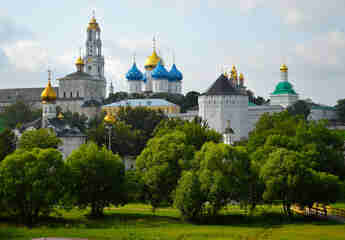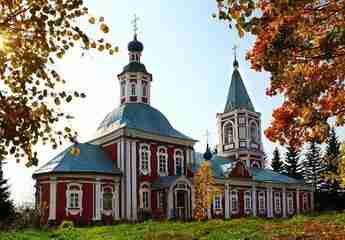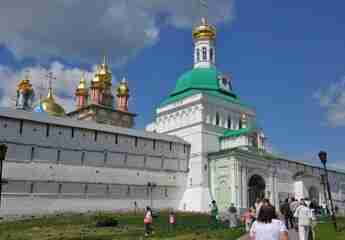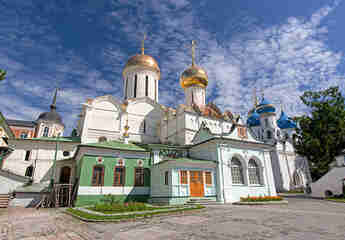

The history of the Spaso-Vifansky Monastery dates back to the 18th century, when monastic sketes began to appear in the forests east of Sergiev Posad – places for special prayerful seclusion, inaccessible to ordinary laypeople. One of them was the hermitage founded by Archbishop Platon of Moscow, abbot of the Trinity Lavra of St. Sergius.
The architect Odoevtsev oversaw the construction of the monastery. The complex included several buildings: the Holy Gates with a bell tower, utility and residential buildings, and the monastery's main structure – the Spaso-Preobrazhensky Cathedral. Built in 1783-1785, it is the main local attraction. Its forms clearly recall early Christian churches, for example, the Cathedral of Hagia Sophia in Constantinople. But not in size, since the building of the Spaso-Preobrazhensky Cathedral, despite its beauty and elegance, is relatively compact.
The cathedral's interior captivates with its unusual, light-filled, life-affirming design. An artificial cave was created here, symbolizing the burial place of the righteous Lazarus. The appearance of the church finally took shape in the second half of the 19th century, when the bell tower, turrets, and new walls were added.
The revival of the monastery, abolished under Soviet rule, began in the 1990s. At present, the holy monastery has been almost completely restored; a Sunday school operates here, and in addition to holding services, the monks engage in animal husbandry and even produce their own wine.