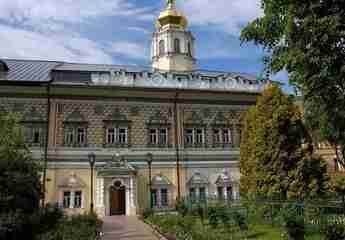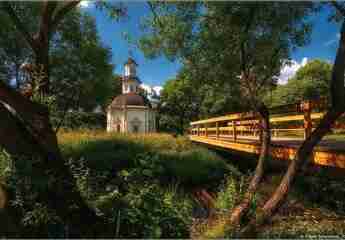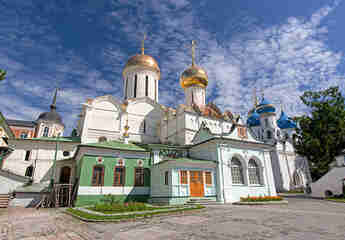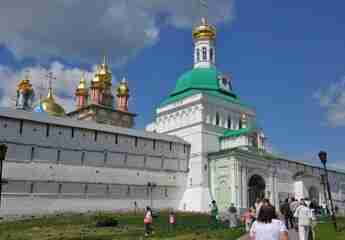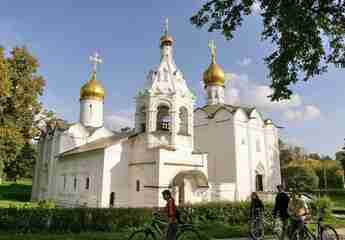

Smolensk Church is considered one of the more stylistically unusual structures of the Trinity Lavra of St. Sergius. This interesting embodiment of Elizabethan Baroque in church architecture was created in 1746-48 by the famous Moscow architect D.M. Ukhtomsky with the financial support of Count A.G. Razumovsky.
The Church of the Smolensk Icon of the Mother of God, also known as "Hodegetria," was consecrated in 1753 in the presence of Elizabeth I. The church as a whole has an oval shape, crowned above by an elegant dome, over which rises a small ornamental cupola with a cross. Two tiers of windows are framed with carved white stone and evenly alternate with white pilasters. On all sides, Smolensk Church is surrounded by entrance staircases.
At present, the church contains a carved iconostasis from 1748, brought from one of the dismantled Moscow churches. The original iconostasis has not survived to the present day.
On the eastern wall of the church there is a stone icon, a copy of the miraculous icon of the Mother of God, which is now kept in the Art Museum. Its miraculous power was the reason for the construction of the church: previously, service buildings, a dining hall, and a kitchen stood on this site, and on one of the walls hung an icon that unexpectedly appeared in a dream in 1730 to a frail psalm reader, who was healed the following morning.
Several years later, Empress Anna Ioannovna ordered the refectory to be converted into a church. Thus Smolensk Church appeared in the architectural ensemble of the Trinity Lavra of St. Sergius.