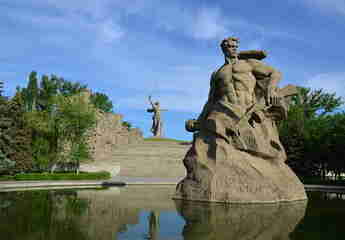

After passing through the Zal Voinskoy Slavy past thousands of names of fallen heroes, you will arrive at Ploshchad Skorbi. There is no greater grief for a person than burying their child, and therefore the symbol of mourning throughout the world has always been a weeping mother.
The thousand-year-old image of a mother mourning her son lying on her knees is called a pieta. It comes from the depths of the ages, from the Virgin Mary holding the body of Jesus on her knees. The greatest creators repeated it hundreds of times in icons, paintings, and statues.
Yevgeny Vuchetich also used the pieta in his sculpture as the most recognizable and profound symbol of grief. The mother bends over her son's body in a final embrace, while he lies sprawled on his back across her knees. The face of the fallen soldier is hidden beneath a battle banner. This device served two purposes: to render final military honors to the hero and not to show a specific likeness, so that every woman could see in the fallen man her son, husband, or father.
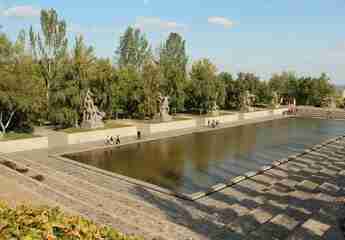
At the foot of the monument there is a small pool, in whose still surface the bottomless sky is reflected. It is called the Lake of Tears, although its volume is probably too small to hold all the tears shed for those killed in that terrible war. A granite path has been laid across the lake to the foot of the monument, along which visitors can walk and lay flowers.
On Ploshchad Skorbi is the grave of twice Hero of the USSR, Marshal Chuikov, who during the creation of the memorial helped architect Vuchetich with consultations and became the prototype for the mighty soldier on Ploshchad «Stoyavshikh nasmert».