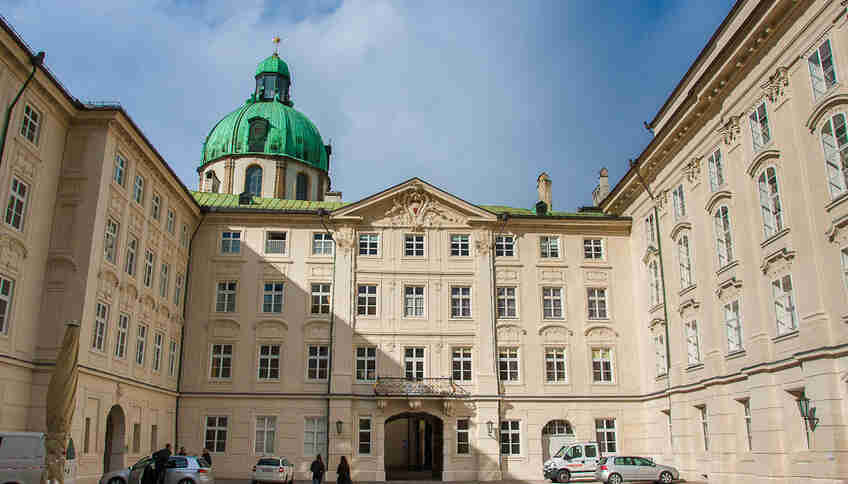
Hofburg Palace in Innsbruck ranks among the three most outstanding buildings in Austria, together with Schönbrunn and Vienna's Hofburg Palace.
The summer residence of the Habsburgs was originally built as a fortress rather than as a palace. In 1460, Archduke Sigismund ordered a castle with defensive structures to be erected here. Over the following 250 years, the castle was remodeled several times and new rooms were added to it, including the tall Heraldic Tower.
The most impressive transformation awaited Hofburg at the end of the 18th century, when it came into the hands of Maria Theresa. The empress wished to turn the castle into a luxurious palace in her favorite Baroque style. Hofburg was changed on the outside as well - the facade and roofs were completely renovated, a new wing was added, and, of course, the interior too.
Hofburg Palace today has preserved the appearance it acquired after that grand reconstruction of 1754-1773. Its ballrooms, dining rooms, drawing rooms, and studies preserve furniture, decorations, and magnificent wall and ceiling paintings. The delightful frescoes by Franz Maulbertsch have been skillfully restored; they can be seen in the Hall of Giants and some other rooms of the palace.
The Imperial Hofburg Palace is divided into 5 themed museum zones - the furniture museum, the apartments of the two empresses Maria Theresa and Elisabeth, the Heritage Gallery, and the art gallery.
One could fill many pages listing the cultural and historical treasures - statuettes, paintings, personal belongings of the imperial family, works of art, and old books on display at Hofburg, but this is precisely the case when it is better to see everything with your own eyes than to read even the most poetic descriptions.