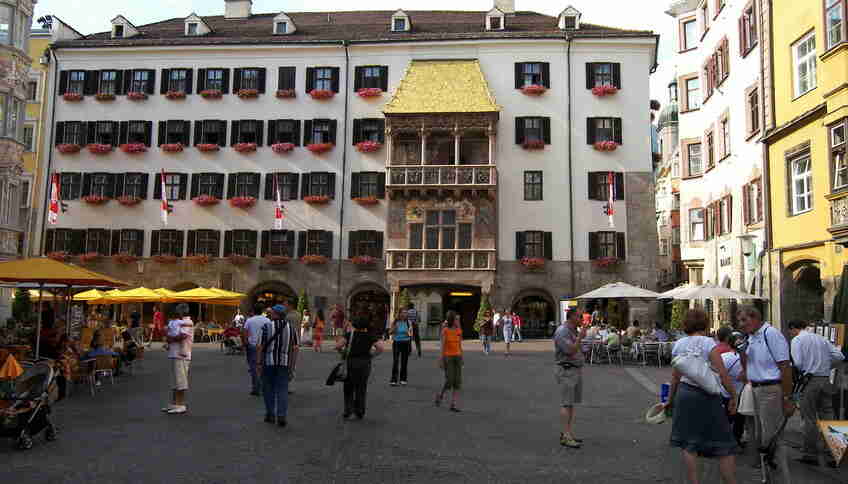
The most famous attraction of Innsbruck, the city's most recognizable symbol, was built at the beginning of the 15th century as the city residence of the rulers of Tyrol.
In 1500, Emperor Maximilian I ordered an elegant oriel to be added to the building – a balcony projecting from the facade of the house. The task was entrusted to the respected architect Nikolaus Turing. The oriel had to be luxurious, because this architectural gesture was intended not only to mark the emperor's forthcoming wedding, but also to dispel rumors about the Empire's financial difficulties.
The famous golden roof covering the oriel consists of 2738 copper roof tiles coated with gold. The two-story balcony is supported by elegant carved columns. Beneath the canopy of the gleaming roof runs a carved cornice with floral ornaments. The carved panels under the balcony railings depict scenes with dancers and acrobats.
The wall of the second floor is decorated with frescoes commemorating Maximilian I – to the right of the exit with his first wife Mary of Burgundy, and to the left with his second wife – Bianca Maria Sforza. From the balcony, the imperial couple watched performances, parades, and knightly tournaments held in the square.
The lower part of the balcony is decorated with the coats of arms of the eight territories belonging to Maximilian, and the fresco on the wall depicts two knights with the flags of the Holy Roman Empire and Tyrol.
Today, civil wedding ceremonies for the residents of Innsbruck are held in the house with the golden roof. Access to the balcony is open, so you can admire the frescoes and balustrades, and give a dignified wave to passersby, imagining yourself as the emperor or his consort.