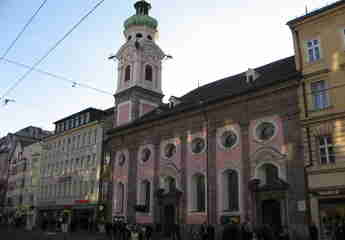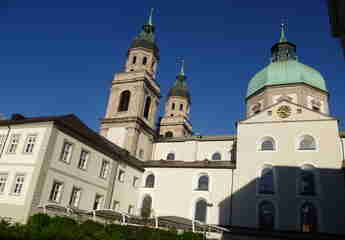
The name Hofkirche translates as “Court Church.” It was built in 1553 for the Tyrolean nobility and the imperial family. Today the church is open to everyone, so do not miss the chance to visit Hofkirche, because the church’s interior contains an incredible number of objects of historical and artistic value.
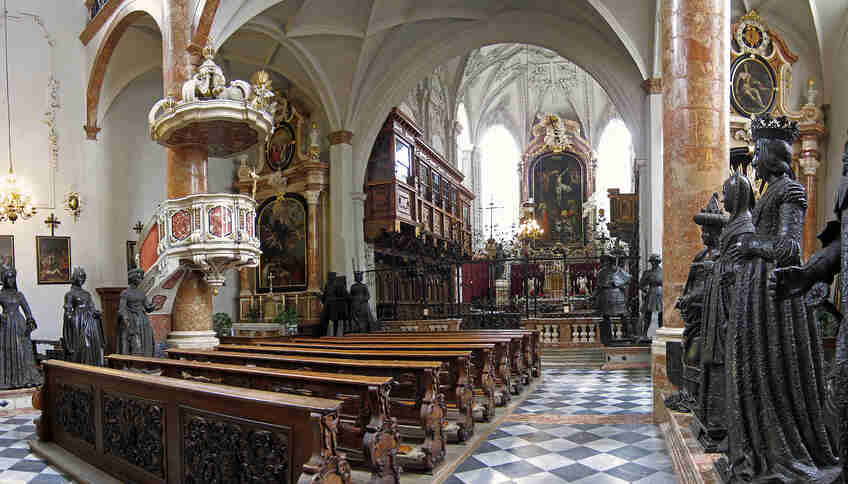
The architecture and design of the spacious halls of Hofkirche create an impression of solemn grandeur; everything here recalls the power and splendor of the Holy Roman Empire. Renaissance and late German Gothic intertwine in the interior, while white marble and graceful stucco combine beautifully with the finest dark wood carving.
Emperor Ferdinand I built Hofkirche to pay tribute to the memory of his grandfather, Maximilian I, who had designed his own tomb during his lifetime. However, Maximilian was buried in the chapel in Wiener Neustadt, where there was no room for the grand memorial, so his grandson decided to erect a spacious church and install the tomb there according to his grandfather’s design.
The cenotaph (a symbolic grave with a tombstone, but without the deceased’s remains) made of black marble stands in the center of the large nave, surrounded by a retinue of 28 black statues. These bronze statues, 2-2.5 meters tall, depict Maximilian’s ancestors and relatives, as well as famous heroes, including the emperor’s idol – King Arthur. The cenotaph itself is decorated with 24 marble bas-reliefs depicting scenes from the great ruler’s life – both of his weddings, his coronation, great battles, and victories.
On the church gallery there are 23 statues of saints – patrons of the Habsburg dynasty, carved from wood around 1520. Hofkirche also contains the tomb of Tyrol’s national hero, Andreas Hofer, with his statue and bas-relief.